Every day, thousands of marketers open ChatGPT, type "write me a social post," and get back something that reads like an instruction manual. Then they head to LinkedIn to complain that AI doesn't work for marketing. The problem is you: nobody taught you how to write marketing prompts that actually do something. And the gap between a mediocre prompt and a good one is the distance between content that competes and content that fills space.

TL;DR: The no-nonsense summary
- A prompt is a brief: if you don't give the AI brand context, audience, and objective, it improvises. And when it improvises, it produces templates.
- Minimum structure: role + context + task + constraints + format. Thirty extra seconds of writing, a result on a completely different level.
- Most common mistake: the one-shot mindset. A prompt is a conversation, not a form you fill out and hope for the best.
- No marketing judgment, no prompt will save you: AI amplifies your knowledge, it doesn't invent it.

Everyone obsesses over writing good prompts when they should be focusing on prompt engineering. That's how you take a real step forward and start designing complex flows and loops. The difference between the basic marketer and the marketer who designs systems.
DaniIn this article
What is a marketing prompt and why does yours fail?
A marketing prompt is the instruction you give a generative AI to produce content, analysis, or ideas within a business context: copy, emails, campaign strategies, audience segmentation, creative briefs. Treat it for what it is: a compressed brief.
And here's the real problem: most marketers treat a prompt like a Google search. They type three words and expect magic. But a generative AI is not a search engine. It doesn't know your brand, your tone, your audience, or your business objective. If you don't spell it out, it improvises. And when an AI improvises on marketing tasks, the result smells like a template from the very first line.
The mistakes turning your prompts into generic garbage
Time for a diagnosis. Because the mistakes are always the same, and I've seen them across teams of every size.
Zero context. "Write me a welcome email." No product, no brand voice, no audience, no objective. It's like handing a blank brief to a junior copywriter and expecting a killer message. The result will be grammatically correct and strategically useless.
Another one I see constantly: trying to get everything at once. "Give me the content strategy for Q3, the copy, the editorial calendar, and the competitor analysis." All in one line. The model drowns, you get frustrated, and the next day you're posting on LinkedIn about how AI doesn't understand marketing. Spoiler: it understands exactly what you explain to it. Nothing more, nothing less.
And the most widespread mistake by far: the one-shot mindset. Fire a prompt, read the result, discard it. Done. A prompt should be worked like a conversation. You iterate and refine, just like when you review a draft with your team. If you also integrate those prompts into an editorial pipeline with human review, the gap between first draft and finished piece closes dramatically.
How to write marketing prompts that work
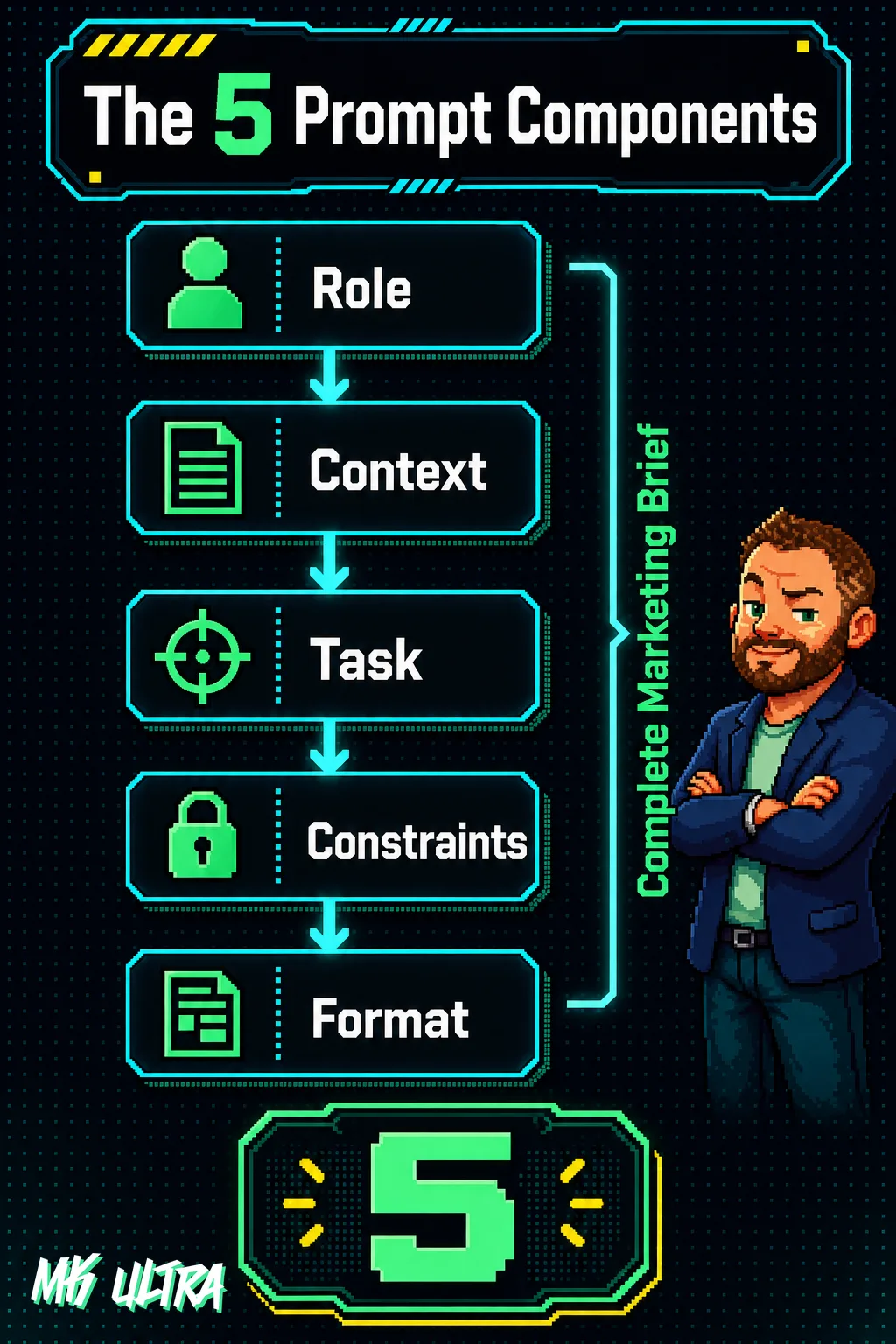
The structure that works has five components. Pure briefing common sense adapted to the format. If anyone tries to sell you "the ultimate prompting framework," run.

- Role: tell the AI who it is. "You are an email marketing specialist for a fashion e-commerce brand." This isn't role-playing for fun, it narrows the response space.
- Context: your brand, your audience, your moment. "The brand is X, tone is direct and approachable, audience is women 25-40 who have already made at least one purchase."
- Task: exactly what you want. Instead of "write me an email": "write the subject line and body of a win-back email for customers who have been inactive for 90 days."
- Constraints: what you DON'T want. "No emojis in the subject line. Maximum 150 words. Don't use 'Dear customer.'"
- Format: how you want to receive it. "Give me three subject line options and one body per option."
More work than typing "write me an email"? Yes, about 30 extra seconds. Worth it?
ALWAYS.
But the real leap isn't a one-off prompt. It's building a marketing prompt library for your brand, with context pre-loaded, that you reuse and refine with every campaign. In my experience, teams that treat their prompts as an asset (versioning and sharing them internally) multiply the quality of their AI content within weeks. Those who stay in "prompt and forget" mode keep complaining on LinkedIn.
I'd bet that within a year, the gap between a team with a well-tuned prompt library and one that improvises every time will be as visible as the difference between a carefully managed Google Ads account and one running on autopilot.
AI agents are already managing entire campaigns. But without well-written prompts behind them, they're powerful cars driven by someone without a license.
The prompt doesn't replace judgment
Now here's the part that stings.
No matter how good your prompt is, if you don't know marketing, it won't matter. A brilliant prompt in the hands of someone who doesn't understand their audience, their funnel, or their metrics will produce content that looks polished and lands nowhere strategically. The prompt is a translation tool: it converts your marketing knowledge into a format the AI can execute. If you don't have that knowledge, no prompt will manufacture it for you.
If you do have it, and you also know how to automate content at scale, you go from producing individual pieces to operating like a content machine with a brain. A machine with judgment, not a content mill. The difference matters.
The next time you open your AI assistant for any marketing task, ask yourself one question before you write the prompt: am I giving it a brief, or am I buying a lottery ticket?
If it takes you more than two seconds to answer, you already know where to start. Now get to it.