What a time to be alive. OpenAI has just launched GPT-5.6 Sol in preview, alongside variants Terra and Luna, and the message is unambiguous: advanced coding, cybersecurity, and biology. OpenAI's most ambitious model to date isn't aimed at the general public or at marketing, it targets technical verticals under restricted access. The race for the most powerful AI is intensifying, and marketing is watching enviously from the sidelines.

TL;DR: The no-fluff summary
- GPT-5.6 Sol: OpenAI's model purpose-built for coding, cybersecurity, and biology. Not an upgraded GPT-4o, it's a different league entirely.
- Restricted access: preview phase, no general availability. EU access: unknown.
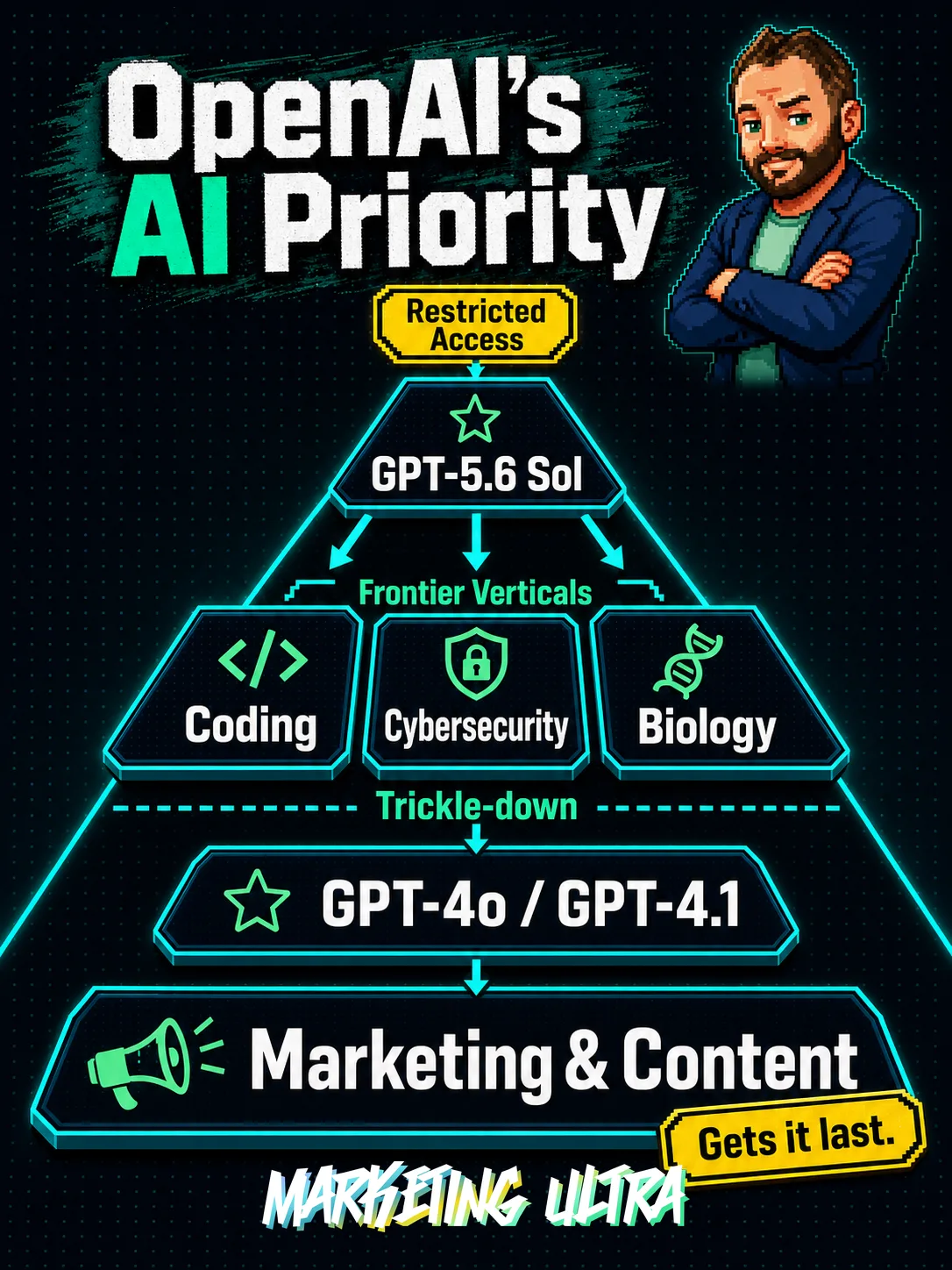
- Vertical specialization: OpenAI is betting on niche models. Marketing is not on the priority list, at least not yet.
- AI geopolitics: U.S. export controls on advanced AI models determine who gets access and from where.

I'll be honest: the fact that it's not built for marketing doesn't really bother me. A new, beastlier model gets me EXCITED. It's one of the few things that still feels like unwrapping a present on Christmas morning, and I've been doing this for years. There'll be time to get technical and wire it into campaigns. Today I'm just sitting with the itch to tinker. The day AI stops exciting me, I'll find another line of work.
DaniIn this article
What GPT-5.6 Sol is, and why it's not just another beefed-up GPT
GPT-5.6 Sol is an OpenAI model built specifically for advanced technical tasks: coding, cybersecurity, and biology. It's not an incremental evolution of GPT-4o, and it's not a patch on GPT-4.1. It's a specialized model targeting specific domains with restricted access.
OpenAI released it as a preview. There's no "try it in ChatGPT." No open API for your content tool. The Terra and Luna variants come along for the ride, but the published information is deliberately sparse: no detailed comparative benchmarks against the GPT-4 family, no roadmap on when it will reach the endpoints powering the tools you and I actually use.
Availability in Europe? Not a word. The official OpenAI announcement says nothing whatsoever about geography.
GPT-5.6 Sol Availability (June 2026)
- Phase: Preview with restricted access.
- General access: Not available.
- EU / UK: Unknown. OpenAI has published no geographic information.
Source: official OpenAI announcement.
What its positioning suggests: it aims to surpass everything that came before. And "everything before" already includes GPT-4o, GPT-4.1, and the o3 reasoning family. That's saying something.
Good grief.
The model wars aren't about technology, they're about geopolitics
OpenAI launched GPT-5.6 Sol in the middle of the AI cold war. That's not a metaphor: the U.S. government actively restricts the export of advanced AI models, and every release happens within that framework. The competition for the world's most powerful AI is no longer decided solely in a lab. It's decided in Washington boardrooms.
The U.S. maintains its policy of restricting the export of advanced AI technology. OpenAI, like every American company, operates within that framework. The result: the most powerful models are developed, announced, and locked down under conditions that depend on political decisions, not technical ones.
For those of us in Europe, the feeling is bittersweet. We watch the announcements roll in. We see the performance promises. But access is conditioned by factors we don't control and that nobody asks us about. Every model that launches with restrictions reminds us that we're playing on someone else's field.
Is it frustrating? Yes. Is it new? No. But the frequency is increasing, and that should be our wake-up call.
Where marketing fits in this model war
If your marketing stack runs on the OpenAI API, content generation, chatbots, large-scale automation, nothing changes in the short term. GPT-4o and GPT-4.1 are still there, still working, still powering most of the tools we use every day.

The problem is medium-term.
With GPT-5.6 Sol, OpenAI is sending a clear signal: vertical specialization is the direction. The generalist models feeding your content pipeline or your AI campaign agents may no longer receive the same level of investment as the verticals where OpenAI sees the greatest margin and regulatory pressure.
In my experience, marketing is NOT in OpenAI's top three priorities for its next-generation models. Coding, science, and security move serious institutional money, the kind that justifies burning through GPUs at massive scale. Marketing is a huge use case in volume, but a weak one for justifying a frontier model.
To be clear: this doesn't mean you'll be left without a model. It means the competitive edge of using "the latest from OpenAI" gets diluted when the latest and greatest goes to a different sector. The coming cycle is obvious: every task will have its specialized model, and orchestrating several will matter more than pinning all your hopes on a single one.
What to do? Diversify. If your entire automation stack depends on a single model provider, now is the time to consider alternatives. Not out of panic, out of common sense.
GPT-5.6 Sol is, today, a statement of intent more than an accessible product. OpenAI says "we have the most powerful model" and immediately adds "but it's not for you." And it does so with the U.S. government regulating who can use it and from where.
The lesson for marketing isn't technical. It's strategic: the most advanced AI won't reach your content tool first. It will reach those who write code, analyze genomes, or hunt for vulnerabilities. If there's eventually something in it for us, it will trickle down, but always as a second-round pick.
The future is multi-model and multi-vendor. And anyone still waiting for OpenAI to toss them the scraps is going to go hungry.