Google has just flipped the switch on something that's been quietly brewing for a while: Gemini Personalization, the system that lets its AI assistant learn your preferences and shape every response around them. Available in over 40 languages, rolling out gradually across "most countries," and built around a single promise, that Gemini stops being a generic chatbot and starts being something that actually knows you. Does it deliver? Yes. The real question is what you're handing over to get there.

TL;DR: The No-Fluff Summary
- What it does: Gemini connects to your Google apps (Gmail, Search, YouTube, Photos) to deliver personalized responses based on your real activity.
- Opt-in only: it's off by default. You choose which apps to connect and can disconnect at any time.
- Europe in limbo: no confirmed availability in the EEA. GDPR remains the wall.
- For marketers: promises sharper copy and useful data synthesis, but the real shift is how this changes your audience's search behavior.
In this article
What Is Gemini Personalization and How Does It Work?
Gemini Personalization is an experimental feature that lets Google's assistant connect to your services, Gmail, Search, YouTube, Google Photos, Calendar, Drive, and deliver responses tuned to your real history and preferences. Instead of generic answers, Gemini checks whether data from your connected apps can sharpen what it gives you back.
What does that look like in practice? Ask for email campaign ideas and it can pull from your past messages to match your tone. Ask for a week-at-a-glance summary and it crosses Calendar with Gmail. Need content inspiration? It looks at your YouTube history.
Google calls it "Personal Intelligence." I'd call it: the assistant that finally has context. Anyone who's used ChatGPT with memory turned on will recognize the concept, but there's one massive difference: Google has far more data on you than OpenAI does. That's its edge. It's also what should give you pause.
What Data Does Gemini Personalization Use?
The list is long. According to the official release notes, Gemini can access:
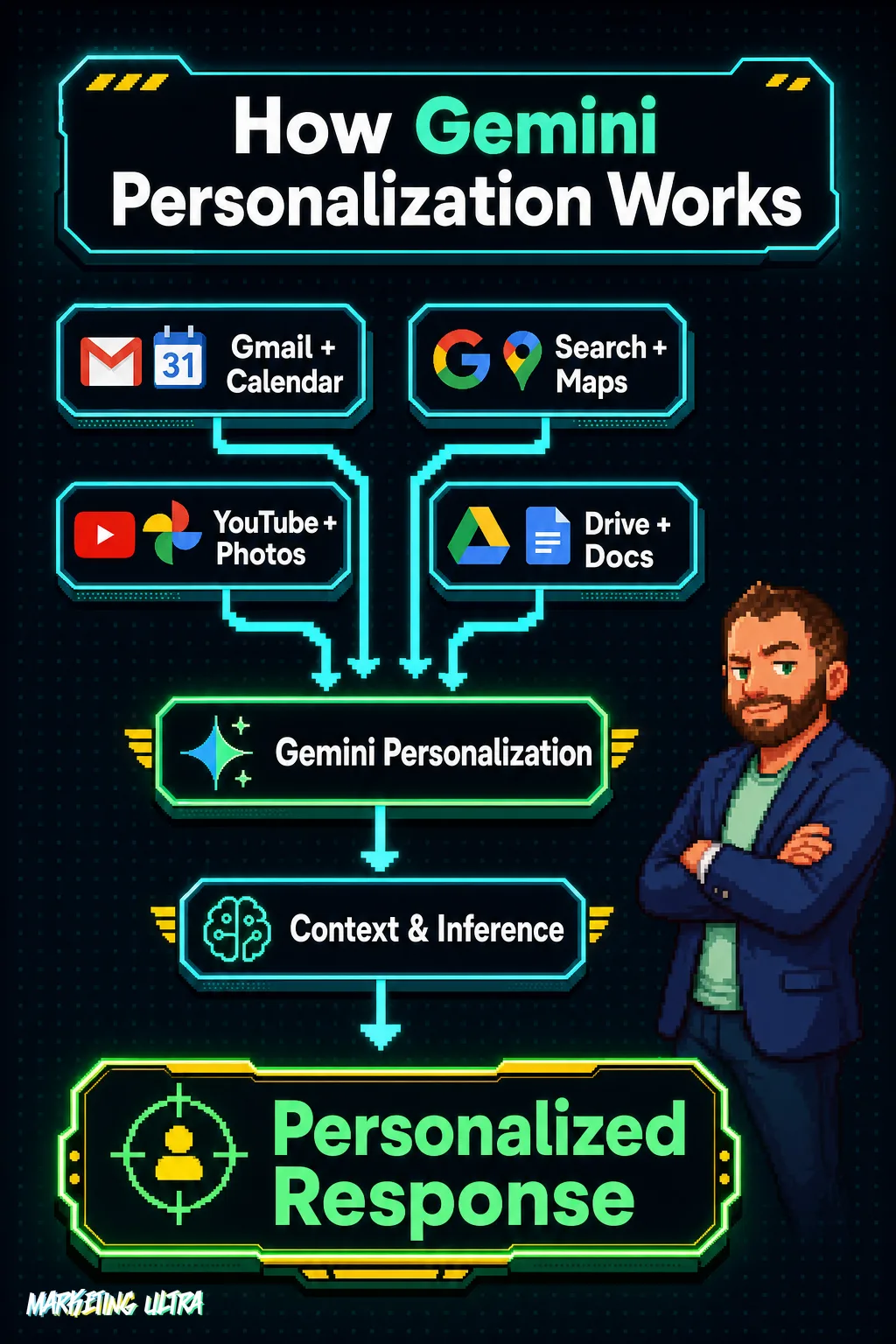
- Google Search (including AI Mode), Maps, Shopping, Flights, Translate
- Gmail, Calendar, Drive, Docs, Sheets, Keep, Tasks, Chat, Meet
- Google Photos and YouTube
- Contacts (US only, English only, requires AI Ultra subscription)
It also draws on your previous Gemini conversations and any custom instructions you've configured. Google clarifies that it doesn't train models directly on your inbox or photo library, it works from summaries, extracts, and inferences. That distinction reads well in a press release. In practice, the difference between "reading your email" and "drawing inferences from your email" is more semantic than functional.
Availability in the EEA/UK: unconfirmed. The feature is rolling out gradually in open beta. Available sources indicate that "Personal Intelligence" features explicitly exclude the EEA, Switzerland, and the UK due to privacy regulations. Users in these regions cannot be confirmed to have access at this time. Available for personal Google accounts only, not Workspace or Education.
How to Enable and Disable Gemini Personalization
It's off by default. Pure opt-in: you decide whether to turn it on and which apps to connect.
To enable it: open Gemini, go to Settings, look for "Personalization (experimental)" or "Personal Intelligence," tap "Connected Apps," and toggle on the services you want to share. Gemini asks for explicit permission before connecting each app.
To disable it: same path, flip the toggles off. For a one-off conversation without any trace, use Temporary Chats, they work like private browsing: nothing gets saved to memory.
The process is clean. Credit where it's due. But ease of disabling doesn't mean most people will bother. Google knows that perfectly well. It's the same playbook as always: voluntary activation, minimal friction to say yes, and once you're in, inertia does the rest.
What Changes for Marketers Using Gemini
Here's where it gets interesting. And where I think most analyses fall short.
The obvious win: if you use Gemini to draft campaign copy, synthesize reports, or plan content, an assistant that already knows your context saves real time. You don't have to re-explain who you are, what you sell, or how you write every single session. That's genuinely useful. Full stop.
But the real change isn't in how you use Gemini. It's in how your audience does.
Think about it. If your prospect's assistant already knows what they like, what they've bought, what they're searching for, and what they're reading, the responses they get are pre-filtered before you ever get a shot. The traditional funnel (awareness, consideration, conversion) compresses. The user arrives with a shortlist already curated by their personal AI. Where does your Discovery ad land in that scenario? Where does your mid-funnel content fit?
My bet: within 18 months, AI personalization will chip away at pure informational search volume. Not because people stop searching, but because their assistant hands them the answer before they even form the question. For anyone whose livelihood depends on the classic paid media funnel, that's a quiet rule change happening in plain sight.
The flip side: Google isn't doing this out of goodwill. The more Gemini knows about each user, the sharper its ad targeting becomes. Assistant personalization feeds ad personalization. They're the same system. And if you advertise on Google Ads, there's a catch: better targeting for you, but less control over where and how your message actually lands.
Europe Watches from the Sidelines (Again)
The pattern is familiar. Powerful feature, global rollout. Europe: out, courtesy of GDPR. It's not the first time, Gemini already restricted Computer Use features in the EEA and the story repeats with every function that touches personal data.

For marketers working in European markets, this means arriving late, again. And when it does arrive, it'll come with caveats. European regulation protects users (a good thing), but it also creates a real competitive gap: marketers in the US have been running with tools that simply don't exist here yet.
Is that a crisis? No. But it's worth keeping in mind when you're reading tutorials and "success stories" from people operating in markets where these features are already live.
The Bottom Line
Gemini Personalization is probably the most significant feature Google has shipped for its assistant this year. Right now it's essentially memory on steroids, fine. But what it implies over the next few years is a different story: an assistant that inserts itself between your brand and your customer, armed with its own judgment and first-party data.
If you're a marketer, don't stop at "great, it writes better copy." Think about what happens when your audience's assistant is filtering before you even arrive. That's where the real game is being played. And for now, Google is the one setting the rules.