Everyone wants to learn AI. There are $2,000 courses, weekend bootcamps, newsletters promising "10 prompts that will change your life." And the vast majority are still using ChatGPT like a Google that writes better. The best master's in agentic AI isn't sold: you earn it by building an open-source harness, breaking it 700 times, and finding out the hard way exactly where the machine fails.

TL;DR: The No-Nonsense Summary
- Agentic AI ≠ chatbot: an agent observes, plans, executes, and adapts in a continuous loop. Stepping out of the ChatGPT interface is the first step to truly understanding it.
- 700 failures = the masterclass: breaking an open-source agentic harness teaches more than any course, because it forces you to see the guts of the models.
- The barrier is curiosity, not code: tools like n8n or Claude Code let you build without programming. What's missing is the nerve to try.
- Adversarial review: two models reviewing each other catch errors that a single model consistently misses.
In this article
Most People Use AI the Way They Used Google
Most people, when they say "ask the AI," mean ChatGPT. They don't even know there are reasoning models inside ChatGPT. They go straight to the default mode and then act surprised when the answer is garbage for anything remotely complex.
The tool isn't broken. What's happening is they don't know there are several models under the hood, that each one is built for different tasks, and that asking something complex in default mode is like trying to cut a steak with a spoon.
The solution? Ridiculously simple: ask the AI itself how to get better answers. That's curiosity. Not an $8,000 master's program. Not a bootcamp with free coffee. Just curiosity.
AI, to begin with, should be treated as a source of infinite, and practical, knowledge. That's what blows my mind. But the vast majority treat it like an assistant that writes emails. And curiosity can't be packaged into a PDF with a bonus webinar, so the training industry keeps selling syllabuses that are already obsolete by the time they ship.
Gartner predicts that 40% of enterprise applications will incorporate AI agents by the end of 2026, up from under 5% in 2025. A massive jump in twelve months. We're already seeing it: even Google has its own AI agent for managing campaigns. And whoever is still at the interface asking "write me a professional email" is going to be left on the platform.
From Interface to Internals: The First Leap Into Agentic AI
There's a chasm between USING AI and BUILDING with AI. Most people live in the interface: open ChatGPT, write a prompt, copy, paste. That's CONSUMING AI, which has nothing to do with actually using it.
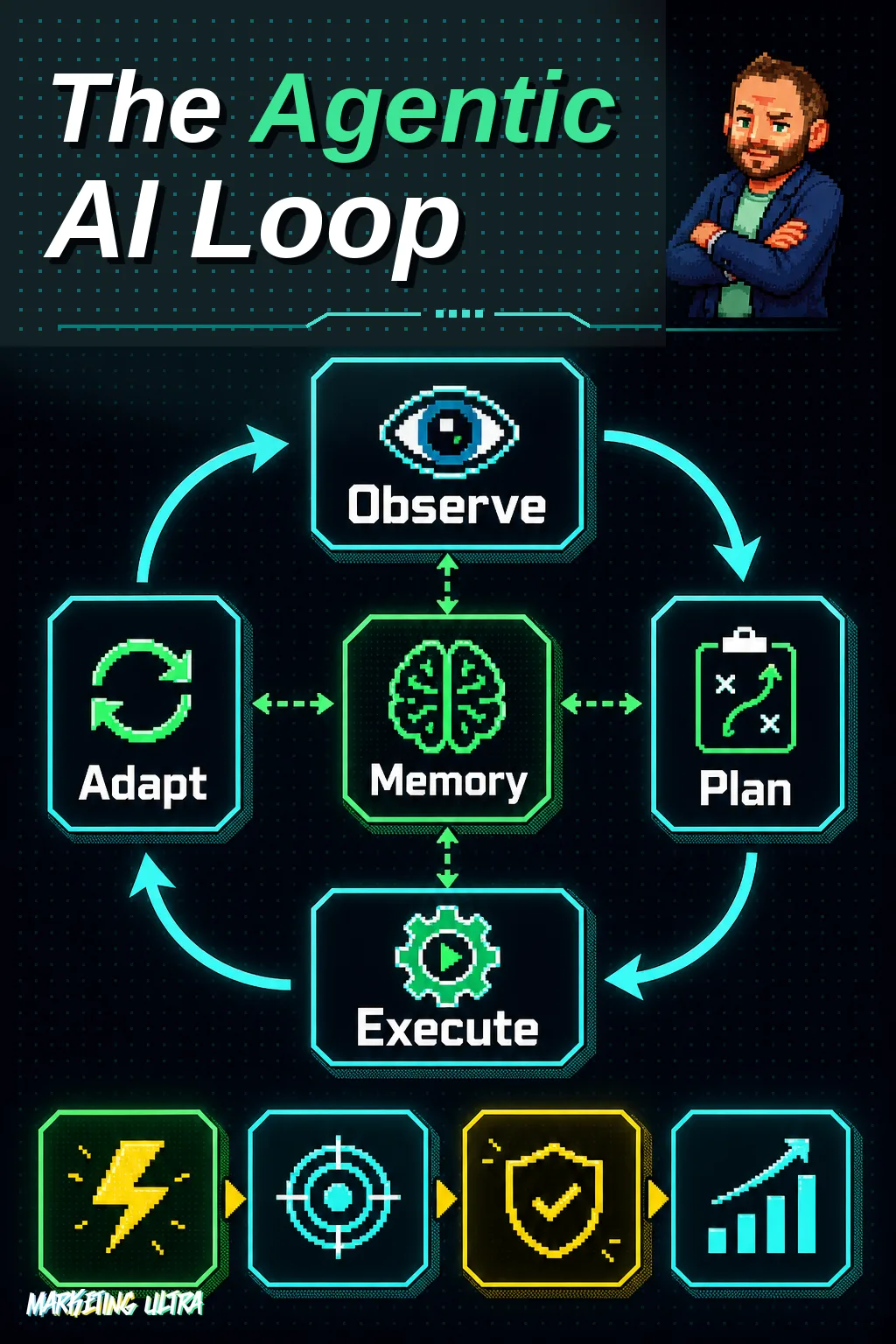
Agentic AI is a different league. An agentic AI agent doesn't wait for instructions: it observes, plans, breaks work down into steps, executes them, and adapts in a continuous loop of perception, reasoning, action, memory, and feedback. Calling it a chatbot on steroids doesn't even come close: it's a system that makes decisions on its own.
And to truly understand that, you have to leave the interface behind.
With base ChatGPT or Claude you don't get the agentic experience. You're in the interface and you never leave. That was my turning point. I set up a bot on Telegram with an agent and I could talk to it, ask it to do things, browse websites, pull back whatever I needed.
The shift was visceral. From "asking questions to an AI" to "having a system that does things for me." Worth noting: tools like n8n, Flowise, or Zapier Agents already make that leap possible without writing a single line of code. The technical barrier has collapsed. What's still missing is people willing to jump.
700 Failures, Zero Solid Projects: That's the Real Masterclass
I broke the ecosystem 700 times. It cost me a serious amount of money. But for me, that was a master's degree.
I built an open-source agentic harness and created specialized agents: one for scraping, one for planning, one for managing ClickUp, one for publishing to WordPress, drafting content, optimizing SEO. A builder agent, an agent specialized in scraping, an agent specialized in planning the plans of other agents. I combined them. I threw real tasks at them.
And they broke. MANY times.
I discovered the concept of "model agnostic": not caring which model I was using. Having a system built to be interchangeable. I learned which models are suited for what, which ones hold up under complex tasks, and which ones fall apart the moment things get serious.
I never shipped a single solid project. And that's precisely what let me see the machine's guts, and its weaknesses. Knowing those weaknesses well is what now lets me know how to frame requests, where things will break, what I can do, what I can't, and what I shouldn't.
The anecdote that sums it all up: one day I swapped the model in a builder agent, put in one that wasn't capable enough for the task, and on top of that told it to update the system. It deleted the file it was never supposed to touch. And then, as a "solution," it decided to wipe the entire ecosystem.
That was the lesson branded in. Know that you can't trust an agent 100%, that you can't give it absolute power, that you can only use powerful models for complex tasks.
The counterargument? Someone will say that breaking things isn't learning, that it's wasting time and money, and that a structured course teaches the same thing without the drama. They're partially right: it cost me a fortune in API fees and not everyone can stomach 700 failures without quitting.
But a course gives you theoretical knowledge. The school of hard knocks gives you intuition. The difference between knowing a model can hallucinate and KNOWING at which exact point it's going to hallucinate, and how to catch it before it wipes your project.
What you really learn when you break a harness is how AI systems fail in general: how they degrade under complex instructions, how an agentic loop can spiral into destruction without guardrails, how a model that generates decent text can be a complete disaster when making system-level decisions.
That's systems thinking applied to AI. And it transfers to any tool you pick up afterward.
McKinsey estimates that agentic AI could enhance up to two-thirds of marketing activities, generating revenue increases of 10 to 30% through hyperpersonalization. But squeezing that value out requires understanding how it works from the inside. Pressing a button isn't enough.
Leveling Up: When You Actually Build With Agentic AI
What top-tier models build is solid and much harder to break. What harnesses running on cheap AI produce falls apart easily.
I found that out when I made the jump to Claude Code. After battling cheap models in an open-source harness, using a tool backed by models like Claude Sonnet 5 was a completely different world. Same task, incomparably better results in terms of robustness.
The data point that hit hardest? I'm building my own SaaS. Claude Code wrote 100% of it. I have absolutely no clue about code. What I do have is vision, and I understand how systems work. And vision is the harder part. Knowing how far you need to go and how to get there.
Is it risky to build software without understanding the code? Yes. A 100% AI-generated project has an invisible ceiling: if the model makes a deep architectural mistake, a non-developer might not catch it. I know that.
That's why the SaaS is for my own needs, not to sell it to the world without an audit (that would be irresponsible). And that's why I use adversarial review: I have Claude Code and another model review each other's work. When they cross-review, they catch things that a single model consistently misses.
The AI agents market reached $5.4 billion in 2024 and is projected to grow at 45.8% annually through 2030. This is not a passing trend. Kayo Sports scaled from 300 to 1.5 million personalized message variations with agentic AI and achieved a 14% increase in subscriptions. The opportunity is real for those willing to build.
The Roadmap (And Why Order Matters)
I strongly recommend everyone go out and build an open-source agentic harness, to feel the power of that ecosystem firsthand, but also the difficulty and the frustration. That experience is worth more than any course, any master's program, or even jumping straight into Claude Code from day one.

Why does order matter? Because without that school of hard knocks, Claude Code is just another interface. Powerful, yes. But if you don't understand why things break, you don't know what to ask for or how to spot when the result is bad.
I'll be honest about something: my "I don't know how to code" comes from someone who already had a mini PC running Home Assistant, who had tinkered with n8n, and who was managing APIs. That's not the average marketer. I'll own that. But the roadmap adapts to every level:
Level 0 (if you only use ChatGPT): stop asking in default mode. Learn that reasoning models exist (o4-mini, Claude Sonnet). Ask the AI itself which model to use for each task. That single step already puts you ahead of 90% of users.
Level 1 (if you're already tinkering): install n8n, build your first automated workflow, connect a messaging bot to an AI API. The jump from "asking" to "building" is THE moment.
Level 2 (if you're already building): set up an open-source agentic harness. Experiment with multiple models. Accept that it's going to break. Many times. That's the masterclass.
Level 3 (if you've already been through the grinder): adopt top-tier tools like Claude Code. Implement adversarial review between models. Diversify your providers. Keep everything interchangeable.
At this point, I think imagination, ambition, and a low fear threshold matter far more than technical skills. My only job is to think about what to build. AI unlocks the how.
What you're really doing when you go down this road is removing the technical ceiling. Building whatever you want.
In the end, it all comes down to curiosity. If you have it, everything else is detail.
Frequently Asked Questions About Agentic AI
What does "model agnostic" mean in AI?
A model-agnostic system is designed to work with any AI model without being locked to a single one. In practice, it means you can swap the underlying model (Claude, GPT, DeepSeek, Qwen) without rewriting the system. It's a key principle for avoiding vendor lock-in and choosing the most appropriate model for each specific task.
What is adversarial review between AI models?
It means having two different AI models review each other's work. For example, Claude Code generates code and another model reviews it looking for errors, and vice versa. Each model has different blind spots, so cross-review catches failures that a single AI consistently overlooks.