We've been watching the same movie for two years: AI is coming for our jobs. CFOs freezing investment, executives using fear as an excuse to stand still, media outlets writing apocalypse headlines because the clicks are guaranteed. A Revelio Labs study of more than 21,500 companies has just dismantled that narrative with hard data: the companies investing most heavily in artificial intelligence are generating jobs. In volume.

TL;DR: The no-nonsense summary
- More AI, more headcount: companies with the highest AI adoption grew employment 10.2%, with junior roles up 12%.
- The market is moving: AI-related job searches have surged 550% and 22% of job postings already require AI skills.
- The apocalypse has fine print: Funcas projects up to 2.3M jobs destroyed, but also 1.61M new ones created. Net loss: moderate at worst, negligible at best.
- The real risk: it's not adopting AI, it's standing still while your competitors integrate and scale it.

In my view, the future belongs to small, supercharged teams, highly capable people who use AI to reach further.
DaniIn this article
What does the Revelio Labs study say about AI and employment?
The companies Revelio Labs classifies as high-intensity AI adopters are those integrating artificial intelligence structurally into their operations, not as a one-off experiment. These companies grew their headcount by 10.2% in the two years following adoption. And junior and entry-level roles grew by a specific 12%.
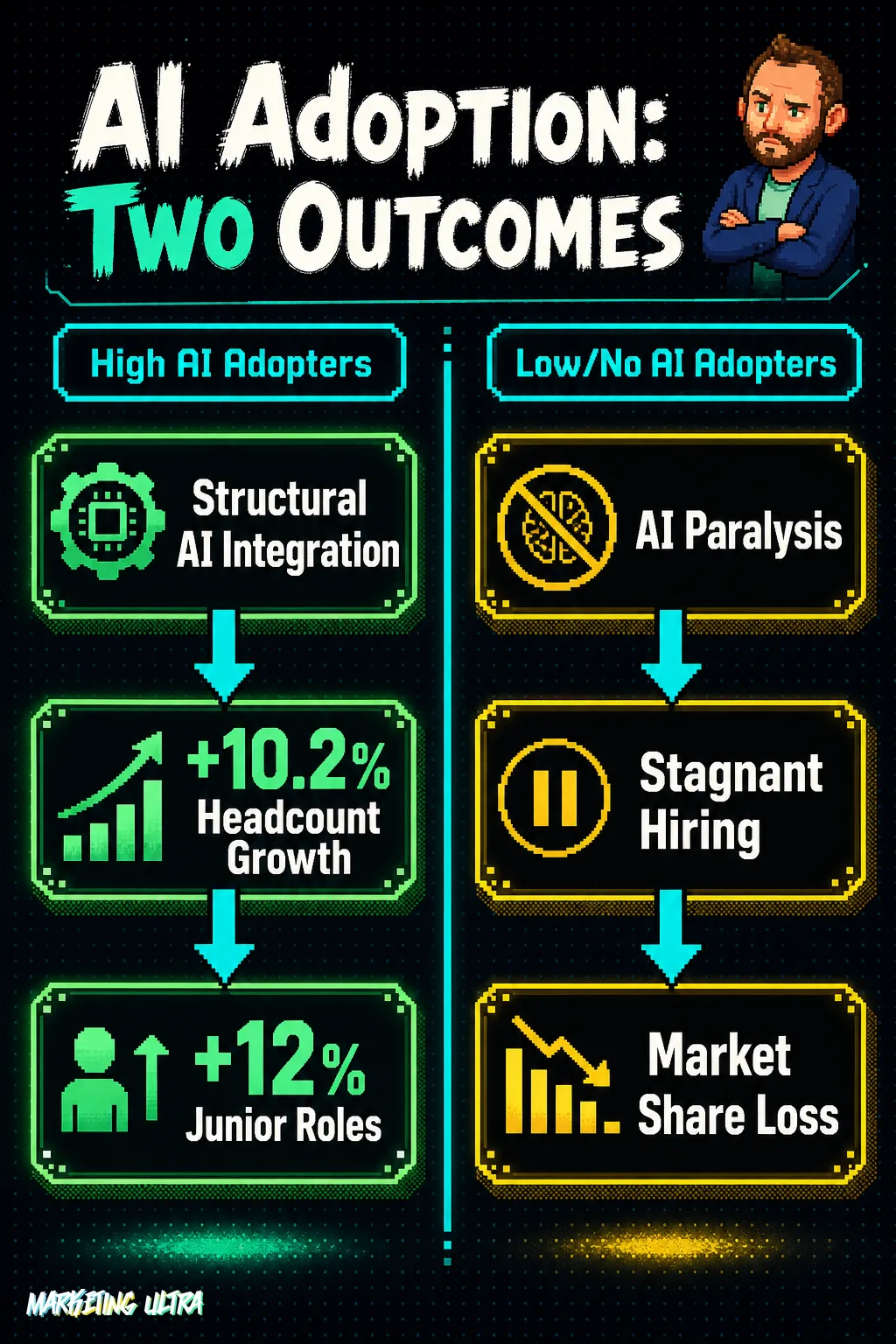
Exactly the profiles the dominant narrative said would disappear first.
The study, conducted in collaboration with Ramp and analyzed by TechCrunch, examined more than 21,500 companies across the United States. Growth wasn't limited to engineering or technical roles: sales, administration, customer support, finance, research. Everything grew.
And the most interesting part? The underlying mechanism. Artificial intelligence allows companies to produce more and gain market share. It's that simple.
That growth generates demand for more people. Not fewer.
Is artificial intelligence actually destroying jobs?
Not quite. But headlines need drama, so let's go to the data.
AI-related job searches have grown by 550% over the past year. Twenty-two percent of job postings already require AI skills. And having those skills can lift your salary by up to 25% compared to similar profiles without them, including in operational and entry-level roles.
And the labor apocalypse the headlines keep selling? The Funcas report from April 2026 projects between 1.7 and 2.3 million jobs destroyed over the coming decade. That sounds devastating, until you read the full report and discover that the same study forecasts the creation of 1.61 million new roles. Net loss in the worst-case scenario: moderate. In the best: near zero.
The fine print matters. But fine print doesn't drive clicks.
The risk nobody mentions in the boardroom
The real danger is paralysis. Companies that slow AI adoption "out of caution" lose ground every month they fail to act.

When a company freezes AI adoption to "protect jobs," it's not protecting anything. It's tying its team to tasks a tool could handle in minutes, while competitors free up that time for thinking and scaling.
In agency work, you see this every week. A team that uses AI well ends up needing people doing different things. More people, in fact.
Profiles that used to spend 60% of their day on repetitive tasks, reports, campaign reviews, data categorization, now spend that time on strategy and qualitative analysis. On the work that actually moves the needle.
The result? More capacity from the same structure. And when capacity grows, clients grow. And when clients grow, you hire.
Pure logic.
My bet: in two years, "AI-driven job destruction" will sound as dated as "SEO is dead", a phrase we've been hearing for a decade.
How to read the data without swallowing the narrative
The Revelio Labs data doesn't say AI is harmless or that every role is safe. It says something more nuanced: companies that adopt AI strategically grow their headcount. Those that don't stay where they are. Or fall behind.
The difference lies in "strategically." That means sitting down to figure out what to automate and what profiles you need now that your team performs at a higher level. The idea of plugging in ChatGPT and firing the intern is headline science fiction.
The pattern repeats across markets: companies most exposed to AI are already leading growth in employment, salaries, and productivity.
And watch out for autopilot mode. The same caveat that applies every time a platform rolls out a "magic" automation, like Google Ads' Ask Advisor, applies here: a tool without human judgment is a blank check. AI amplifies what's already there. If you have strategy, it multiplies results. If you have a mess, good luck.
The data is clear: the companies investing most in AI are the ones hiring most. Those waiting are falling behind.
If the conversation in your organization is still "will AI take our jobs?", change the question. The one that matters: how much market share are you losing while your competitors already have it running?