For twenty years we've been targeting ads with the same mental framework: you either chase a keyword or you chase a demographic profile. Now OpenAI introduces a third option that fits neither of those boxes, and forces us to rethink how we describe user intent when that user is no longer searching, but having a conversation. A new channel, fine, that happens every couple of years. A targeting model that looks NOTHING like anything we've used before? That actually changes things.

TL;DR: The no-nonsense summary
- Context hints: not keywords or audiences, but natural-language descriptions of the buying scenario where your ad fits.
- Three funnel moments: Google captures explicit demand, Meta generates passive demand, ChatGPT Ads intercepts active deliberation.
- Initial costs: CPMs around $60 and CPCs of $3-5 in beta, with no minimum spend since May 2026.
- Privacy by design: targeting is based on real-time conversation context, not cookies or behavioral profiles.
In this article
What are ChatGPT Ads context hints?
Context hints are the targeting unit in ChatGPT Ads. Instead of bidding on an exact term ("cheap running shoes") or defining a profile ("male, 25-34, interested in fitness"), you describe in plain language the type of conversation where your product is relevant. Something like: "user comparing shoes for their first marathon, concerned about cushioning and working with a mid-range budget."
OpenAI's system interprets the context, topic, and intent of the user's query to decide whether your ad is a fit. The system doesn't look for word matches. It understands what the conversation is about. Hints are configured at the ad group level and act as the primary targeting signal.
And what about user data? Here the difference is stark. Targeting is based on what the user SAYS in that moment, not on who they ARE according to a profile built from cookies. If the user opts into personalization, the system can use additional signals like past conversations or general location. But the primary engine is real-time conversational context.
Keywords vs. audiences vs. hints: three models, three moments
Each targeting model maps to a different funnel moment. And this is where people are going to get confused thinking one kills the other.
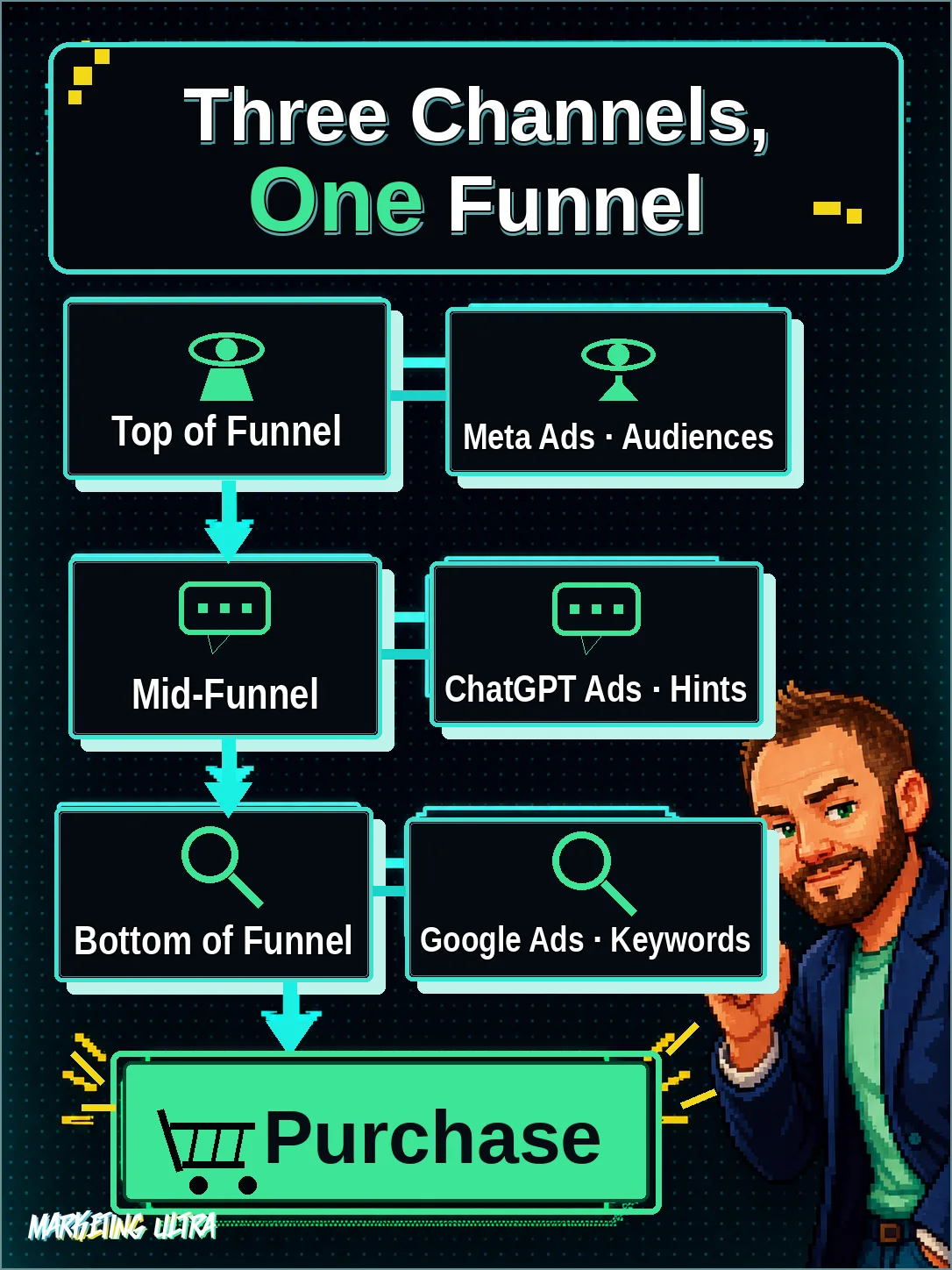
Google Ads (keywords): you capture demand that already exists. The user knows what they want, types it in, and you bid on that declared intent. Bottom of the funnel. Works brilliantly when there's enough search volume. The system gets more automated every quarter, but the core logic stays the same: keyword, bid, ad. In the accounts we manage, CPCs run $2-4 with 3-5% conversion rates on search, though it varies considerably by sector.
Meta Ads (audiences): top of the funnel, pure discovery. The user is scrolling without looking for anything, you put a creative in front of them that makes them stop. Advantage+ has automated a large part of that, CPMs of $10-20. You already know this one.
ChatGPT Ads (hints): you intercept deliberation. The user isn't searching for your product (Google) or stumbling across it (Meta). They're THINKING. Comparing options, asking for advice before making a decision. You tell the system: "when someone is in this type of conversation, show them my ad." Reported CPMs of around $60, CPCs of $3-5 in beta. Yes, that sounds expensive. We'll get to that.
Mid-funnel. Active consideration. That moment when the user hasn't yet typed a Google search because they don't quite know what they want yet.
The numbers: what it costs and who it reaches
OpenAI launched advertising on ChatGPT on February 9, 2026. The self-serve manager arrived in May 2026 for U.S. advertisers, then opened up to Canada, Australia, and New Zealand. The initial investment minimums ($200,000 in the first phase, $50,000 in the pilot) were dropped in May.
Ads only appear for Free and Go account users. Plus, Pro, Business, Enterprise, and Education subscribers don't see ads. Neither do users under 18. This limits available inventory, but also filters: the user who sees your ad is on the free tier, most likely exploring whether ChatGPT can solve something specific for them.
Current formats include sponsored cards below the model's response (headline, description, image, link), product feed ads for retailers (similar to Shopping ads, available from June 2026), and conversational banners that let users "ask ChatGPT about this ad." The system supports CPC and CPM bidding, with standard metrics: impressions, clicks, CTR, conversions.
When to run ChatGPT Ads, and when not to
Here's my honest take, and you won't find this angle in any "complete guide to ChatGPT Ads" piece, because they're all stuck in tutorial mode.
Hints work when the user's decision process is LONG. Products or services where people deliberate seriously before buying. B2B software, education, travel, insurance, technology, healthcare. Anything where "let me ask ChatGPT" comes before "let me Google it."
They DON'T work, or don't add any meaningful differentiation, when the decision is instant or purely impulsive. If you're selling $15 T-shirts, users aren't consulting an LLM. They click buy or they don't. Meta is still your channel there.
And watch out for the CPM trap. $60 versus Meta's $10-20 sounds expensive. But if the intent signal is three times deeper and the user is closer to converting, the final cost per acquisition can be competitive. My bet: the first advertisers who nail their hints will achieve CPAs comparable to search, lower volume, but lead quality that justifies the price. We'll see. For now, inventory is limited and competition is low. That won't last.
The other trap: treating hints like long-tail keywords. They're not. A keyword tells you what the user typed, full stop. A hint goes further: it describes the situation they're in and what they need to resolve before deciding. If you port your search campaign structure directly into ChatGPT Ads, you'll burn money. You need to think in conversation scenarios, not terms.
The full picture: three channels, one strategy
If you manage paid media and your client has budget to test, the question is no longer "Google or Meta?" It's: where in the decision process are you losing the user? If your funnel empties out between discovery (Meta) and the final search (Google), that's a gap hints can fill.

To be clear: this doesn't replace anything. It's a complementary channel with a targeting model that didn't exist before. And like any new channel, it has the first-mover advantage: low competition, contained CPCs. But also the immaturity risk: limited metrics, small inventory, English-speaking markets only for now.
My bet? In 12 months there'll be a new line item in reports from serious agencies: "conversational ads." And the latecomers are going to pay CPMs they can't even imagine right now.
Frequently asked questions about ChatGPT Ads targeting
What's the difference between a hint and a negative keyword?
A negative keyword excludes specific terms from your search campaigns. A hint doesn't exclude anything: it positively describes the scenario where you want to appear. There's no such thing as a "negative hint" in ChatGPT Ads yet, which limits control over where you DON'T show up.
Can you use UTM parameters in ChatGPT Ads?
Yes. The ChatGPT Ads Manager lets you add UTMs to destination URLs and also offers a conversions API for more granular tracking. It works just like any other paid advertising platform.
Is ChatGPT Ads available outside the US?
As of July 2026, self-serve is open in the US, Canada, Australia, and New Zealand. There's no official date for the UK or other markets, though non-English inventory does exist for global Free account users.