August 17, 2026 falls on a Monday. That day, thousands of campaigns will keep spending the same and start converting less without anyone touching a thing. It's not a bug: it's the Google Ads bidding change for budget-limited campaigns, announced in writing with an official example included. I've spent years defending Google's automation. That's exactly why I'm telling you: there's a catch here.

TL;DR: The no-nonsense summary
- What changes: from August 17, 2026, budget-limited campaigns with target CPA or target ROAS that beat their goal will start bidding "toward the target". Official example: target 10, actual CPA 5, result 10.
- The arithmetic: same spend with CPA doubled means half the conversions. The disaster example isn't mine, it's Google's.
- The window: the bid target adjustment tool arrives July 6. You get six weeks to decide campaign by campaign.
- The gotcha: the official FAQ advises against setting bid limits in response to the change. The levers they leave you are targets and budgets: the two Google bills you through.

I'm a declared fan of Google's automation, and that's exactly why this feels like devious malice to me: they know their users perfectly and they know what's going to happen in August. My plan is clear: well-calculated portfolios with max CPC, my own scripts watching every account, and the target rewritten as what it is now, a price. Whoever reaches August 17 without doing their homework will experience the mini heart attack in real time.
DaniIn this article
- What changes in Google Ads bidding on August 17?
- Every number you give Google becomes a commitment
- The gotcha in the official FAQ
- PMax loses its leash
- Lead scoring: from star strategy to extreme sport
- The part where Google has a point
- What to do before August 17
- Frequently asked questions about the Google Ads bidding change
What changes in Google Ads bidding on August 17?
Starting August 17, 2026, if a campaign is limited by budget and uses target CPA or target ROAS, it will stop performing better than your goal: the system will bid "more consistently toward the target" you wrote down. That's straight from Google's official announcement, with this example: target of 10, actual CPA of 5. From August on, that CPA moves to 10.

Do the math. Same budget, CPA doubled: half the conversions. Without touching anything. On a Monday in August.
It affects Search, Shopping, Performance Max, Demand Gen, Display, Hotels and Travel, also via SA360 and DV360. Apps and video campaigns are spared. The announcement dropped on June 15 inside a package of bidding and budget changes, and it comes with a window: on July 6 the Bid Target Adjustment Tool arrives so you can decide, campaign by campaign, whether to keep your target, adjust it to recent performance, or set another number. Google touches nothing on its own. You have six weeks.
Every number you give Google becomes a commitment
This doesn't come alone. On June 1, Google killed the indirect brake on spend: even if you schedule ads only a few days a week, the month can run up to 30.4 times your daily budget. I covered it in the article on spend control and ad scheduling. On August 17 it kills the indirect brake on efficiency: beating your target no longer lets you stay cheap.
That's the pattern. Every number you give Google stops being an aspirational ceiling and becomes a spending commitment.
It's one thing to defend automation, and you know I'm a fan if you read me. It's another not to notice this is devious malice from Google, a company that knows its users perfectly. Plenty of managers used the budget limitation for exactly this: resting easy knowing the algorithm would stay conservative, and spending their time hunting the freshest opportunities. With this change it won't care that the budget is limited: it will run with the full aggression of whatever ROAS or CPA you gave it.
August will bring mini heart attacks. A lot of people will suddenly discover the algorithm no longer turns conservative when you're not watching. And it's not the first warning: the Smart Bidding shift was already pointing this way. We had gotten used to one dance with the algorithm and now we'll have to dance another.
The gotcha in the official FAQ
When I read the announcement, my consultant instinct kicked in immediately: max CPC bid limits on portfolio strategies. The leash I've always used. Then I opened the official FAQ and found that Google has a question dedicated to advising against EXACTLY that.
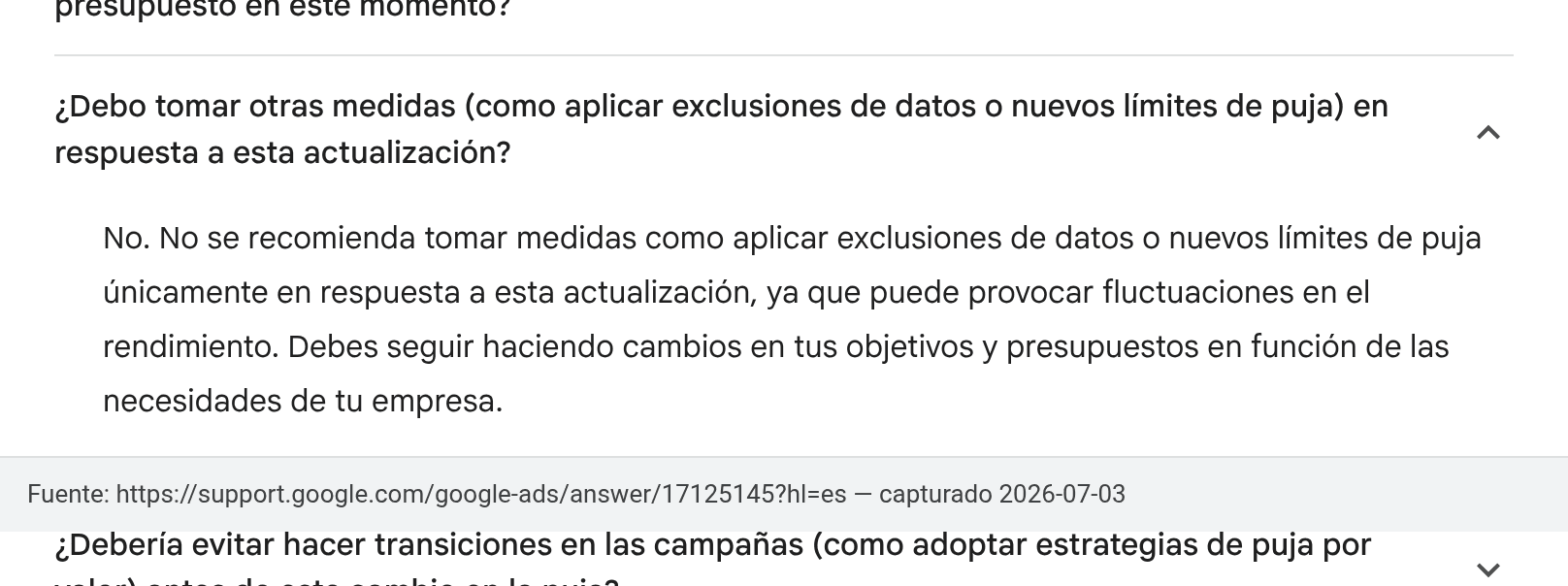
Read it slowly, because it's loaded. The word that gives it away is "solely". They don't say bid limits are bad: they say don't set them as a reaction to this change. And what do they offer instead? Keep adjusting targets and budgets. The two levers Google bills you through.
What a catch.
I stand by it: portfolio control with max CPC is the clear answer to this. Knowing what you're doing, mind you, because some people squeeze too hard and the algorithm needs room to breathe.
PMax loses its leash
The target safeguard was what let us stay calm while running a campaign that is designed to go wild. And Google just dropped the leash: the FAQ itself admits that in multi-channel campaigns like Performance Max and Demand Gen, spend allocation across channels may change with the update.
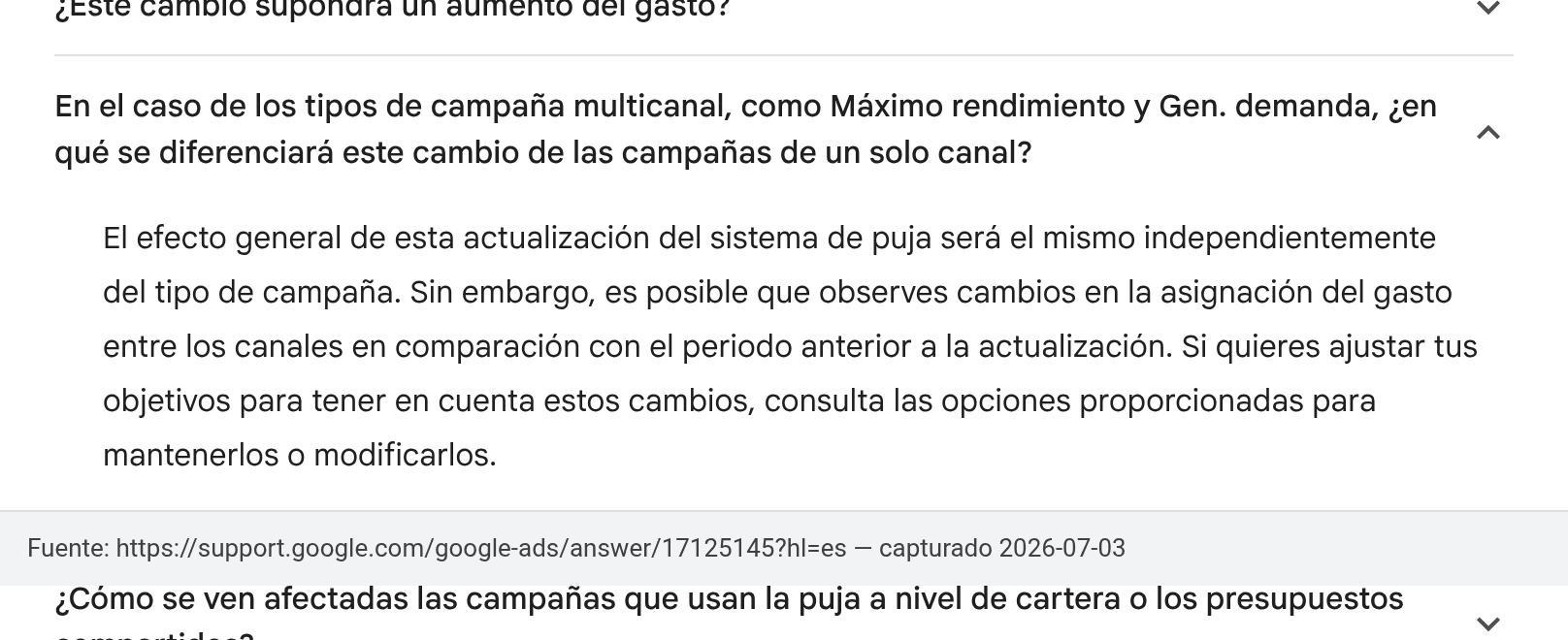
Now the kicker. Remember the leash Google advises against? In PMax it doesn't even exist: max CPC bid limits are only available on portfolio strategies and only apply to Search Network auctions. The most opaque campaign in the system has no possible bid limit. The change is literally orchestrated to let PMax and Demand Gen go crazy.
Lead scoring: from star strategy to extreme sport
The change affects every conversion type, online and offline, including the values you import from your CRM. If you run accounts with lead scoring, pay attention. You build a funnel of conversions and micro-conversions with values, a PMax wanders into display, cheap conversions from a micro-conversion start flowing in and pushing badly calibrated value. That already creates volatility today. Add this change and it becomes uncontrollable. If the consultant doesn't add another automation layer on top, it's a bomb.

And the contradiction is huge: lead scoring is one of the star strategies Google has been pushing for years, ever since automated campaigns took over. Running an account like that is about to become an extreme sport.
The part where Google has a point
Let's be fair. The target is what you said you could tolerate: if your acceptable CPA was 5, your target should have been 5. Scaling will be more predictable: today, raising the budget on a limited campaign produces erratic CPA jumps. There's a tool, six weeks of notice, and an email. And part of the August scare will be transition noise: the FAQ itself asks you to wait one or two conversion cycles before judging.
All of that is true. And none of it changes the core issue: the target spent years working as leash and aspiration at once, the whole market operated it that way, and changing the semantics of a setting with years of use isn't aligning incentives. It's moving the goalposts.
What to do before August 17
My three rules for the new dance:
- Portfolios with max CPC on Search. It's the safeguard that remains. Well calculated: squeezing too hard kills the flexibility the algorithm needs.
- Scripts and your own automation. Without automated alerts and controls, a consultant with several accounts can't keep up with the dance. Those who build it will come out ahead.
- The same artisanal management as always, with more hours. There's no trick that replaces staying on top of it. There's simply more work now.
And the six-week checklist:
- Inventory: campaigns flagged "Limited by budget" with target CPA or ROAS. The distance between your target and your actual CPA is your exposure.
- Decide with the tool from July 6: if you want to keep current performance, lower the target to your recent actual CPA or ROAS. Your target is now a price, write it as one.
- Budget-limited PMax beating its target: red zone. No bid limit possible and channels reshuffling. Reinforced monitoring or a rethink.
- Lead scoring and offline values: recalibrate values before August.
- From the 17th: CPC and CPA alerts from day one, and one or two conversion cycles before drawing conclusions.
Why are they doing this? Google Ads accounts aren't doing badly. My bet: there was a quarterly meeting and someone said revenue has to go up. And it will go up, no doubt. But three months from now we get a crisis in the paid media world: short-term gains for the company and a huge mess for those of us managing accounts.
The system doesn't get better for the advertiser. It creates new errors in accounts that worked, demands craftsmanship exactly where it suits Google, and sells total automation everywhere else. Google being Google.
Frequently asked questions about the Google Ads bidding change
How do I know if a campaign is limited by budget?
Google Ads flags it in the Status column with the label "Limited by budget": it means your daily budget runs out before capturing all available demand. Those campaigns, if they also beat their target CPA or ROAS, are the ones affected by the August 17, 2026 change.
What is a portfolio bid strategy in Google Ads?
A bid strategy shared across several campaigns from the account's strategy library. It's the only place where max CPC bid limits can be set, and those limits only apply to Search Network auctions: neither PMax nor Display supports them.