Google just dropped another model into the race. Gemini 3 Flash Preview lands with a headline that raises eyebrows: reasoning close to Pro, Flash-level speed, and cost cuts of up to 60% versus previous generations. For any team already working with the Gemini API, this looks like a serious leap forward. But there is fine print. And if you are in Europe, it affects you directly.

TL;DR: The no-fluff summary
- Performance: Gemini 3 Flash closes the gap with Pro at 25% of its cost per million input tokens.
- Speed: up to 2x faster than the previous Flash and 3x faster than Gemini 2.5 Pro on some metrics.
- Context: 1-million-token window. Enough to process an entire product catalog or a full campaign history in a single call.
- Europe: Google has NOT confirmed availability in the EU or the European Economic Area.
In this article
What Gemini 3 Flash Is and What Actually Changes
Gemini 3 Flash Preview (gemini-3-flash-preview in the API) is Google's new fast multimodal model. It accepts text, images, video, audio, and PDF as input and returns text. So far, nothing unexpected for a Flash-tier model.
What changes is the jump in reasoning. Until now, picking a Flash model meant accepting a clear capability trade-off in exchange for speed and price. With this release, Google claims performance approaches Gemini 3 Pro and that on several benchmarks it actually outperforms Gemini 2.5 Pro.
The figures Google publishes in its official documentation:
- Up to 2x faster than previous Flash versions.
- 3x faster than Gemini 2.5 Pro on some metrics.
- Cost: approximately 25% of Gemini 3 Pro's price per million input tokens.
- Context window: 1 million tokens.
- Configurable thinking levels: fast, thinking, pro.
It includes improvements in tool use, structured outputs, and multi-turn conversation handling. That last one matters more than it sounds: it is what allows you to build agents that do not lose the thread halfway through a task chain.
Does it sound too good to be true? A little. Let us look at the data.
Where Gemini 3 Flash Fits in Marketing and E-commerce
Gemini 3 Flash fits any marketing task where you need to push volume without blowing the budget. With Pro models, many of those tasks simply did not pencil out.
High-volume content generation. Product descriptions, ad copy variations, social posts. With a 1-million-token context window you can feed the model an entire catalog and ask for brand-consistent output across every single entry.
Low-latency campaign analysis. Some sources cite an 84% predictive accuracy in bid management simulations, outperforming GPT-5.2 and Claude Opus 4.5 in that specific scenario. Worth flagging: this is simulation data, not live account performance. Anyone who has managed PPC knows that lab benchmarks and real-world results are distant cousins, the kind that only end up at the same table once a year.
Chatbots and customer support. If your chatbot takes three seconds to respond, the user is already gone. Full stop. This is where Flash earns its keep.
Document data extraction. Invoices, reports, PDFs. Feeding a document and asking for clean JSON output is one of the scenarios where Flash genuinely shines.
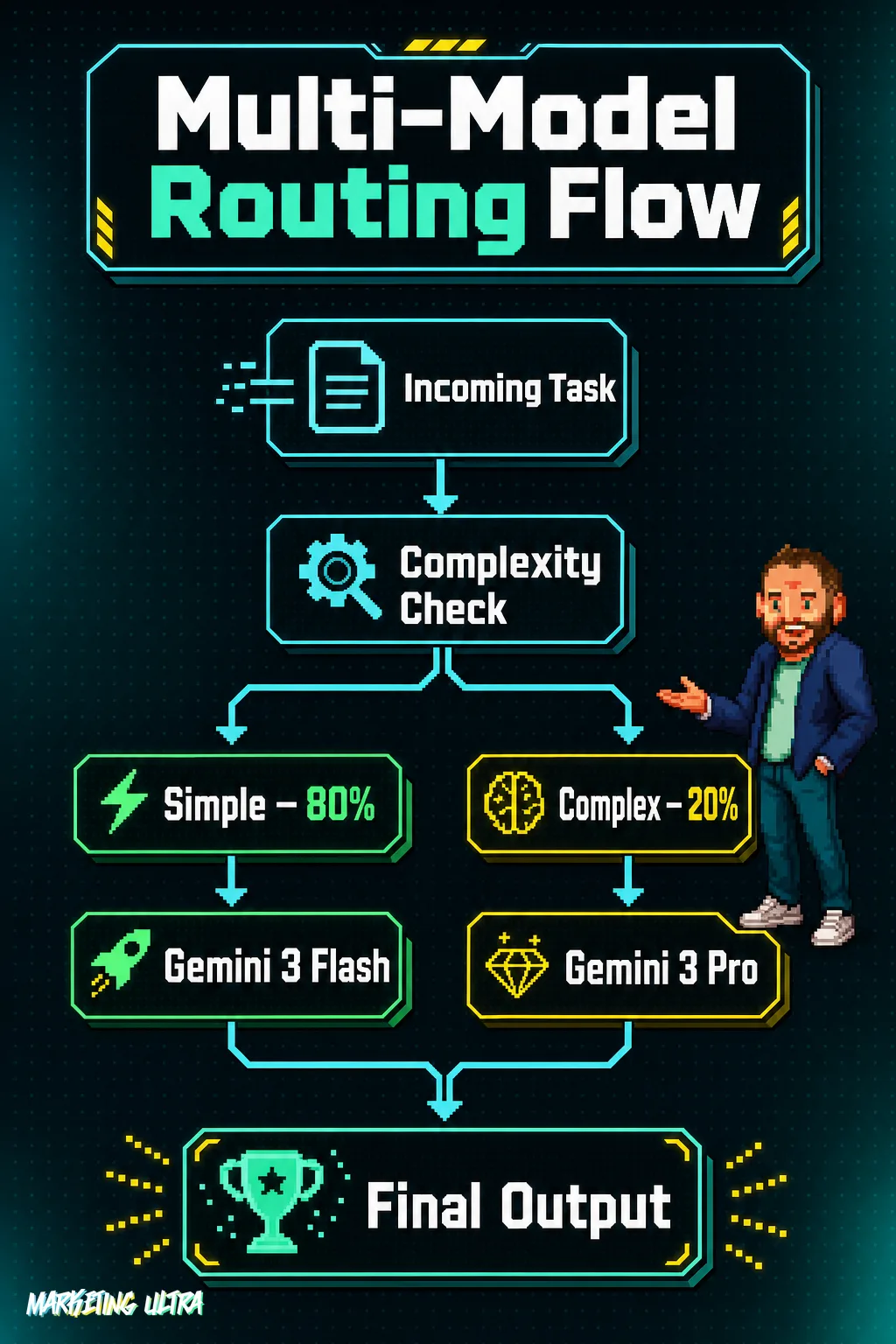
The real value probably does not lie in using Flash on its own. It lies in multi-model routing: Flash for the 80% of routine tasks, classification, summaries, templated responses, Pro for the 20% that requires deep reasoning. This is not a Google-only trend: Anthropic made a similar move with Claude Sonnet 5, bringing top-tier performance to a much more accessible price point. If Flash performs nearly as well as Pro but costs 75% less, the cost structure of any AI-driven agency or e-commerce operation changes fundamentally. At these prices, doing things manually starts to be the expensive choice.
Europe Watches from the Sidelines
Google has NOT confirmed availability of Gemini 3 Flash Preview in the European Union. The rollout is described as "gradual and global" in the official changelog, but "global" does not mean "available everywhere."
No mention of the European Economic Area, no evidence of access from European accounts. Zero.
This is not new. Google has been accelerating its bet on AI agents in advertising for months, while European regulators move at a different pace. The EU AI Act, GDPR, and Google's own caution with Brussels have been holding back access to generative AI features on this side of the Atlantic for some time.
If you work in marketing from any EU country, the recommendation is straightforward: do not build a workflow that depends on this model until Google confirms access. You can test it if you have a preview-enabled account, but do not treat it as production-ready.
Is It Worth Waiting for Gemini 3 Flash?
Yes, with your feet on the ground. On paper, Gemini 3 Flash Preview is the model that makes generative AI something a marketing agency can actually afford. Flash speed, near-Pro reasoning. And a price that no longer makes your finance director wince.

The "near" matters. This is a preview. The numbers are promising but not final. And if you are in Europe, you are still waiting.
Fast, cheap models are going to swallow routine marketing tasks whole. If your competitors are already automating lead classification and product description generation with this generation of models, sitting on the sidelines means bleeding money. Month after month.
Frequently Asked Questions about Gemini 3 Flash
What does a 1-million-token context window actually mean?
A token is roughly three-quarters of a word. One million tokens translates to approximately 750,000 words that the model can process in a single interaction, enough to feed it a complete product catalog, a full campaign history, or a lengthy document without splitting the information across multiple calls.
What is multi-model routing?
It is a strategy that directs each request to the most suitable model based on its complexity. Simple tasks, classification, summarization, templated replies, go to a fast, cheap model like Flash; tasks that require deep reasoning are escalated to Pro. The result is high performance without runaway costs, and it is the architecture that makes the most sense when Flash matches the capability of models that cost four times as much.