Google just unveiled Gemini 3.5 Live Translate and the headline sounds compelling: real-time, bidirectional voice translation built into Google Meet and the Google Translate app. Over 70 languages, no button to press, with a synthetic voice that tries to sound like you. Sounds like it could put interpreters out of a job overnight. But read the fine print before you cancel anything.

TL;DR: The No-Fluff Summary
- Direct voice-to-voice: the model translates audio without going through an intermediate text step, which cuts latency and sounds more natural than the classic pipeline.
- 70+ languages, 2,000+ combinations: automatic language detection that attempts to preserve the speaker's tone.
- Real limitations: voice inconsistencies in long sessions, failures with heavy accents, and zero guarantees on technical terminology.
- Europe and the EU: Google says "global" but the official source does not confirm availability in the European Economic Area.
In this article
How Gemini 3.5 Live Translate Works
Gemini 3.5 Live Translate is a real-time voice translation feature that processes audio directly, voice to voice, skipping the classic chain of speech-to-text, text-to-translation, and translation-to-synthetic-speech. That technical leap is the whole point.
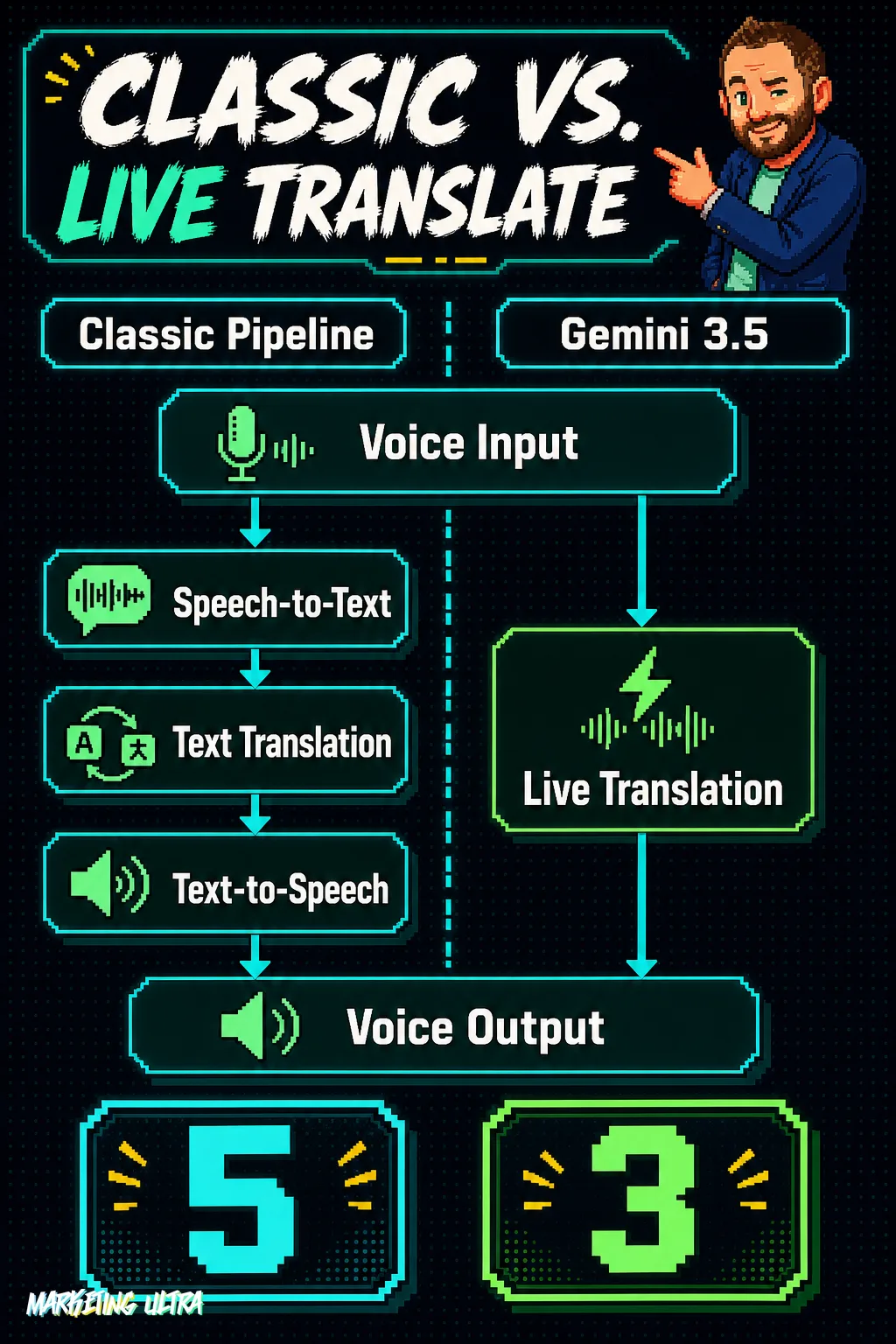
According to the official Google DeepMind post, the model automatically detects over 70 languages and handles more than 2,000 language pair combinations in a single meeting. Declared latency: "only a few seconds behind the speaker." The system attempts to preserve the original speaker's tone and rhythm, not the flat, robotic voice of every auto-translator you have ever sat through. Or at least that is the promise.
In the Google Translate app (Android and iOS), it is already generally available. In Google Meet, it is currently in private preview for selected Workspace customers. Developers have public preview access through the Gemini Live API and Google AI Studio.
This does not come out of nowhere: the Gemini Flash Computer Use feature was already heading in this direction, AI embedded in real operations. Live Translate is the same play applied to something more everyday: the meeting with someone who does not speak your language.
Who Actually Benefits From This
If you manage teams spread across multiple countries and your internal meetings run in broken English that nobody truly commands, this is for you. A lot.
The clearest use case is the internal meeting: weekly sync with the dev team in Poland, follow-up with the Italian supplier, call with the partner in Japan. Contexts where communication matters but you are not betting a six-figure contract on it.
What about client meetings? That is where I would pump the brakes. For a first contact or a product demo, it can work. But if you are negotiating contract terms or discussing legal clauses, I would bet the human interpreter is still non-negotiable. The model's limitations, coming up next, do not hold up to that level of precision.
If you already use AI to transcribe your meetings, real-time translation is a natural next step. But be careful: transcription tolerates errors you can fix later. Live translation does not give you that second chance.
The Limitations Google Buried in the Fine Print
The official announcement is engineered to leave you with the "wow." Here comes the "but."
Voice inconsistencies. In long sessions or with multiple speakers talking fast, the translated voice can shift gender or get stuck on a single voice profile. Imagine your CEO suddenly sounding like the new intern. Uncomfortable, to put it mildly.
Accents. Your Brazilian colleague speaks heavily accented Spanish and the system confuses Portuguese with Spanish. In bilingual teams where people switch languages mid-sentence, you run into the same wall.
Technical terminology. For specific legal, medical, or financial vocabulary, Google recommends "human review for critical outputs." Translation: they do not trust their own tool when a mistake costs money. Worth noting too: the model only accepts voice input, no text entry, no advanced features. Pure translation, nothing more.
Availability in Europe: unconfirmed. Google announces Live Translate as globally available, but the official Google DeepMind source does not specify whether the European Economic Area is included. In Google Meet, the feature remains in private preview for selected Workspace customers only. Check your account before assuming you have access.
Does This Kill the Human Interpreter?
No. Not even close.

What Gemini 3.5 Live Translate kills is the excuse. The excuse not to call the client in Munich because no one on the team speaks German. The excuse to push back the Seoul meeting because "we just can't communicate." The excuse to limit your market to countries where someone on the team can muddle through the language.
For internal meetings and first contacts, this changes the game. For high-stakes negotiations, AI still is not up to the task. And Google knows it: there is a reason they launched first in the free app and restricted access in Meet, where the meetings that actually drive revenue happen.
There is also a pattern worth watching. Google has spent years launching AI features that reach Europe months late or with regulatory strings attached. If Live Translate follows that same path, and I would bet it will, European teams will be left waiting. Again. In a world where AI is already automating every link in the workflow chain, having a communication tool delayed in Europe puts you at a real disadvantage against teams that already have it.
Live Translate works. You already know that. What you have to figure out is whether it works well enough for what is at stake in each conversation.