You've spent months optimizing to get cited by AI. Tweaking structure, answering questions under every H2, following AEO guides to the letter. You open GA4, look for the "AI Assistant" channel, and find a big fat zero. Zero visits. Measuring visibility in AI search engines doesn't work like tracking positions in Google, and if you're using the wrong tools, you'll convince yourself all that work was pointless. It probably wasn't.

TL;DR: The No-Fluff Summary
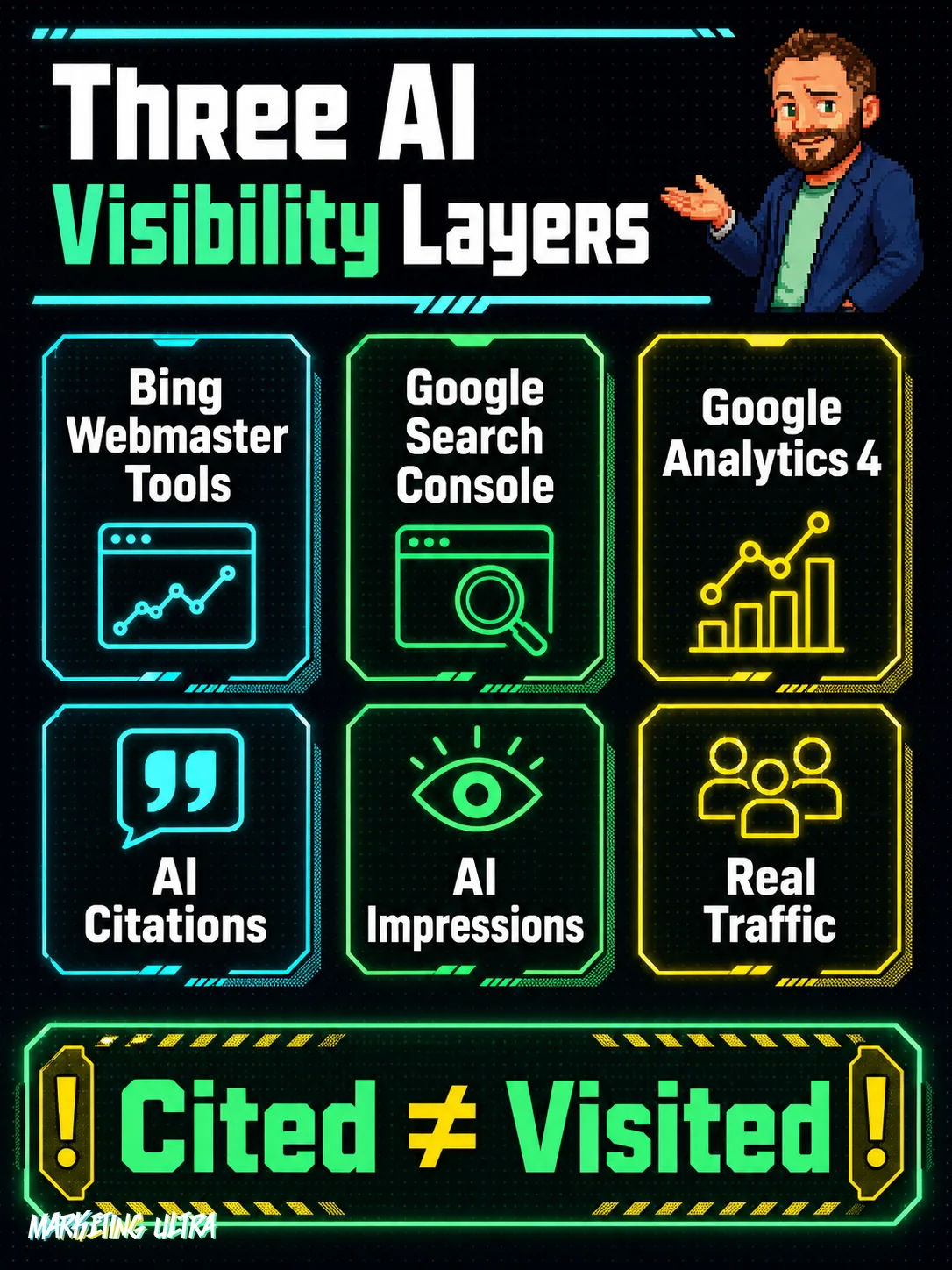
- Three layers, three tools: BWT measures AI citations, GSC measures impressions in generative AI features, GA4 measures real traffic from assistants.
- Cited is not the same as visited: you can have 61 grounding queries in Bing and 0 AI visits in GA4. Both numbers are true at the same time.
- Citation Share: since June 2026, BWT shows your citation share versus competitors for a given query. The first real competitive metric in AI search.
- An underdocumented niche: almost no one publishes this measurement process with their own real data. A wide-open opportunity.
In this article
Measuring AI Visibility Is Not Measuring Rankings
Visibility in AI search is measured in citations, not rankings. Assistants like Copilot, Gemini, ChatGPT, and Perplexity generate answers, and if they decide to use you as a source, they include you. There's no position 1 or position 10. It's either "you're cited" or "you don't exist."
Classic organic traffic has been declining for months across many blogs. AI is absorbing part of those visits, converting them into citations inside its responses. If you only measure traffic, you're only seeing half the picture.
The full picture comes from combining BWT (how often you're cited), GSC (how often you appear in generative AI features), and GA4 (how much real traffic reaches you from assistants). Each one answers a different question, and none of them replaces the others.
Three Tools to Track Whether AI Cites You
And here's where things get messy. People pull one number from BWT, another from GA4, throw them together, and conclude that "AI is useless for me." The problem isn't AI, it's the jumble of data.
Bing Webmaster Tools: Copilot Citations
Microsoft was the first to show its hand. In February 2026, it launched "AI Performance" in Bing Webmaster Tools, and since then you can see real data on how your content surfaces in Copilot and Bing's AI summaries.
The metrics that matter:
- Total Citations: how many times you've been cited as a source in AI responses.
- Grounding Queries: the queries the AI used to retrieve your content, the keyword equivalent, but for the world of assistants.
- Average Cited Pages: the average number of unique pages from your site that appear as sources in AI responses per day.
At Marketing Ultra, we went from 18 grounding queries to 61 in the latest period, a 3.4x increase. Not massive traffic, but proof that something is moving. And the most useful part: you can see which queries trigger a citation, not just how many there are.
In June 2026, Microsoft added four new views to the dashboard: Intents, Topics, Citation Share, and Compare. Citation Share shows your share of citations versus competitors for the same query (if you got 3 out of 10 citations, your share is 30%), the first real competitive metric in AI search. Topics turns grounding queries into a thematic view, closer to how we think editorially.
Google Search Console: Generative AI Impressions
Since June 2026, GSC has added dedicated performance reports for generative AI: AI Overviews, AI Mode, and AI features in Discover. You can filter by impressions, pages, countries, and devices.
One important caveat: it only shows impressions, not clicks. You know Google is including you in its AI responses, but not how many users actually click your link. In our case, we detected 88 queries tied to AI features. Cross-referenced with BWT's grounding queries, they start to draw a map: where we show up and where we simply don't exist.
GA4: The Ghost Channel That Finally Has a Name
Since May 2026, GA4 has a native channel called "AI Assistant" that identifies visits from ChatGPT, Gemini, Claude, and others, no manual configuration required. Before that update, that traffic was buried in "referral" or "direct," mixed in with everything else.
Our number? Zero. GA4 shows 0 visits from AI assistants.
Does that mean AI isn't citing us? No. BWT says it is (61 queries). What's happening is that being cited is not the same as sending traffic. An assistant can mention you as a source without the user ever clicking through. They're different data points. Both count.
If you want to track historical data or assistants the native channel doesn't catch, you can create a custom channel group using a regex that covers the main domains: .*chatgpt.*|.*gemini.*|.*perplexity.*|.*claude.*|.*copilot.*.
What These Tools Won't Tell You
All three give you first-party data, but each only sees its own slice. BWT covers Copilot and Bing. GSC covers Google. GA4 catches whoever links to you. If your audience lives primarily in ChatGPT or Perplexity, none of the three tells that story. You're measuring one slice of the pie and assuming the rest behaves the same way. In practice, it rarely does.

To cover that blind spot, there are third-party tools like HubSpot's AEO Grader, Otterly.ai, and Dageno. HubSpot audits your visibility in ChatGPT, Perplexity, and Gemini across five dimensions: recognition, ranking, quality, perception, and share of voice. They cover exactly what BWT and GSC can't reach.
The catch: almost all the documentation is in English, but very few sites publish this process with their own real data. I'd bet that whoever builds and shares a well-documented AI visibility measurement system first will own that search territory without much competition. That's why we're publishing our own process, as part of the strategy we detailed in our guide on agentic search.
You've already seen it in our data: 61 queries in Bing and zero visits in GA4. A single layer of measurement lies.
Before obsessing over getting AI to recommend you, that's the achievement side, which we cover in our article on AEO, make sure you can actually see when it happens. That comes first.
Frequently Asked Questions About Measuring AI Visibility
What are grounding queries in Bing Webmaster Tools?
Grounding queries are the queries an AI assistant used to find and cite your content in its responses. They're not classic search keywords, they reflect what the user asked inside a conversation with the assistant, not what they typed into a search bar. You can review them in the "AI Performance" panel in BWT since February 2026.
Can I prevent Google from using my content in AI responses?
Yes. Since June 2026, Google Search Console includes a control that lets you decide whether your content appears in generative AI responses. Most sites will want to keep it active (free visibility), but if your model depends on the direct click, that decision comes down to your specific business model.