ChatGPT Ads Manager just went from a private members club to an open bar. OpenAI has dropped the $50,000 minimum spend requirement and opened its advertising platform to any advertiser. Canada, LATAM, APAC. Self-serve.
And every paid media professional reading this has the same look on their face: a mix of "this could be HUGE" and "this could be the budget black hole of the quarter."

TL;DR: The No-Fluff Summary
- Self-serve with no minimum spend: OpenAI removes the $50,000 barrier and opens ChatGPT Ads Manager to any advertiser, with expansion to Canada, LATAM, and APAC.
- 800 million weekly users: 2.5 billion daily prompts generate an intent signal that search simply does not have. The user reaches your ad AFTER the AI has already answered their question.
- Zero benchmarks: no reference CPAs, no industry history. Going in without a clear measurement plan is throwing money into a beta.
- The early adopter profile: mid-to-high ticket ecommerce and B2B SaaS with longer sales cycles. Local businesses or thin-margin operations should wait.
In this article
- What Is ChatGPT Ads Manager and Why Does It Matter Now?
- Post-Response Intent: This Is Where Everything Changes
- What Type of Advertiser Should Test ChatGPT Ads in 2026?
- Measuring Without Benchmarks: The Three Metrics That Matter
- Testing Smart: The Only Play That Makes Sense
- Frequently Asked Questions About ChatGPT Ads Manager
What Is ChatGPT Ads Manager and Why Does It Matter Now?
ChatGPT Ads Manager is OpenAI's advertising platform that lets brands place ads directly inside ChatGPT conversations. Until recently, getting access required a $50,000 entry ticket and being in a select market. That era is over.
The numbers are anything but modest: 800 million weekly users and 2.5 billion daily prompts. New formats include product carousels and conversational banners powered by the advertiser's own knowledge base. The ad can answer user questions with your brand's information, in real time.
Done right, that is genuinely powerful. Done wrong, it is spam on steroids.
Post-Response Intent: This Is Where Everything Changes
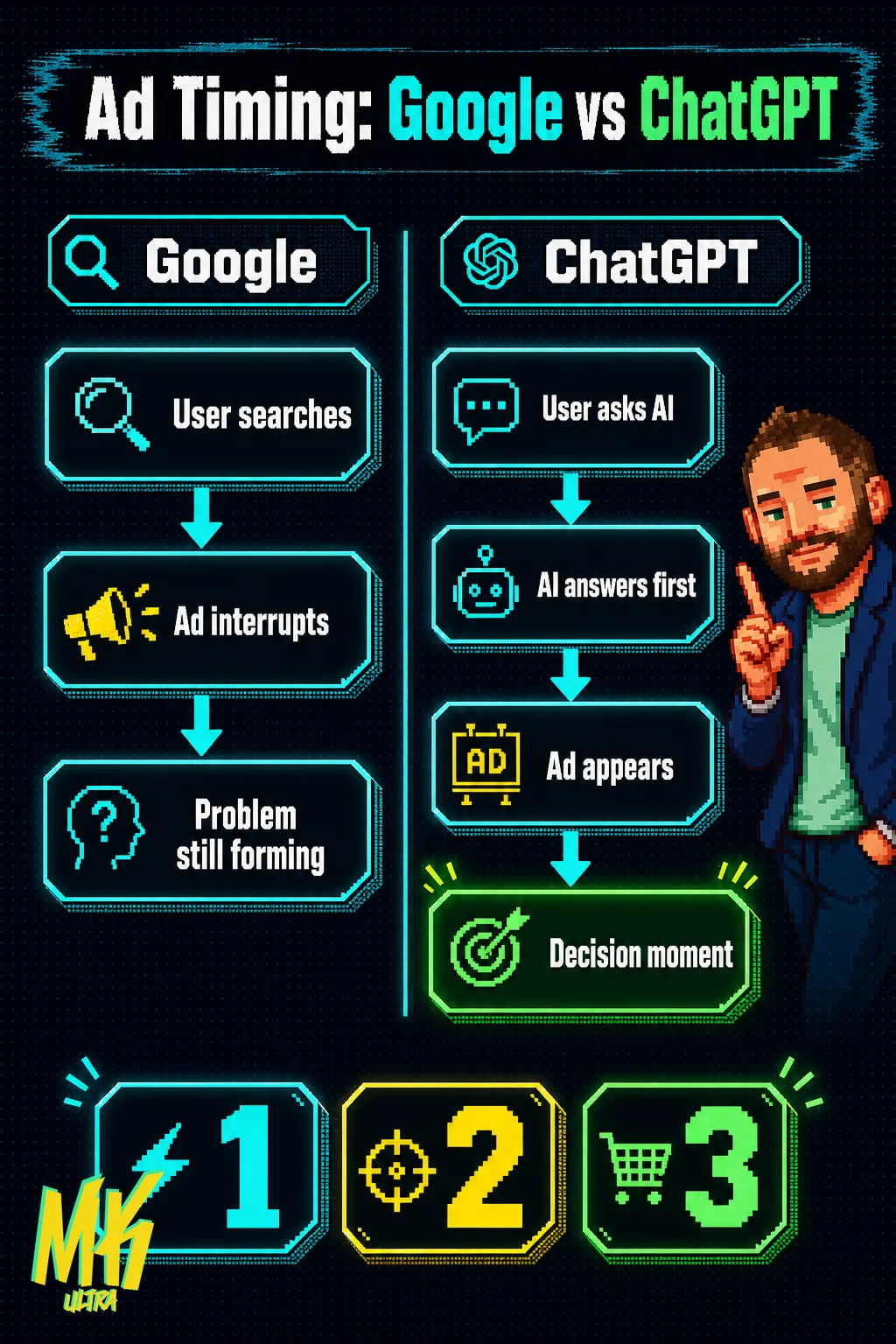
The format is the least of it. What changes EVERYTHING between advertising on ChatGPT versus Google is the moment.
When someone searches on Google, they are in question mode. They need information, they are still framing their problem. When that same user sees your ad on ChatGPT, the AI has ALREADY given them an answer. They are still there because they want to compare options or make a decision.
And you know what that means for paid media?
The purchase intent is in a different league. The user already has the answer, already has the context. You show up when they are closest to pulling out their card.
If the AI answers before the brand does, the discovery phase loses weight. Relevance lives at the decision moment. And right there, ChatGPT has something that Google, for now, cannot replicate.
Sounds great. Almost too great. And when something sounds too good in paid media, that is exactly when you hit the brakes.
What Type of Advertiser Should Test ChatGPT Ads in 2026?
Speaking from an agency perspective, that is where I work.
Not every client should jump in. Not even close. The profile that makes sense RIGHT NOW:
- Ecommerce with a broad catalog and mid-to-high ticket. Product carousels are a natural fit if what you sell answers the kinds of questions people actually ask ChatGPT.
- B2B SaaS with a long decision cycle. If your buyer researches with AI before purchasing, and more of them do every day, being present when they compare options is a no-brainer.
- Brands already investing in search that want to diversify channels without losing their heads.
Who should hold off? Local businesses. Thin-margin ecommerce. Anyone who cannot afford to burn budget on a channel with no performance history.
Because that is the elephant in the room.
Measuring Without Benchmarks: The Three Metrics That Matter
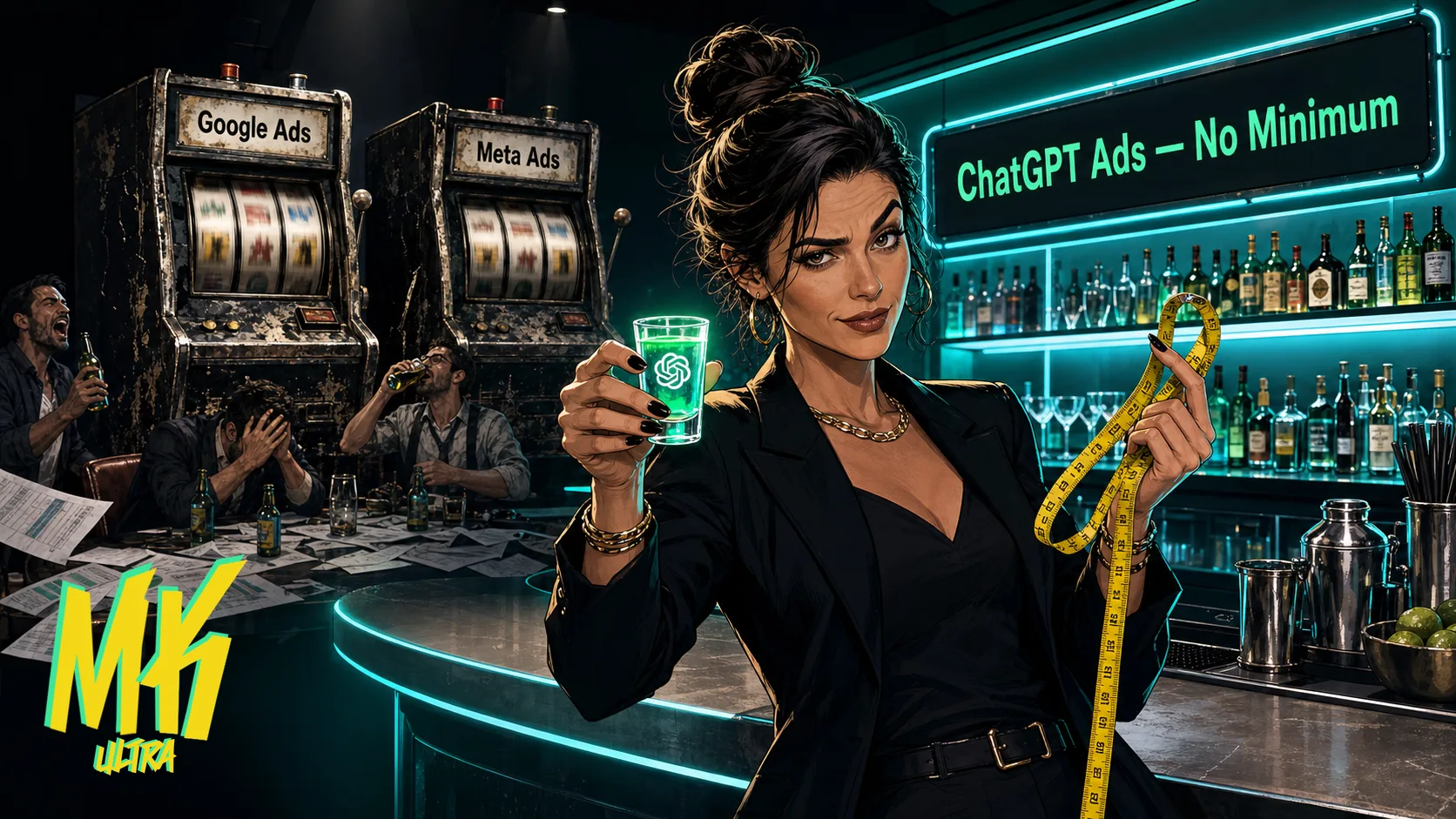
There are no industry benchmarks, no reference CPAs. Zero historical data. You are in the beta of an advertising platform, and that is EXACTLY what it is: an experiment.
What do you measure when you have nothing to compare against? Three things:
1. Conversational engagement. Display CTR is meaningless here. Did the user click AND keep interacting with the conversational banner? That is the signal that counts.
2. Assisted conversion. ChatGPT Ads will most likely function as an assist channel, not a last-click one. If you only look at direct attribution, you will kill the channel before you understand it. In an environment where the data outweighs the click, this is non-negotiable.
3. Incrementality. The only honest metric on a new channel: do my total sales go up when I turn this on? Controlled test, not a pretty dashboard.
And heads up: we have seen this movie before. When Google forced mandatory CPM in Demand Gen for Discover, plenty of advertisers ended up paying more without understanding why. When Meta set Advantage+ as the default, control quietly slipped away.
Platforms launch beta products to drive adoption. Not to protect your ROAS.
I am not saying OpenAI will repeat the pattern. I am saying the pattern exists, and you need to go in with your eyes wide open.
Testing Smart: The Only Play That Makes Sense
My position is clear: 5-10% of your experimentation budget. Not your total budget. Your experimentation budget. If you do not have one, build it before you touch ChatGPT Ads Manager.
Set a campaign with a measurable objective. Define a timeline, minimum 30 days, anything less has no statistical validity. If you have a catalog, use product carousels. If not, the conversational banner with your knowledge base can give you strong signals about how your audience behaves in an AI-native environment.
And document EVERYTHING. Because when industry benchmarks eventually show up, and they will, the advertisers who built their own first-party data will have a real edge. Those who waited will still be exactly where they are: no data, no leverage.
The channel is new. The opportunity is real. Those who go in without measuring will burn money. Those who wait too long will miss the window.
Pick your poison.
Frequently Asked Questions About ChatGPT Ads Manager
What is a conversational banner with a knowledge base?
It is an ad format within ChatGPT Ads Manager that allows the ad to answer user questions in real time using the advertiser's own knowledge base. Unlike a static banner, the user interacts with it like a mini brand chatbot embedded directly inside the ChatGPT conversation.
What is incrementality in digital advertising?
Incrementality measures whether the sales generated by a channel are genuinely new, or whether they would have happened anyway. It is calculated by comparing an exposed group to a control group with no ad exposure. On channels with no history, like ChatGPT Ads Manager, it is the most reliable metric for knowing whether your spend is creating real value or simply redistributing conversions you were already going to get.