Meta just dropped three separate improvement blocks for Teen Accounts across Instagram, Facebook, and Messenger. AI-powered age detection, automatic parental alerts, and content restrictions for users over 13. All wrapped up in the corporate ribbon of "we're protecting your children."
Fair enough. Necessary, even. Nobody's arguing with that.
But let me raise an eyebrow for a moment.

TL;DR, The No-Nonsense Summary
- Three blocks, not one. Meta is rolling out 13+ content settings, AI age detection, and parental alerts. Each feature has its own timeline and geographic rollout.
- EU covered... partially. Age detection and parental alerts are coming to the EU, but the "global" content settings don't explicitly confirm the European Union in the first wave.
- Your campaigns can change without warning. AI will reclassify accounts that lied about their age, which could shrink your young audience on Meta Ads overnight.
- Necessary and profitable aren't mutually exclusive. Verifying ages with AI is also building ad-targeting infrastructure. Meta never does anything for free.
In this article
What Are Meta's Teen Accounts, and What's Changing in 2026
Meta's Teen Accounts are profiles with privacy and content restrictions enabled by default for underage users across Instagram, Facebook, and Messenger. They're not new. But what Meta just announced is: three additional layers that shift the playing field considerably.
Block 1: 13+ content settings. New restrictions on what type of content teenagers can see from age 13. Meta describes the rollout as global, though without explicitly mentioning the EU in the first wave.
Block 2: AI age detection. The AI identifies minors who lied about their age at sign-up and reclassifies their accounts as Teen Accounts. Priority rollout in the EU, Brazil, and India.
Block 3: parental and guardian alerts. Automatic notifications when risky interactions or situations are detected. Also with priority for the EU, Brazil, and India.
And here's the interesting part: each block runs on its own timeline and geographic footprint. A completely asymmetric rollout, and that changes how you should read this.
EU Availability: Three Features, Three Speeds
The full Teen Accounts package for EU markets isn't confirmed across the board. Here's where things stand according to the official announcement:
| Feature | Announced Coverage | EU Coverage |
|---|---|---|
| 13+ content settings | Global (per Meta) | Not explicitly confirmed |
| AI age detection | EU, Brazil, India | Included (first phase) |
| Parental and guardian alerts | EU, Brazil, India | Included (first phase) |
Source: Meta Newsroom, June 2026. Full package availability in EU markets not confirmed.
The EU appears as a priority market for two of the three blocks, which in principle covers all member states. But the 13+ content settings, presented as "global," don't explicitly name the European Union in the first rollout wave.
Worth noting: not being 100% confirmed doesn't mean it won't arrive. But right now, you can't plan your campaigns as if it's already live.
What This Means for Your Meta Ads Campaigns
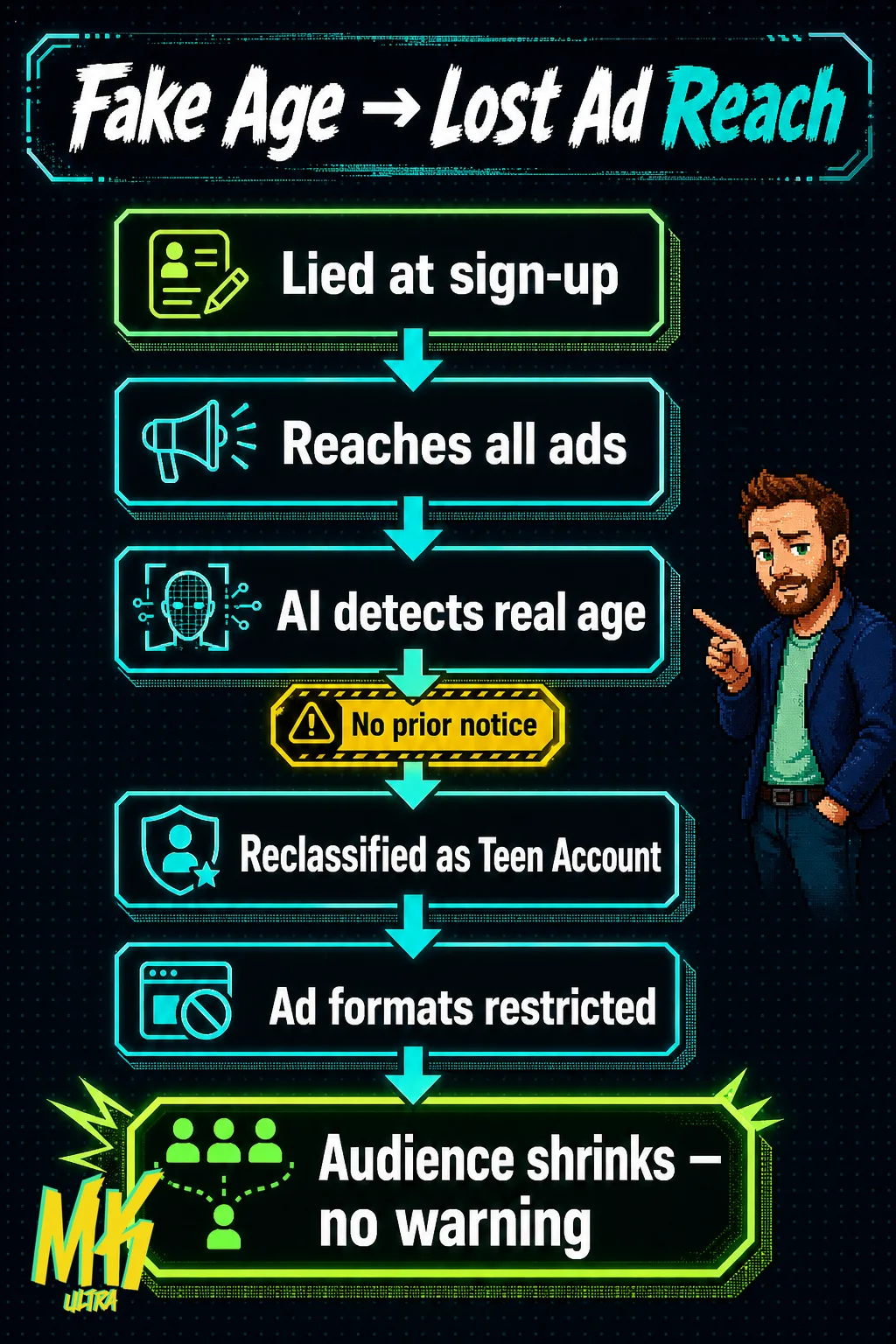
If you're running Meta Ads campaigns that touch the teen audience segment, this affects you. And not in the rosy way the press release suggests.
AI age detection will reclassify accounts. Profiles currently outside the Teen Accounts radar, because they lied at sign-up, will move into protected status. Part of your audience will lose access to certain ad formats and content. And if past experience with Meta tells us anything, it'll happen without prior notice and without so much as a courtesy email.
Those of us who've already watched Advantage+ take liberties with default targeting know the drill: more uncertainty on a platform that doesn't exactly excel at warning you before it makes a move.
Check now what percentage of your Meta audience sits in the 13-17 bracket. If it's significant, start preparing for adjustments in reach and available ad formats. Don't wait for the algorithm to break the news via a performance dip you can't explain.
The Uncomfortable Question: Why Now

Meta has been under regulatory pressure for years over minors' exposure to harmful content. The EU tightening the screws with the Digital Services Act (DSA), the US with state-by-state legislative pushes. And a public that's no longer willing to stomach more scandals involving teenagers on social media.
Is it altruism? Come on.
Every time a platform strengthens child protection, it also builds an age-verification system with ENORMOUS advertising applications. If you can precisely verify who's 14 and who's 18, you can segment with a granularity that simply doesn't exist today. And that gets monetized.
Sure, it's a good thing. But anyone who thinks Meta is doing this purely for the kids has never read a quarterly earnings report in their life. Tick the regulatory box and walk away with a powerful age-segmentation engine for ads in the process. Watch the move closely.
Meta's Teen Account improvements are necessary. Full stop. But don't swallow the corporate storytelling whole. If you have kids, activate the alerts as soon as they roll out. If you manage campaigns, audit the 13-17 bracket today. And Meta, well played.
For the record, we're still watching with the other eyebrow raised.
Frequently Asked Questions About Meta's Teen Accounts
What is the Digital Services Act (DSA) and how does it affect Meta?
The Digital Services Act is the European Union regulation that requires large digital platforms to protect underage users, moderate illegal content, and be transparent about their algorithms. Meta, as a designated platform under the DSA, is legally required to implement specific protection measures for teenagers across the European market.
Do Teen Accounts only affect Instagram, or also Facebook and Messenger?
Teen Accounts apply to all three of Meta's main platforms: Instagram, Facebook, and Messenger. While most media coverage focuses on Instagram, where the teenage user base is most visible, the privacy and content restrictions, and the new parental alerts, extend across all three apps.