Shopify just dropped 150 features at once in its Spring 2026 Edition. One hundred. Fifty. In a single biannual update. And the question nobody seems to be asking is the same old one: does this solve real problems, or is Shopify just planting its flag?

TL;DR, The No-Fluff Summary
- Spring 2026 Edition: Shopify's most ambitious biannual update yet, agentic commerce, a universal protocol, and more AI for merchants and agencies.
- 150+ features: lots of promise on paper, but the real challenge is separating the useful from the roadmap noise.
- Universal Commerce Protocol: Shopify wants to be the invisible plumbing of commerce. If it pulls it off, the rules change for developers and agencies alike.
- EU availability: Shopify says "global," but the official source makes no explicit mention of the EU or EEA. No one has confirmed it for EU-based accounts.
In this article
- What the Shopify Spring 2026 Edition Actually Brings
- Agentic Commerce: When AI Buys, Sells, and You Just Watch
- Universal Commerce Protocol: Shopify Wants to Be the Plumbing of Commerce
- Expanded AI Toolkit and New APIs: What This Means for Your Agency
- The Big Asterisk: Availability in the EU and Beyond
- Frequently Asked Questions: Shopify Spring 2026 Edition
What the Shopify Spring 2026 Edition Actually Brings
The Shopify Spring 2026 Edition is the most ambitious biannual update the platform has ever shipped. More than 150 features grouped into four blocks: agentic commerce, Universal Commerce Protocol, an expanded AI toolkit, and new APIs for developers and agencies. All of it, according to the official Shopify changelog, available to all merchants, and we'll come back to that "all" shortly.
Sounds like a revolution. It probably does if you're on Shopify's comms team.
For anyone running an actual store, the exercise is different: separating what solves a problem you have TODAY from roadmap noise dressed up as a feature.
Agentic Commerce: When AI Buys, Sells, and You Just Watch
Agentic commerce is the headline block of this edition: AI agents that act on behalf of the merchant or the buyer to automate purchases, sales, and operational management. No human in the loop.
Sound familiar?
It's the same philosophy Google has been selling for years with automated bidding: "hand it to the algorithm, it knows best." And we all know how that plays out when no one's watching. In Google Ads, data drives more than the click, but only when a human is there to interpret it.
The premise isn't bad. An agent managing inventory based on demand signals makes complete sense. The problem is the usual one: autopilot without expert oversight.
Call it negligence with a good PR team.
My bet: the average merchant will flip these features on, see that "something is happening," and assume everything's working. Until it isn't.
Universal Commerce Protocol: Shopify Wants to Be the Plumbing of Commerce
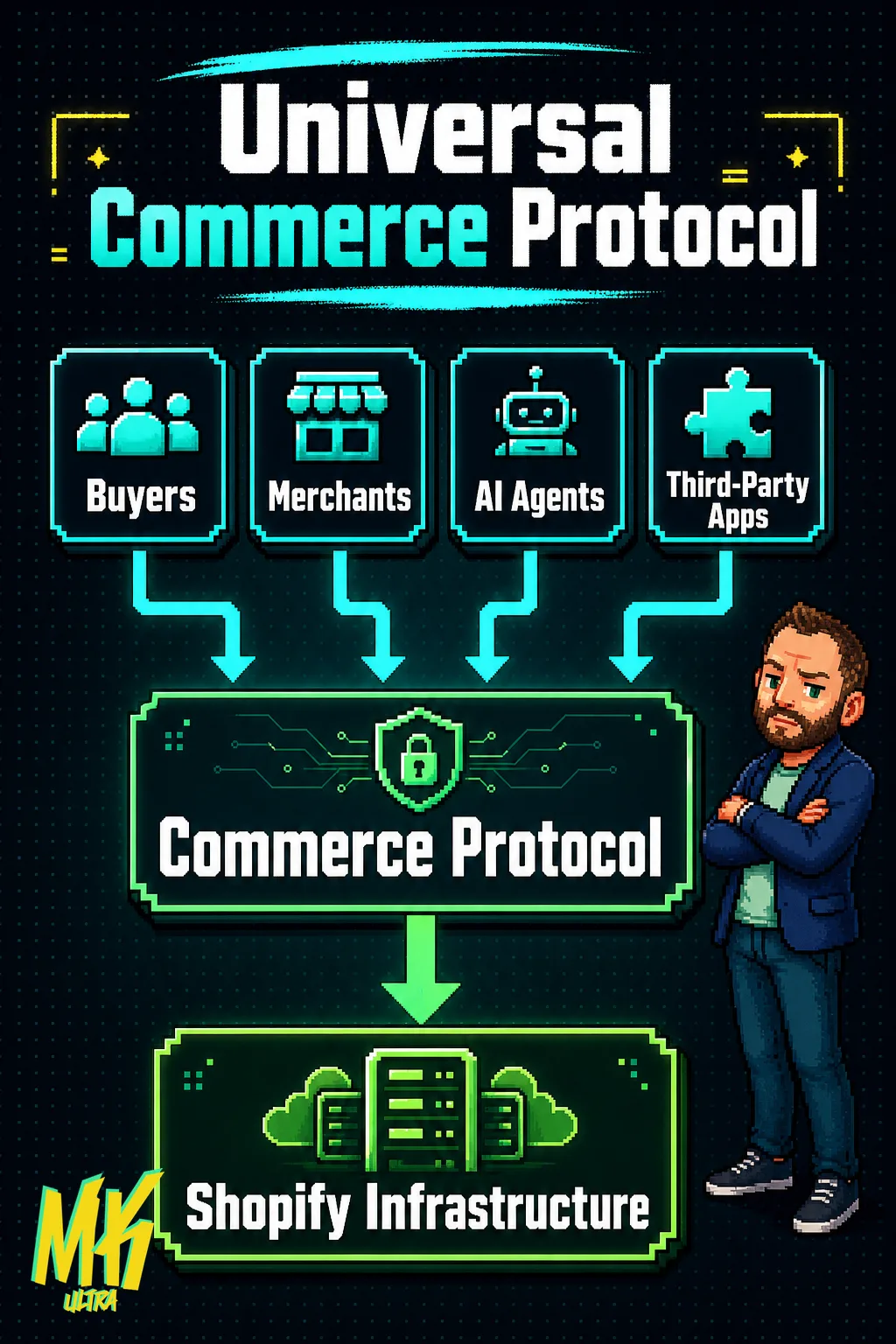
The Universal Commerce Protocol is a standard designed to connect buyers, merchants, and AI agents through a common protocol layer. In plain English: any commerce interaction can run through Shopify's infrastructure. Not just native stores, apps, marketplaces, external AI agents, third-party systems. Everything speaking the same language.
If it works, it's a serious power move.
Think about what Stripe did with payments: it became the invisible plumbing of ecommerce. Shopify wants to do the same thing, one level up. Define the standard that ALL commerce runs on. Transactions are just the foot in the door.
For agencies and developers: if your clients are on Shopify, you'd better get your head around this protocol. What's optional today could easily become mandatory tomorrow.
Expanded AI Toolkit and New APIs: What This Means for Your Agency
What about agencies and developers? Shopify expands its AI toolkit and opens new APIs through its developer platform. The merchant toolkit grows, though the announcement is light on specifics, and developers gain deeper integration points with their stack.
Sounds good. But here's the catch: more APIs don't always mean better.
More integration surface means more failure points and higher maintenance costs. That part doesn't make it into the keynote. If migrating your AI model without breaking your pipeline is already a challenge, adding another layer of complexity isn't free. Before you get excited about the possibilities, calculate the real cost of keeping them running six months from now. The feature ships free. The integration doesn't.
The Big Asterisk: Availability in the EU and Beyond

Shopify declares global availability for all merchants, but the official source makes no explicit mention of the EU or the EEA.
EU and EEA Availability: Unconfirmed
Shopify declares global availability for all merchants, but the official source makes no explicit mention of the EU or the EEA. It is not possible to confirm that these features are active on EU-based accounts until Shopify states so explicitly. Source: official Shopify changelog.
This doesn't mean they're unavailable in your region. It just means no one has confirmed it. And in a regulatory environment like Europe's, GDPR, AI regulation, assuming availability without confirmation is a gamble.
If you manage Shopify stores in the EU, the advice is simple: don't restructure your operations based on an announcement. Wait for Shopify to confirm. Or test it in your own account and report back.
Shopify is doing what platforms do when they want to dominate: ship so much that competitors don't know where to begin. 150 features at once. That move has a name: a statement.
What actually matters: out of those 150 features, how many solve a problem YOU have? If the answer is "not sure," you probably don't need any of them.
Frequently Asked Questions: Shopify Spring 2026 Edition
Are the Spring 2026 Edition features available in the EU?
As of June 2026, Shopify declares global availability but makes no explicit mention of the EU or EEA in its official changelog. Before making any changes, check directly in your Shopify account to see whether the features are active.