Google Ads is making moves again. Quietly, as usual.
Starting August 18, your Enhanced Conversions data will be automatically turned into Customer Match audiences. Google is calling them conversion-based customer lists, and they're switching them on for every account that has both Enhanced Conversions and Customer Match enabled. No request needed. No setup required.
The gut reaction: outrage. My data, my rules.
Mine: good on Google.

TL;DR: The no-nonsense summary
- Automatic lists from your own data: Google will cross-reference your Enhanced Conversions data with Customer Match to build audiences without you lifting a finger. Kicks off August 18.
- Good news for most: Most advertisers underuse Customer Match. Automating a decent baseline beats the current void.
- Check your privacy setup: Your data policies and client agreements need to cover this use case. If you're not sure, find out now.
- Opt-out deadline: You can exit before August 18. After that, processing will have already started.

I think most consultants either don't build their remarketing lists in Google Ads at all, or they build them poorly. It's not mission-critical, but it is fundamental to certain smart bidding strategies, especially when running advanced campaigns. So for once, I don't think this is bad news.
DaniIn this article
What are conversion-based customer lists in Google Ads?
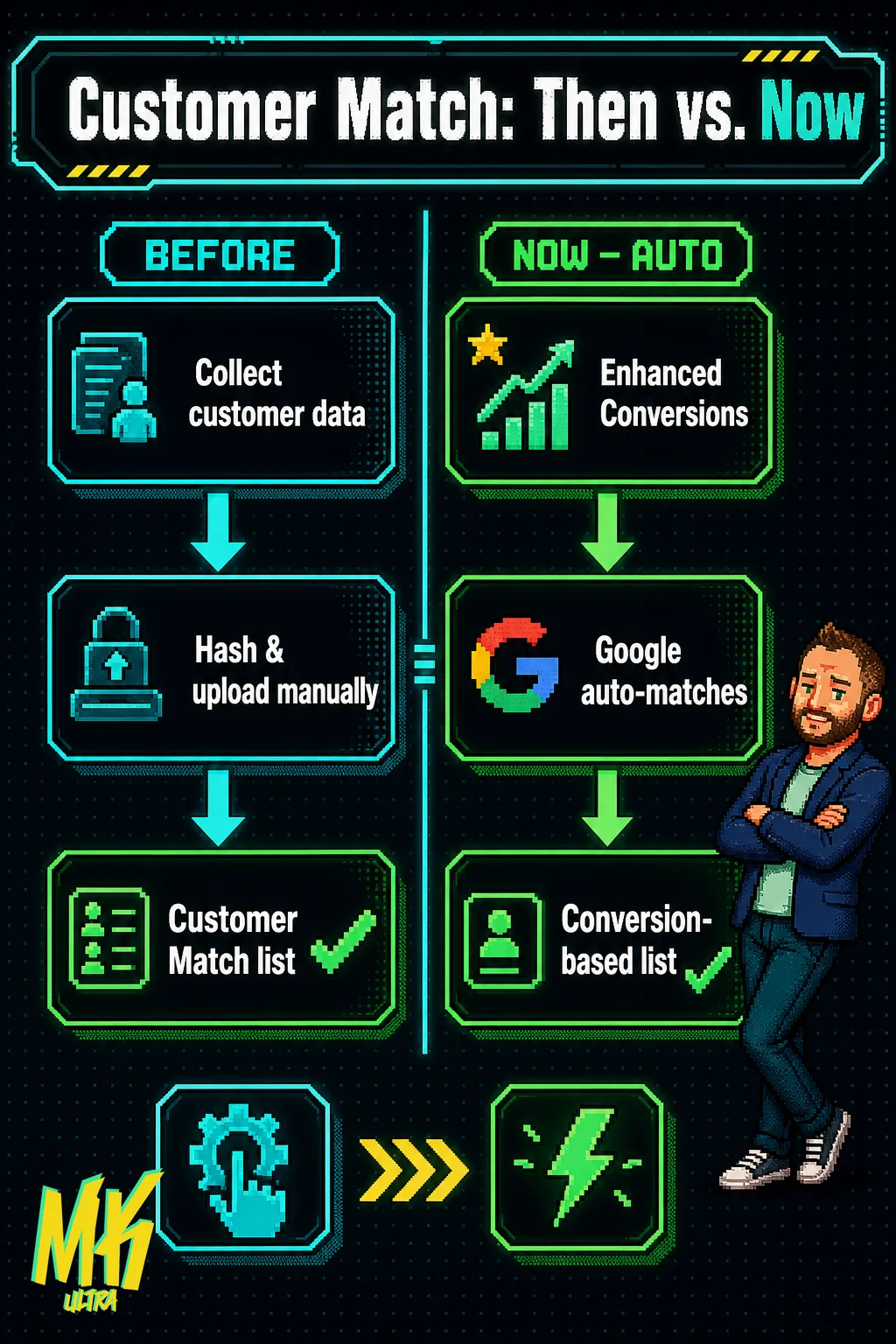
Conversion-based customer lists are audiences Google generates automatically by matching the data you already send with each conversion, via Enhanced Conversions, against its Customer Match system. You don't upload hashed email lists or manually configure segments. Google handles it using the signal you're already feeding it.
The change, first reported by Search Engine Land, affects every account with both features active. That's a massive pool: Google has spent months pushing Enhanced Conversions as the go-to measurement standard. If you listened, you're already in.
The timeline? Automatic activation starts August 18. Do nothing before then, and you're enrolled.
Why this doesn't keep me up at night
Here's the unpopular take.
The vast majority of advertisers are doing audience management in Google Ads badly. They don't upload updated lists. They don't segment by customer value. They don't connect CRM to platform. Customer Match is powerful, but most of the market underuses it, or ignores it entirely.
Automating something that's being done poorly and setting a decent baseline is an improvement. Full stop.
Is it the same as an audience strategy designed by a professional? Not even close. But for the average account running on autopilot with blind faith in automation, and there are plenty of those, anything beats nothing.
With the average Google Ads CPL hovering around $66.69 according to Wordstream's benchmarks, the pressure to improve targeting is very real. If automation lifts targeting quality for those who weren't doing it, the net result is positive. For the advertiser and for Google, which takes its cut. Of course.
We've said it before when looking at how data outweighs the click in Google Ads: the system rewards whoever feeds it the cleanest signal. Conversion-based customer lists are Google saying, "if you're not doing anything with this data, I will."
The nuance you can't ignore

Google is taking first-party data you collected, hashed emails, phone numbers, and using it to build audiences it then sells back to you. Let me state the obvious: that's not a neutral act.
If you're working with clients, check three things before August 18:
- Your privacy policy. Does it explicitly cover using customer data to build advertising audiences on third-party platforms?
- Your data processing agreements. If you manage accounts for others, has the client authorized this specific use?
- Your GDPR compliance. Does the legal basis for Enhanced Conversions extend to creating derived audiences?
If the answer to any of those is "not sure," you have homework to do.
The same thing happened with the CPM billing change in Demand Gen: every time Google automates something, your responsibility to supervise doesn't disappear. That part is still on you.
What to do before August 18
Opting out is possible before the deadline. After that, processing will have already started, and unwinding things always costs more than stopping them in time.
Where? In the Customer Match settings of your account. Google has included the option, though they're not exactly putting it in lights. No surprise there.
Stay in if:
- You're not doing anything with Customer Match right now. Any automation beats a void.
- Your account is already sending Enhanced Conversions data and you want to see whether the automatic audiences move the needle on CPAs.
Opt out if:
- You have a solid manual audience strategy and automatic lists could introduce noise.
- Your privacy agreements don't cover this use.
- You manage accounts in sensitive sectors, healthcare, finance, with additional restrictions on data handling.
And if you're serious about this: stay in, measure, then decide. Data over opinions. Always.
Google isn't doing this for your benefit. It's doing it because it needs more first-party signal to sustain its ad business in a post-cookie world.
But a self-interested motive doesn't invalidate the outcome.
Conversion-based customer lists automate what most advertisers weren't doing. If those of us who do it properly get the option to switch it off, great. For everyone else, welcome to the automation.
Knowing the button exists before someone else pushes it for you. In Google Ads, that's still the one advantage they can't automate away.
Frequently asked questions about conversion-based customer lists
What are Enhanced Conversions in Google Ads?
Enhanced Conversions is a feature that sends hashed first-party data, email address, phone number, postal address, to Google to improve the accuracy of conversion measurement. They're the prerequisite for automatic conversion-based customer lists to be generated. Google has spent months pushing them as the default measurement standard.
Has Customer Match always required manual list uploads?
Until now, yes. Customer Match required advertisers to manually upload customer data lists, emails, phone numbers, or integrate via the API to create audiences. With conversion-based customer lists, Google generates those audiences automatically from Enhanced Conversions data, without the advertiser lifting a finger.