Google has a habit that's becoming something of a tradition: taking away tools that work and replacing them with ones you control less. The latest casualty is called Dynamic Search Ads. And this time, they're not even going to ask.

TL;DR: The no-fluff summary
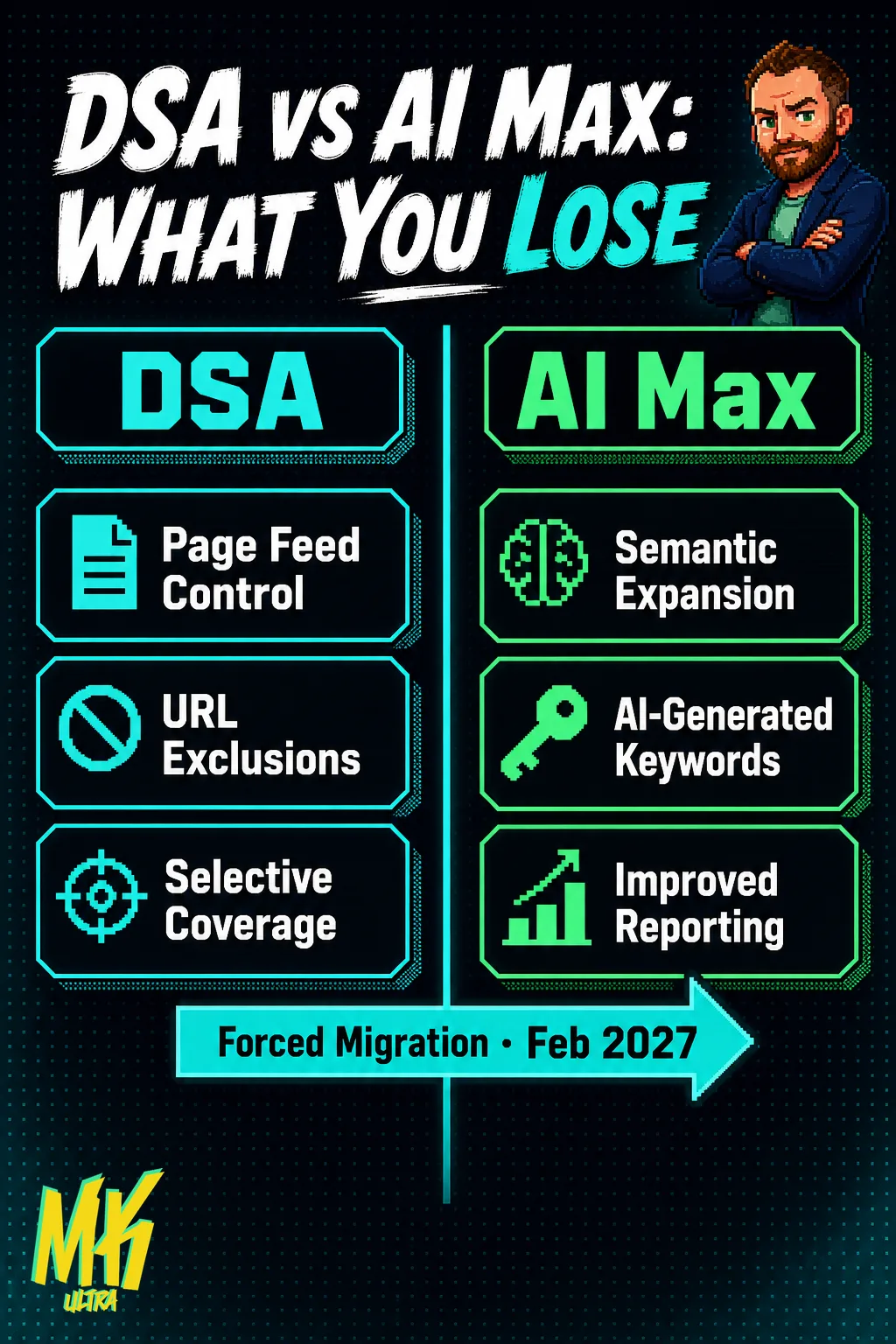
- Forced migration: Google will automatically migrate all DSA campaigns to AI Max starting February 2027. It is not optional.
- More reach, less control: AI Max expands semantic coverage but reduces your ability to decide which pages are advertised and with which exact terms.
- Accounts at risk: large-catalog ecommerce sites and sites with sections that should not be monetized are the most exposed.
- Act now: audit your URL exclusions, test AI Max in parallel, and document your current DSA setup before Google decides for you.
In this article
- DSA Is Gone: Automatic Migration to AI Max Arrives in 2027
- Which Accounts Are Most Vulnerable to the DSA-to-AI Max Migration?
- Does AI Max's New Reporting Make Up for the Loss of Control?
- What to Do Before Your DSA Campaigns Migrate to AI Max
- Mandatory Automation: That's the Real Problem
- Frequently Asked Questions About the DSA to AI Max Migration
DSA Is Gone: Automatic Migration to AI Max Arrives in 2027
Dynamic Search Ads (DSA) is the Google Ads format that crawls your website and generates dynamic ads for long-tail searches, no manual keyword management required. For years it has been the go-to tool for capturing long-tail traffic with reasonable control over which pages appear in your ads and which don't.
Google has confirmed that all DSA campaigns will be automatically migrated to AI Max starting February 2027, as reported by Search Engine Land. Google is not asking. Automatic. Mandatory.
AI Max for Search is Google's bet on automatically expanding your keywords and targeting using generative AI. Sounds good? Of course it does. You put in the budget and Google decides where it goes. That's the catch.
And this isn't happening in isolation. Google is pushing generative AI across its entire advertising ecosystem, from new Gemini-powered YouTube insights to AI Max search coverage. The pattern is familiar: more automation, fewer levers for you.
Which Accounts Are Most Vulnerable to the DSA-to-AI Max Migration?
Not every account is going to feel this the same way. Some profiles should be reviewing their campaigns today, not in January 2027.
Large-catalog ecommerce. If you have thousands of products and sections that should NOT appear in your ads (clearance pages, legal pages, low-margin categories), DSA let you exclude URLs with precision. AI Max expands coverage. And "expanding coverage" when you have pages you never wanted to monetize means one thing: you're going to burn budget where you shouldn't.
Sites with sensitive sections. Corporate blogs, career pages, informational content that doesn't convert. With DSA, you excluded those URLs from your page feed. With AI Max, the expanded semantic coverage can pull traffic to pages you never intended to advertise.
Set-it-and-forget-it accounts. Here's the real problem. If your DSA campaigns were running on autopilot, configured once and left alone, the automatic migration is not going to ask for your permission. And if you're not watching what AI Max does with your account, watch out.
Budget gone. And you won't even know it happened.
Does AI Max's New Reporting Make Up for the Loss of Control?

Google has announced reporting improvements for AI Max alongside this transition. In theory, that means more visibility into which searches trigger your ads and which pages get served.
Is that enough? Not even close.
The problem isn't just knowing what happened after the fact, it's being able to decide what happens before. DSA gave you that control. Page feeds, URL exclusions, targeting by specific categories. AI Max gives you a report and a "trust us."
It's the same old playbook: first they give you a tool with real control, then they automate it, then they remove the manual option. It happened with match types. It happened with the death of ETAs. The automatic Customer Match move happened just recently. Now it's DSA's turn.
And there's something notably underhanded about the way this rolls out. For the serious account manager who looks after their campaigns, this won't break anything, review, adjust, move on. But for whoever has been running accounts on blind faith in automation, this could land a very expensive hit.
What to Do Before Your DSA Campaigns Migrate to AI Max
If you have active DSA campaigns, don't wait for Google to migrate them on your behalf.
- Audit your URL exclusions. Document which pages you're currently excluding in DSA. You'll need to replicate those exclusions in AI Max, if it even allows the same level of granularity.
- Review your page feed. If you're using page feeds to control which URLs are advertised, check how that translates to AI Max. The "expanded" coverage may bypass your current restrictions.
- Test AI Max in parallel. Don't wait for the forced migration. Set up a test campaign now with a limited budget and compare performance over several weeks. Your own account data is worth more than Google's promises.
- Monitor the reporting. Use the improved reporting tools to understand what AI Max is doing with your ads. If the reports don't give you the visibility you need, you already have your answer.
Mandatory Automation: That's the Real Problem
AI Max can work. Expanded semantic coverage performs well in accounts with a solid structure and a well-defined AI strategy.
But the FORCED migration, with no alternative, that says a lot. Google wants your trust. You should verify.
If you manage accounts with large catalogs, sensitive sections, or tight budgets, now is the time to prepare for the transition. Not in February 2027. Now. Because when Google automatically migrates your campaigns, anyone who hasn't done their homework is going to burn through budget without even realizing it.
And I'd wager there are people at Google rubbing their hands together, again.
Frequently Asked Questions About the DSA to AI Max Migration
What is a page feed in Google Ads?
A page feed is a spreadsheet you upload to Google Ads containing the exact URLs you want to advertise in your DSA campaigns. It lets you control which pages on your site appear as ad destinations, and which don't. With the migration to AI Max, that level of granular control over specific URLs may be significantly reduced.
Can I keep using DSA after February 2027?
No. Google has confirmed that the migration will be automatic and mandatory starting February 2027. Existing DSA campaigns will be converted to AI Max without any action required from the advertiser. Our recommendation: don't wait until the deadline, test AI Max in parallel now to catch any issues specific to your account before Google makes the call for you.