Every few months, someone announces "the ChatGPT killer." Most of the time it is smoke, a polished paper and a demo that collapses within three days. But when a 753-billion-parameter model ships under an MIT license, with a one-million-token context window and benchmark results that beat the top proprietary models on public leaderboards... you sit down and pay attention.
GLM-5.2 just landed. And it is not a lab toy.

TL;DR: The no-fluff summary
- GLM-5.2 in two sentences: a 753B-parameter model from Zhipu AI, MIT license, 1M-token context window. Benchmarks above the top proprietary models.
- MIT license = no lock-in: download it, modify it, deploy it on your own server. No per-token bills, no dependency on OpenAI or Anthropic pricing.
- The real barrier: you need a serious technical team or an API provider that already serves it. Without DevOps muscle, this is not for you yet.
- The savings: if your company already spends on ChatGPT Enterprise or Claude Pro, running the cost comparison is worth the 20 minutes it takes.
In this article
What Is GLM-5.2 and Why This Model Matters
GLM-5.2 is a 753-billion-parameter language model developed by Zhipu AI (Z.ai), released in June 2026 under an MIT license. Its context window reaches one million tokens and its results on public benchmarks outperform the top proprietary models currently on the market.
For anyone outside the technical bubble: this plays in the same league as ChatGPT or Claude. With one significant difference: you can download it, modify it, and deploy it without asking anyone's permission or paying a cent per query.
And who is Zhipu AI? A Chinese company that has been building language models for years. They are not new to this. They have scaled with each generation, and with GLM-5.2 they have made a leap you can no longer ignore.
MIT License: What It Actually Means for Your Business
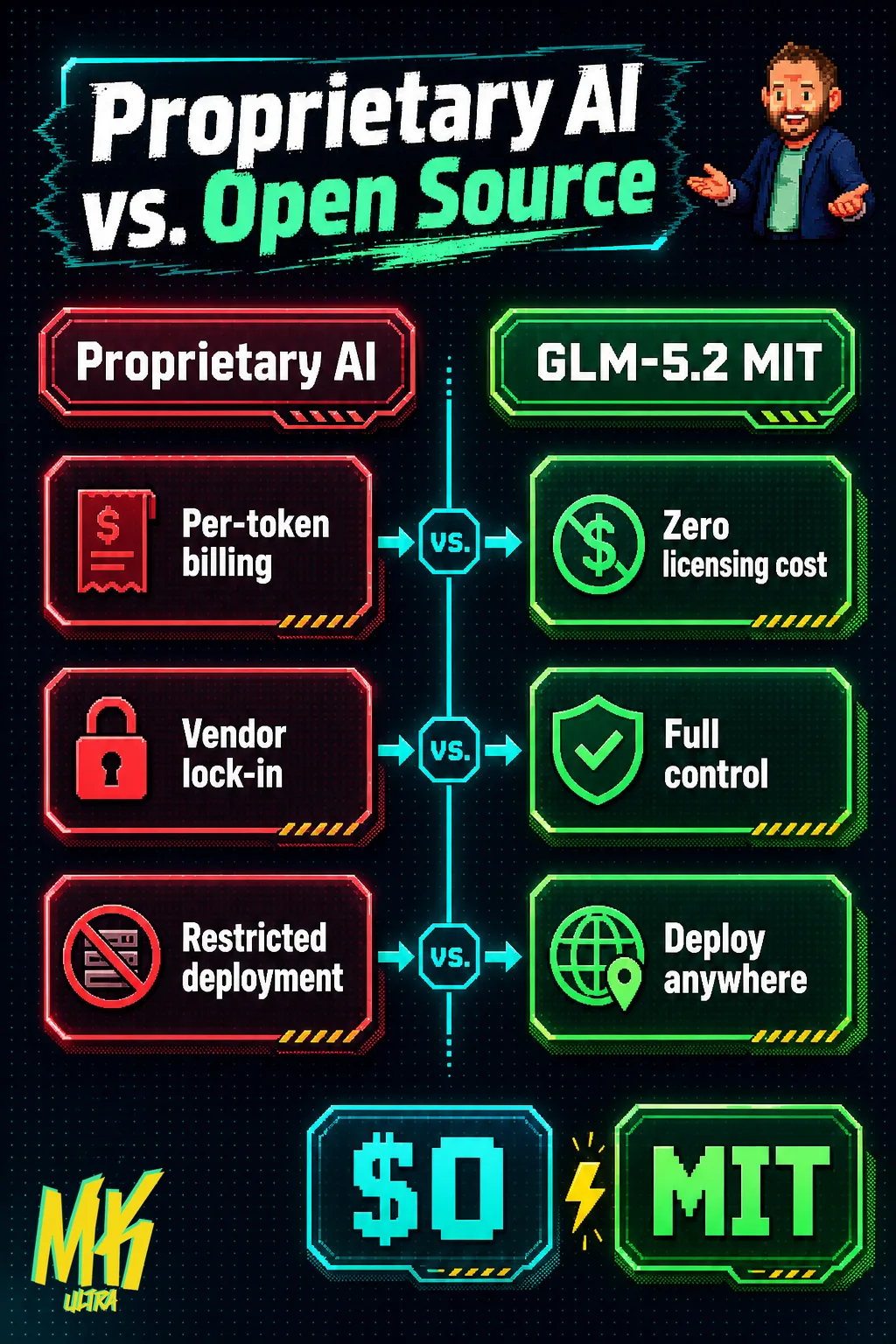
The MIT license is the most permissive software license in existence. In plain English, here is what it means for your business:
Use the model without paying per token. No invoices that scale with usage. Whether you process 10,000 queries or 10 million, the licensing cost is the same: zero.
Modify it without restrictions. Fine-tune it for your industry, train it on your own data. Your model, your rules. No unusual clauses, no permissions to request.
Deploy it wherever you want. On your own server, in your private cloud, in the CTO's rack if there are spare GPUs. No dependency on anyone's API or on OpenAI's or Anthropic's pricing cycles.
And that last point is the big one. Anyone who has lived through a cloud provider pricing change knows what it means to wake up on a Monday to an inflated bill. It is no coincidence that OpenAI has had to launch specific spend controls for Enterprise: costs scale and businesses get nervous. With an open-source model under MIT, that risk disappears. You control the infrastructure, you set the ceiling.
How many companies are paying tens of dollars per user per month for proprietary AI tools? A lot. And that bill only grows.
When Does It Make Sense to Consider GLM-5.2?
Time to get real.
GLM-5.2 makes sense if you have a technical team capable of deploying and maintaining a model of this size. Or if you have access to an API provider that already serves it. And there will be plenty of those, an MIT license attracts providers like moths to a flame.
If your company already spends a significant amount on proprietary AI licenses, the exercise is straightforward: calculate how much you pay per year, estimate the infrastructure cost to serve GLM-5.2 (or the cost via API from an alternative provider), and compare. In many cases, I would bet the savings exceed 50%.
If you already have experience deploying AI without depending on the cloud (for example, running meeting transcription locally), the learning curve will be gentler. And if your concern is migrating between models, the switch does not have to be painful if your architecture is properly set up.
But be honest about one thing. If your technical team consists of "the intern who knows computers," this is not for you. Not yet. Deploying a 753B-parameter model requires serious hardware, multiple high-end GPUs, and infrastructure knowledge that cannot be improvised.
The realistic alternative for most companies: wait for API providers like Together, Fireworks, or similar to offer it as a service. You pay per use, but at prices significantly lower than proprietary alternatives. And you keep the option to migrate to self-hosting when you are ready.
What GLM-5.2 Does Not Solve

An open-source model is not a magic wand. So before you pop the champagne:
Support is community-driven. If something breaks at 3 a.m., there is no support line to call. You have GitHub Issues and the goodwill of the community. For many companies, that is a deal-breaker. For others, it is just another Tuesday.
Benchmarks are not the real world. A model outperforming the best proprietary options on standardized tests does not mean it will do so for your specific use case. You have to test, measure, and compare with your own data before migrating anything.
Privacy has its own cost. Yes, your data stays on your server. But keeping that server secure, updated, and operational is an ongoing job. Someone has to do it. And get paid for it.
Copy this and paste it into Claude Code, Cursor, or your favorite coding assistant:
Find the GLM-5.2 model by Zhipu AI at huggingface.co/THUDM. Download the lightest quantized version, install the dependencies, and run a test with the prompt "Summarize in 3 sentences what my company does" to compare output quality against my current model.
No coding knowledge required. The assistant handles installation, configuration, and testing for you.
Open Source as Leverage, Not Religion
GLM-5.2 is not going to kill ChatGPT or Claude. But it forces them to move.
Until now, using first-tier AI meant accepting the terms and pricing of four providers. Now there is an alternative with comparable results and no lock-in.
Is it for everyone? No. Is it for anyone with the technical muscle or the right contacts to procure it? Absolutely.
Open-source AI has stopped being a lab promise. If your company pays AI bills, you are already overdue to run the numbers.
Frequently Asked Questions About GLM-5.2
What does a one-million-token context window mean?
It is the amount of text the model can process in a single pass: roughly 750,000 words, or the equivalent of several full-length books. In practice, it lets you analyze long documents, entire contracts, or knowledge bases without chunking them. Many proprietary models work with much smaller windows, so 1M is a meaningful leap forward.
Can I use GLM-5.2 without an in-house technical team?
Running it locally, no: a 753B-parameter model requires serious GPU infrastructure. But the MIT license allows API providers such as Together AI, Fireworks, and similar services to offer it on a pay-per-use basis. Once that happens, using it will be as simple as swapping an API key in your application, no hardware changes required.