We deliberately planted a fake headline, complete with an invented statistic, inside our own AI content pipeline.
The editor-in-chief agent caught it, rewrote the headline to something accurate but compelling, and justified every correction. Fully automatic.
But here's the bigger story. Without that agent, the headline would have made it to the blog. Published. Indexed. With a figure that existed in no source anywhere. And not one of the other agents in the pipeline would have said a word.

TL;DR: The no-fluff summary
- Order matters more than headcount: restructuring agents like a real newsroom, editor before SEO, eliminated the defect that was desynchronizing titles and content.
- An editorial gate changes everything: a single agent whose only job is to veto caught a fake headline with an invented stat that every other agent had let through.
- AI fabricates URLs: models generate perfectly formatted links that point to pages that don't exist. Automated validation is non-negotiable.
- Scaling without standards is scaling garbage: more agents don't mean better content if none of them have the authority to stop publication.
In this article
The design flaw everyone is copying
An AI content pipeline is essentially a chain of agents, writer, SEO optimizer, rewriter, humanizer, passing the article down the line until it gets published. The standard logic says the more agents, the better the output. More passes, more "quality."
Wrong.
We audited our pipeline top to bottom and found a flaw so obvious it was embarrassing: the text was being rewritten multiple times after it had been SEO-optimized. The published titles and metadata corresponded to a version of the article that no longer existed. The H1 promised one thing; the body delivered something else.
And you know what's worse? This pattern isn't unique to us. It's the industry standard. Almost every AI content pipeline I've seen operates this way: write first, "optimize" second, rewrite three more times for good measure. Nobody stops to think about agent order.
As it turns out, order matters far more than headcount.
How to structure an AI content pipeline that actually works
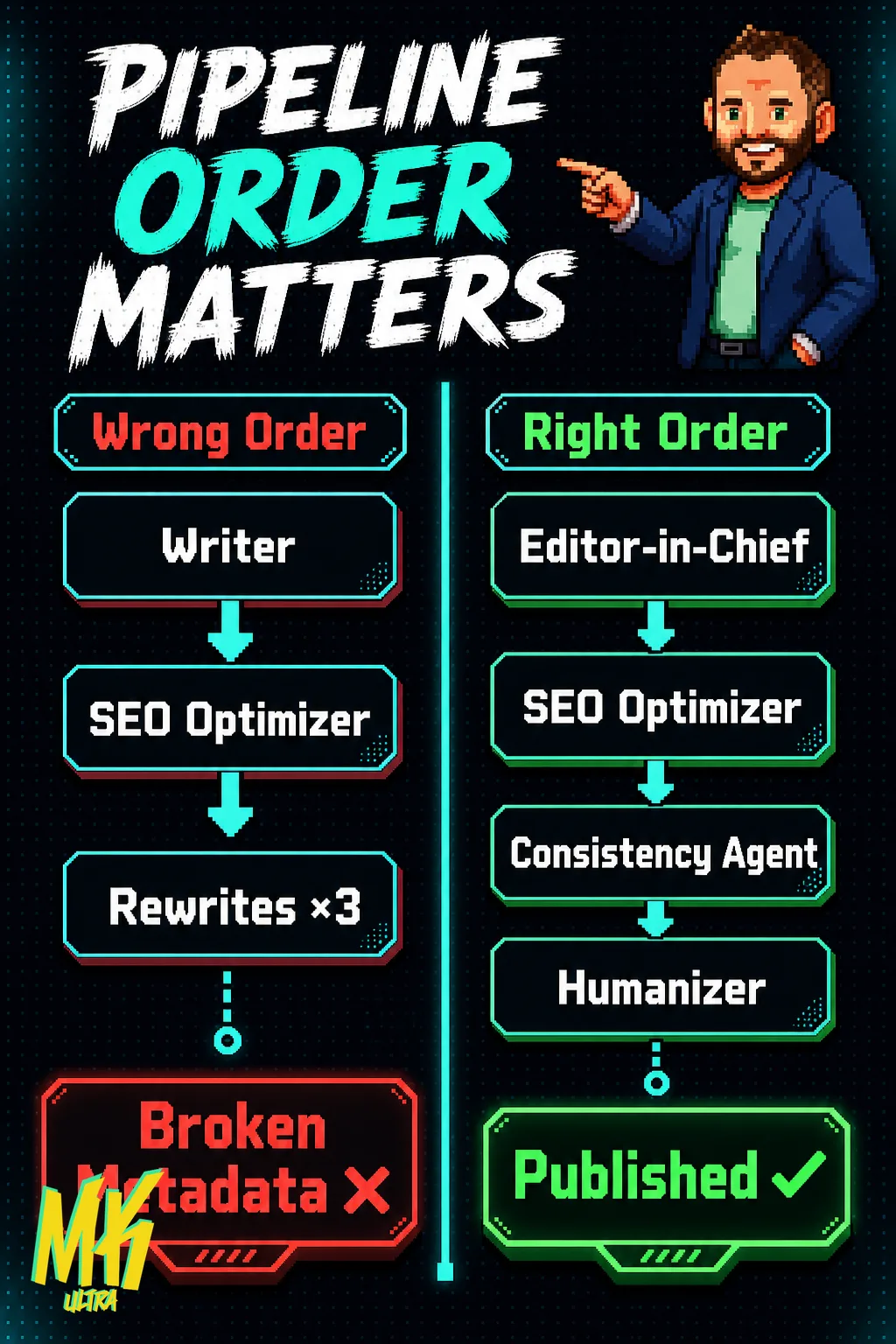
Pipeline performance changes entirely when the agent with editorial judgment reviews the content before the SEO optimizer touches it. Just like a newspaper, where the editor-in-chief signs off before copy editing or layout ever begins.
Anthropic describes this as the "evaluator-optimizer" pattern in their guide to building effective agents: one agent evaluates quality, another executes. The key isn't stacking layers of processing, it's placing evaluation at the right point in the workflow.
We applied that logic and restructured the pipeline like a real newsroom:
- Editor-in-chief: reviews before SEO. The standard is purely journalistic. Is it accurate? Does the headline reflect what the article actually says? Are there claims with no verifiable source? If it doesn't pass, the article doesn't move forward.
- SEO optimizer: enters afterward, working with text that's already been validated. Keywords are applied to correct content, no risk of bending the truth to squeeze in a long-tail phrase.
- Consistency agent: generates title and meta description from the final text. Not from a draft that's going to mutate three more times.
- Humanizer: closes the workflow using the author's real voice as a reference. It replicates an existing voice from the corpus, no guesswork.
Each agent does one thing and does it at the right moment. No circular rewrites. No orphaned metadata. No headlines that promise something the article never delivers.
The stress test: the fake headline that didn't make it through
To verify the system actually worked, we ran the hardest test we could think of: feeding it a headline with an invented statistic. A bold, attention-grabbing figure, exactly the kind any AI writer agent generates without hesitation because it "sounds credible" and "drives clicks."
The result?
The editor-in-chief flagged that the figure appeared in none of the brief's sources. It rewrote the headline to one that was accurate to the actual content but still editorially sharp. And it documented every correction with its rationale: unverifiable data point, headline inconsistent with the article body.
There's no magic here. It's an agent with a well-designed prompt whose sole function is to hunt for inconsistencies between headline, data, and body copy. If something doesn't add up, it stops the line. Full stop.
And that's exactly what any pipeline that wants to publish content worth publishing needs. Google's helpful content guidelines penalize thin, automated content produced without genuine expertise or editorial judgment. Whether AI wrote it is beside the point. An editorial gate with real standards is real oversight, and that's a distinction Google is increasingly capable of making.
AI also fabricates links (and nobody validates them)

AI doesn't just invent statistics. It fabricates URLs too. During the audit, we found a completely fictional link inside one of our articles. Flawless formatting, a real domain, a slug that made perfect sense for the topic. But the page didn't exist.
If you're working with AI agents to generate content, this shouldn't come as a surprise. It's one of the most well-documented failure modes of large language models. What's surprising is that it makes it to production without anyone checking.
The fix was almost embarrassingly simple: an automated validation step that fires an HTTP request at every URL an agent includes in the text. If it doesn't come back with a 200, it's flagged for manual review. Takes seconds. And saves you from publishing articles with links to pages that only exist inside the model's imagination.
It seems so obvious it barely feels worth saying. But it wasn't there. And I'd bet it's missing from most AI content pipelines out there.
The most valuable agent in your pipeline doesn't write, it vetoes
Everyone talks about scaling content with AI. More articles, faster. And yes, you can.
But the bottleneck was never production. It's quality.
You can have 10 agents writing and 5 more optimizing keywords. If none of them have the judgment to say "this doesn't ship," you're scaling noise. And scaling noise faster is still noise. Just more expensive to clean up.
It took us a while to see it. And the fix was almost laughably simple: give a single agent the power to say no. Sometimes the hardest thing to automate is knowing when to stop.
FAQ: AI content pipelines
What is the evaluator-optimizer pattern in AI agents?
It's an architecture where one agent evaluates output quality and another executes the task, documented by Anthropic as one of the key patterns for building effective agent systems. In a content pipeline, it means placing a reviewer agent with editorial judgment before the SEO optimization agent.
Why does AI generate URLs that look real but don't exist?
Language models generate statistically probable text, not verified facts. They can fabricate URLs with correct formatting, real domains, and contextually relevant slugs because those patterns exist in their training data. The way to prevent this in production is to validate every link with an automated HTTP request before publishing.