Google just swept the floor for the second time in six months. And it moved fast: two days to complete the rollout. If your SEO is clean, this is background noise. But if in the last twelve months you've been playing in the gray zone, bulk AI content, bought links, scraping dressed up as curation, the June 2026 Spam Update is your warning shot before the bigger penalty lands.

TL;DR: The No-Fluff Summary
- Second spam update of 2026: Google completed the rollout in just two days (June 24-26), the fastest propagation ever recorded for an update of this type.
- SpamBrain sharpens its aim: the system hunts bulk AI content with no added value, scraped pages, and hollow affiliate content. No new policies, but the existing ones are being enforced harder than ever.
- Search Console is your first stop: check manual actions, performance, and indexing. A sudden drop = likely algorithmic impact. A gradual drop = look elsewhere.
- Reconsideration requests only work for manual actions: if there's no manual penalty in Search Console, filing one won't help. Clean up first, then wait, months, not days.
In this article
What Happened with the June 2026 Spam Update?
The Google June 2026 Spam Update rolled out between June 24 and 26: two days of full propagation, according to Search Engine Land. It's the second spam update of the year, breaking the loose "one per semester" pattern the industry had grown used to.
Under the hood, this is a SpamBrain improvement, Google's AI-powered system for detecting manipulative practices. No new policies were announced alongside this specific update, but the existing ones are now enforced with sharper teeth.
What are they targeting? The usual suspects, with better aim:
- Bulk AI-generated content with no added value. The classic "spin up 500 pages from a single prompt and see what ranks" play.
- Scraped content: pulling from other sites without adding anything that justifies your page's existence.
- Hollow affiliate content: product pages copy-pasting the manufacturer's description with a link slapped on. That's not a review.
- Deceptive redirects and spam in forums or comment sections.
Worth noting: this update did NOT specifically target link spam or site reputation abuse. But that doesn't mean Google has stopped watching for them.
What to Check in Search Console When Traffic Drops Overnight
If your organic traffic fell off a cliff between June 24 and 26, Search Console is your first stop. Not X. Not the SEO forums. Search Console.
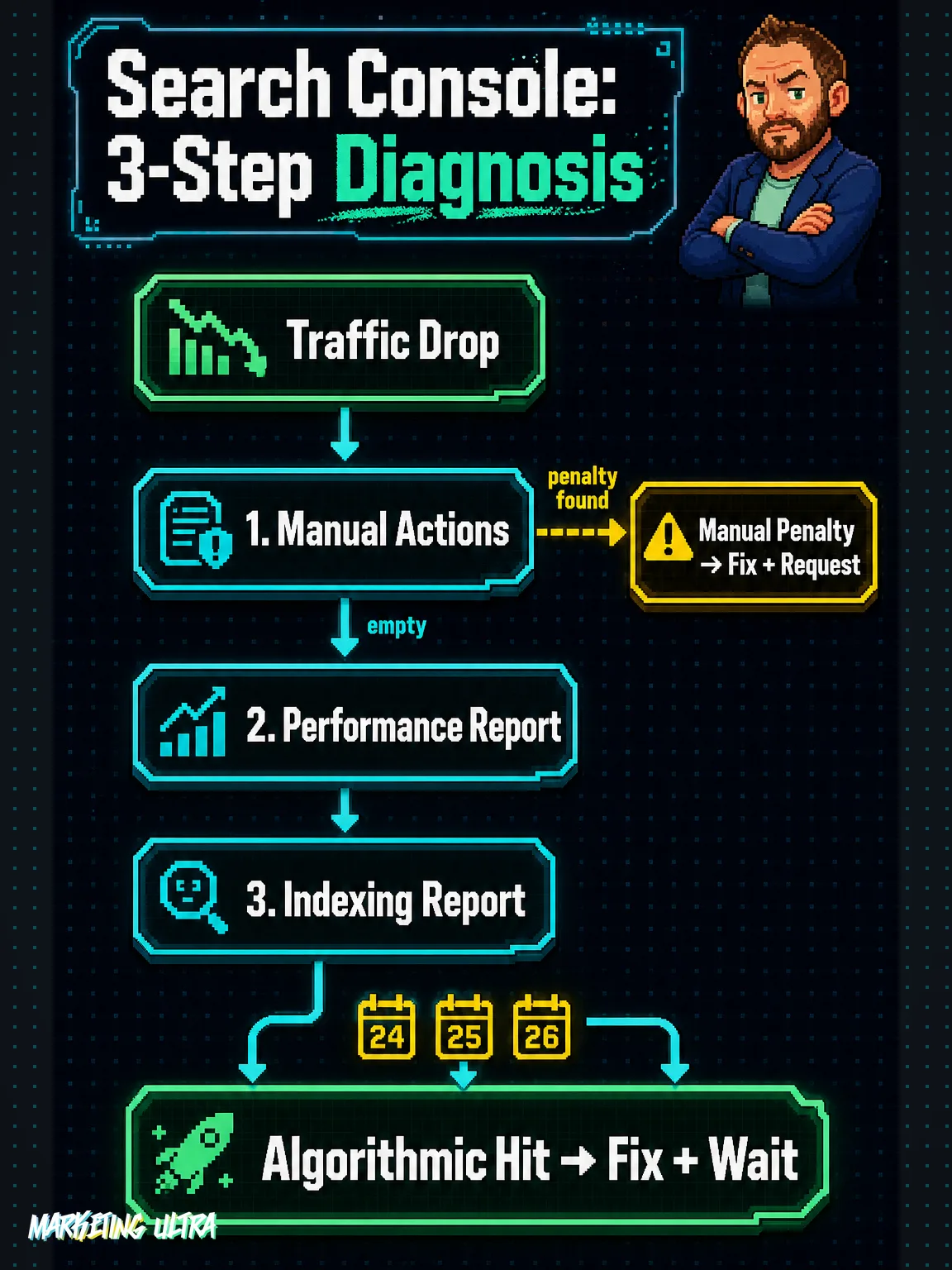
Three places, in this order:
1. Manual Actions. If there's a notification there, the problem is clear and you have a defined path: clean up and file a reconsideration request. If it's empty, breathe, you don't have a manual penalty.
2. Performance Report. Compare June 24-30 against the two preceding weeks. Look for drops in impressions, clicks, and average position. If the decline is site-wide, the update likely caught you. If only a handful of URLs are down, the issue may be more surgical.
3. Indexing Report. Have pages disappeared from the index? A sudden spike in coverage errors right after a spam update usually means Google has decided those pages don't deserve to be there.
Read the pattern, that's where the real signal lives.
A sharp, site-wide drop coinciding with the rollout dates is the clearest sign of algorithmic impact. That's not normal fluctuation.
A gradual decline usually points somewhere else: technical issues, seasonality, or, increasingly, Google's AI Overviews absorbing clicks that used to be yours. That's not a spam update problem. It's a different problem, and possibly a worse one long-term.
Reconsideration Request or Cleanup: Which One Applies to You
The reconsideration request only works for manual actions. ONLY. If the Manual Actions report in Search Console is empty and you file one anyway, Google will reject it. It's not that it "doesn't work", it's that the mechanism simply doesn't apply to algorithmic penalties.
If your drop is algorithmic, the only path forward is to identify the violations, fix them, and wait. Really wait: we're talking months before Google's systems re-evaluate your site. There's no magic button.
What to fix? Start with low-quality content: remove or substantially improve pages generated in bulk without editorial oversight. Audit your link profile for anything unnatural. And document every change, because if a manual action eventually lands on top, incomplete reconsideration requests get rejected every time.
What This Update Reveals About Where Google Is Headed
Here's where I'll go out on a limb.

Two spam updates in six months. The fastest rollout I can recall for a spam update, two days, compared to the usual one to two weeks. Google is accelerating its cleanup cadence, and that changes the ground rules for anyone operating in gray areas.
My bet: this is a permanent shift in pace. Google needs a clean index for its regular results, sure. But more importantly, it needs clean sources to feed its AI Overviews. If Google's AI answers start citing third-party AI-generated junk, the product loses credibility. The incentive to sweep aggressively has NEVER been higher.
We've been watching it for months: generic content blogs are hemorrhaging organic traffic. It's not a coincidence. Google rewards genuine utility, and high-volume, low-value content is paying the price. If your strategy has been "publish a lot and let something rank," this update should be a wake-up call, not a surprise.
If your SEO is built on useful content, real expertise, and links you've actually earned, these updates are good news, less junk competing against you in the SERPs. But if you've been running bulk generation or inflated link profiles, now is the time to clean up. Not next month. Now. Because Google is no longer sweeping once a year. It's sweeping every quarter. And each pass is more thorough than the last.
Frequently Asked Questions About the Google Spam Update
What is SpamBrain and how does it detect spam?
SpamBrain is the AI system Google uses to catch spam in its search results. It analyzes content patterns, link profiles, and manipulative behaviors automatically. With each spam update, its models are refined to catch techniques that previously flew under the radar.
How long does it take to recover from an algorithmic spam penalty?
Recovery from an algorithmic hit takes three to six months, even after you've fixed everything. Google needs to recrawl your site and reassess its quality using the updated systems. There's no shortcut: reconsideration requests only apply to manual actions, not algorithmic penalties.