Google just added Maps to Demand Gen and is marketing it like it invented a new advertising channel. The announcement landed in the Demand Gen Drop for June 2026, complete with fanfare and bullet points. It sounds compelling. But if you manage accounts with physical locations, you need to separate what this announcement actually changes from what is pure Google spin, because the press release bundles two very different moves, and you should not swallow them whole.

TL;DR: The No-Nonsense Summary
- Maps in Demand Gen: Google Maps is now a selectable channel in Demand Gen, no PMax required. You can run Maps-only campaigns.
- Granular controls: you can now exclude Display, Gmail, or Shorts at the ad group level. This is what actually changes day-to-day.
- Incremental inventory: minimal if you were already running PMax with physical stores. Real if you had no PMax and wanted Maps without the black box.
- The bigger pattern: Google is consolidating all its visual inventory under Demand Gen. Display is already migrating. Maps is next. Sound familiar?
In this article
What Is Google Announcing with Demand Gen and Google Maps?
Google Maps is now a selectable channel within Demand Gen, with no need to activate Performance Max. Until now, if you wanted to run visual ads on Maps you had two options: PMax or Local campaigns. With either one, your control over where and how your ads appeared was minimal. Now you can create Demand Gen campaigns that include Maps, or even run Maps-only campaigns.
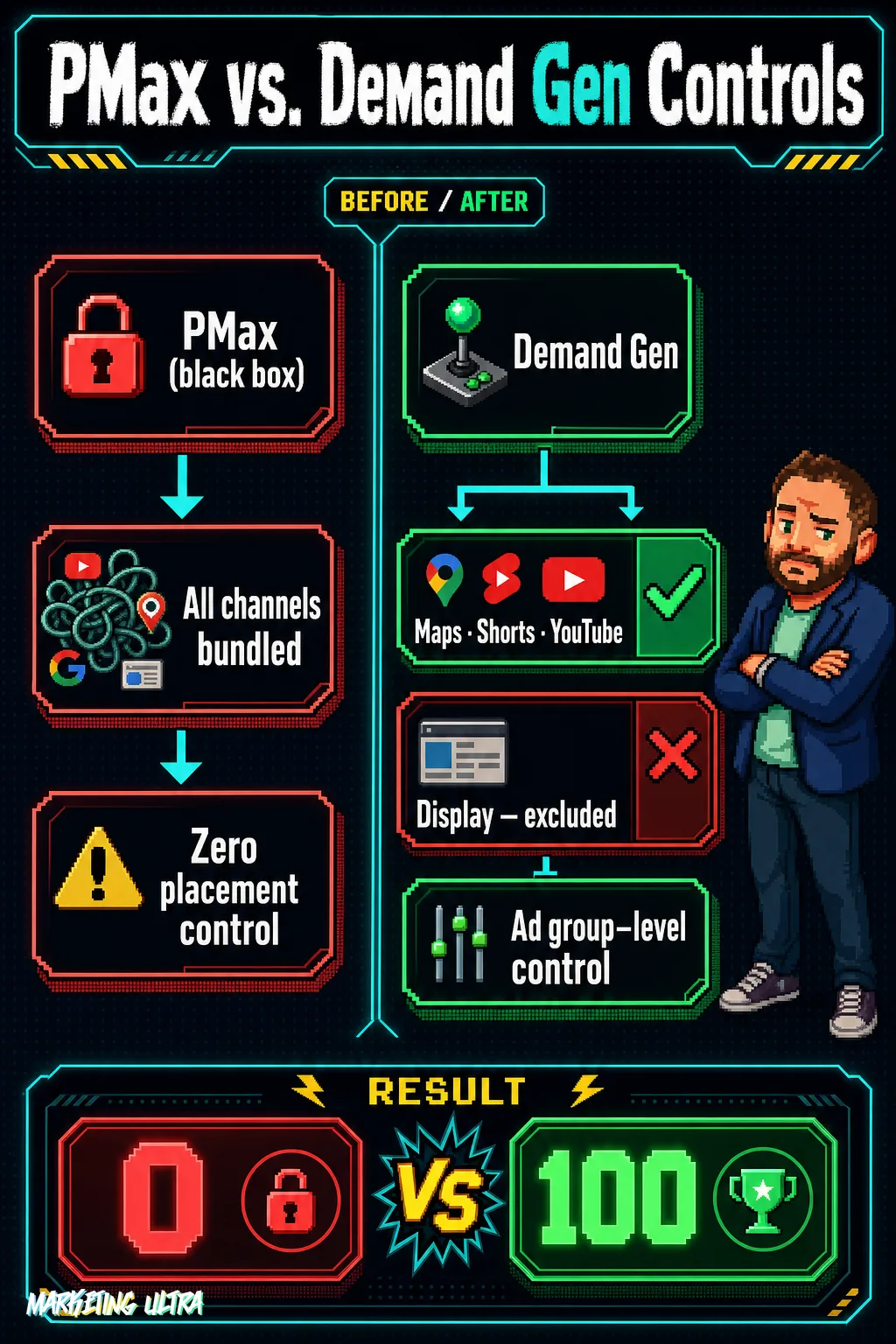
The second move, the one generating far fewer headlines, is granular placement controls. You can now select or exclude specific channels at the ad group level: YouTube In-stream, Shorts, Discover, Gmail, Display, and now Maps. Each one independently.
And you know what happens when Google bundles two announcements into a single press release? The shiny one overshadows the one that actually matters.
Placement Controls vs. New Channel: Two Different Things
Let us take these one at a time.
The placement controls are, without drama, the most useful part of the announcement. Being able to exclude Display or Gmail at the ad group level fixes a problem that has been dragging on for years. How many times have you watched your Demand Gen budget drain into the Display Network with nothing you could do about it? Now you can cut it off. Advertisers have been demanding transparency for months, and Google has had to give ground. A real improvement.
Maps as a channel is a different story. Google frames it as "new inventory," a "location-focused surface." Technically, that is not wrong. But if you were already showing up on Maps through PMax, what exactly are you gaining here?
Control. Not inventory.
The Maps inventory already existed. What did not exist was the ability to isolate it and measure its performance separately. For a hands-on account manager, that has genuine value. For someone running everything on autopilot, it changes nothing, their PMax was already "doing it" (or so Google told them).
Real Incremental Reach or Recycled Inventory?
I will go out on a limb here. I would bet that for most advertisers already running PMax with physical locations, the incremental volume is going to be minimal. Google did not conjure new ad space on Maps overnight. What it did was hand you a new key to the same door.

Where there IS a genuine gain is for advertisers who were using Demand Gen upper-funnel but had no active PMax. That profile, retail or restaurant brands with moderate budgets who did not want the black box of full automation, can now appear on Maps without going through the PMax toll booth. That is new. And it matters.
The nuance nobody is talking about: Google is migrating Display campaigns to Demand Gen starting this very June. All visual inventory is consolidating under one roof. Forget whether Maps is a new channel. What you should be watching is whether Demand Gen is quietly becoming the new PMax with better packaging. Same destination, different marketing.
What Actually Changes in Your Daily Account Management
If you manage accounts with physical locations, three concrete things.
First: you can create ad groups specifically for Maps. Creatives tailored to the local discovery context, someone searching "restaurants near me" while browsing the map. Format matters more here than in other channels, because the user is literally on the move or planning a visit.
Second: you can isolate Maps performance from everything else. Inside PMax, figuring out how much of your conversions came from Maps was an act of faith. Now you have clean data at the ad group level. And clean data drives real decisions, not gut feelings.
Third, and most welcome: you can exclude what is not pulling its weight. If your business is 100% local and Display brings nothing to the table, cut it. If your vertical video performs better on Shorts than In-stream, configure it that way. It sounds basic, but a year ago you could not do this inside Demand Gen.
Something we noted when we analyzed Ask Advisor: Google hands advertisers more control precisely when its campaign AI is so opaque that without it, trust erodes. It does this because it has to, not out of generosity.
Worth noting: TikTok is doing exactly the opposite with its modular Smart+, letting advertisers choose what to automate and what not to, piece by piece, by design. Google is giving you more buttons inside a system that still belongs to Google. That is not the same thing.
My take: what is valuable in this announcement is the placement controls. Maps as a new channel looks good in a press release, but the inventory was already there, if you were running PMax, you know this. If you manage accounts properly, what actually changes your day-to-day is being able to exclude Display once and for all.