Figma just dropped its most aggressive move yet at Config 2026. AI-generated motion graphics, shader tools, and a canvas that breaks free from static design: the prototyping editor you knew no longer exists. Figma wants to be your entire creative studio. And agencies that produce visual content and animated creatives need to pay close attention.

TL;DR: The no-nonsense summary
- Figma is no longer just design: Config 2026 adds AI motion graphics, shaders, and a full canvas to produce final assets without leaving the editor.
- Small agencies, take note: if you don't have a dedicated motion designer, this could free you from After Effects dependency for the bulk of your animations.
- Availability with an asterisk: Figma describes this as global and in GA, but has not explicitly confirmed coverage for the UK, EU, or other markets. Watch this space.
- The hidden risk: every new feature is one less reason to leave Figma. Convenience at the cost of lock-in.
In this article
What Figma announced at Config 2026
At Config 2026, Figma made it clear that static design is no longer enough. The company unveiled three major feature sets that fundamentally reshape the editor's scope (the official Config 2026 recap has the full breakdown).
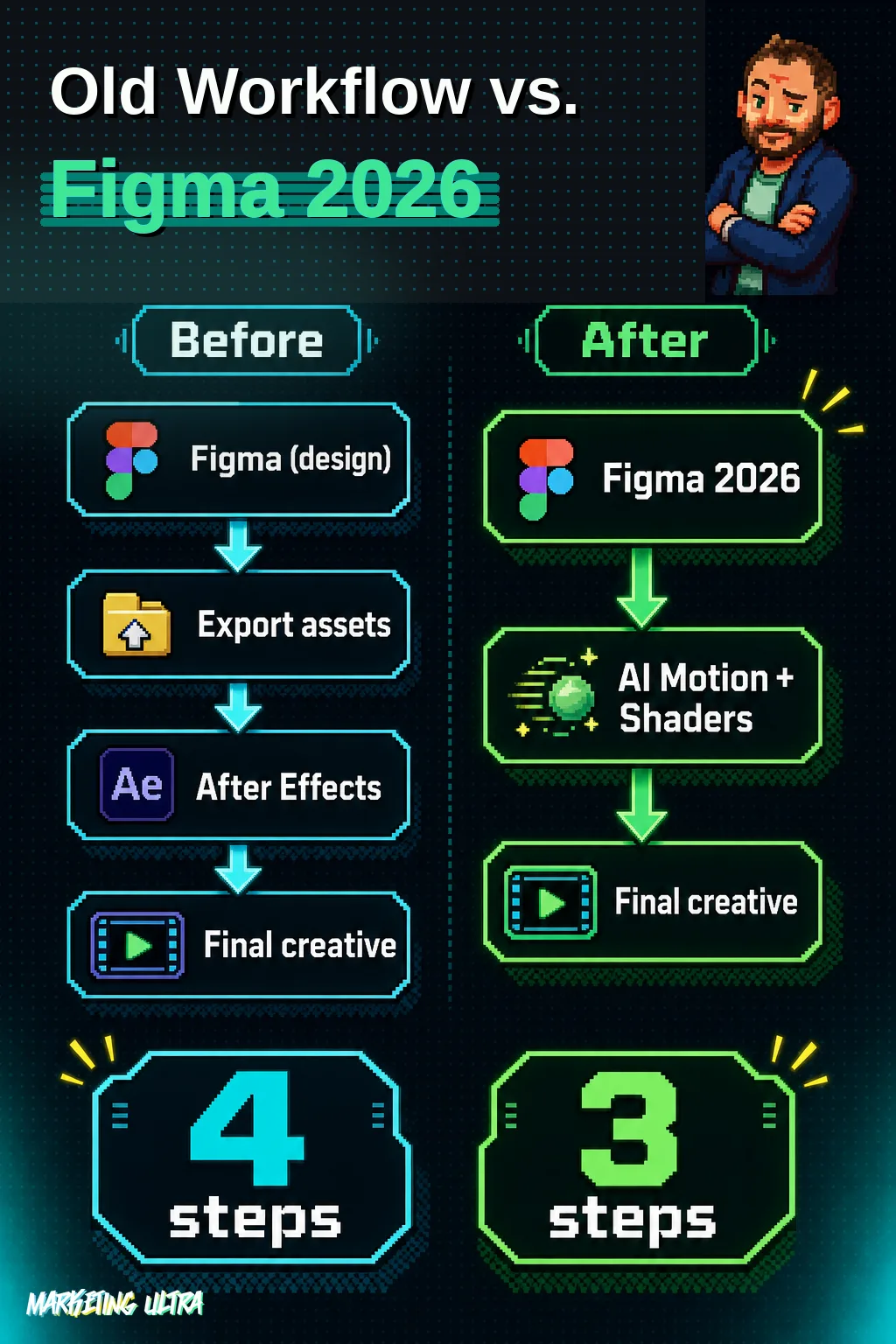
- AI motion graphics: generate animations and moving graphics directly inside Figma, with AI assistance throughout. No exporting. No external tools.
- Shader tools: advanced visual effects, complex gradients, textures, lighting, built natively into the editor, no plugins or third-party software required.
- Full-stack canvas: an expanded workspace that goes beyond prototyping to produce final production-ready assets, not just mockups.
Phase? General availability (GA). Scope? Figma says global. But here's the fine print, more on that below.
AI motion graphics: the designer becomes the director
This is the announcement that's going to make the most noise. And rightfully so.
Until now, the standard workflow in any creative team looked like this: design in Figma, export the assets, hand them off to After Effects (or whatever animation tool you use), and have a motion designer assemble the animated piece. Back-and-forth file transfers, version mismatches, the usual headaches. What Figma wants is to cut that chain entirely, generate animated graphics from inside the editor itself, with AI assisting throughout the process.
And this isn't about churning out basic GIFs. We're talking animated creatives for paid ads, social stories, brand content, all without leaving the editor.
The teams that will feel this most are small and mid-sized agencies without a dedicated motion designer. That 3-to-5-person shop that designs, prototypes, and produces everything in-house: if Figma removes their dependency on external tools for 80% of their animations, they've just reclaimed hours in their day. And in agency life, hours are margin.
Shaders and full canvas: Figma wants to be the whole studio
Shaders are the most technical part of the announcement, and probably the least understood outside the world of 3D design and visual development. At their core, they're small programs that compute visual effects in real time: complex gradients, reflections, distortions, generative textures. Things that normally live inside graphics engines or experimental CSS.
Bringing shaders natively into Figma means a designer can create advanced visual effects without touching code or opening another tool. For brands chasing more sophisticated visual identities, that iridescent gradient you see absolutely everywhere right now, this dramatically simplifies production.
The full canvas pushes in the same direction. Figma no longer wants to be where design starts. It wants to be where design starts and ends. A single environment for design, animation, visual effects, and final asset production. It's the classic platform play: the more you do inside Figma, the fewer reasons you have to leave.
What no one is telling you: lock-in and availability
Now for the flip side.

Figma has been running the same playbook for years: enter as a collaborative design tool, displace Sketch, add prototyping, displace InVision, add developer handoff, and now add animation and effects. Every new layer is one less reason to leave its ecosystem. Convenient, sure. But that convenience carries a cost most teams don't want to look at: lock-in. If your team designs, animates, and produces everything in Figma, migrating gets harder with every project you store there.
We see this pattern constantly in paid media. Google makes it easy, automates the tedious parts, and one day you realize that leaving its ecosystem is a nightmare you can't afford to untangle. I'm not saying Figma's intent is the same. But the outcome looks remarkably similar, and that's worth keeping in mind before you move your entire creative operation into a single editor.
Availability outside the US: Figma describes this launch as global and in GA, but has not explicitly confirmed availability in the UK, the EU, or other markets. It wouldn't be the first time a US tech company's "global" launch reaches international markets months later. Awaiting official clarification from Figma.
Small teams will feel the relief most acutely; larger ones will feel the vertigo of rethinking a workflow that already worked. But let's be clear: Figma gives you more tools, not more talent. And no software update will ever change that.