Google has just put a date on something many of us saw coming: in September, Google AI Max will absorb Dynamic Search Ads, automatically created assets, and broad match at the campaign level. All in one package. If you manage Search accounts with any real volume, especially brand or e-commerce with tight ROAS targets, this affects you directly. This is a scheduled migration, not a suggestion. Make no mistake.
TL;DR: Google is migrating key Search features into AI Max this September. Managers in the beta are reporting ROAS drops of up to 35% on brand campaigns and branded traffic cannibalization. Before it becomes mandatory, use Google's new Performance Max experiments to validate with your own data, it's using Google's own tools against Google's narrative.
In this article
What Is Google AI Max and What Changes in September
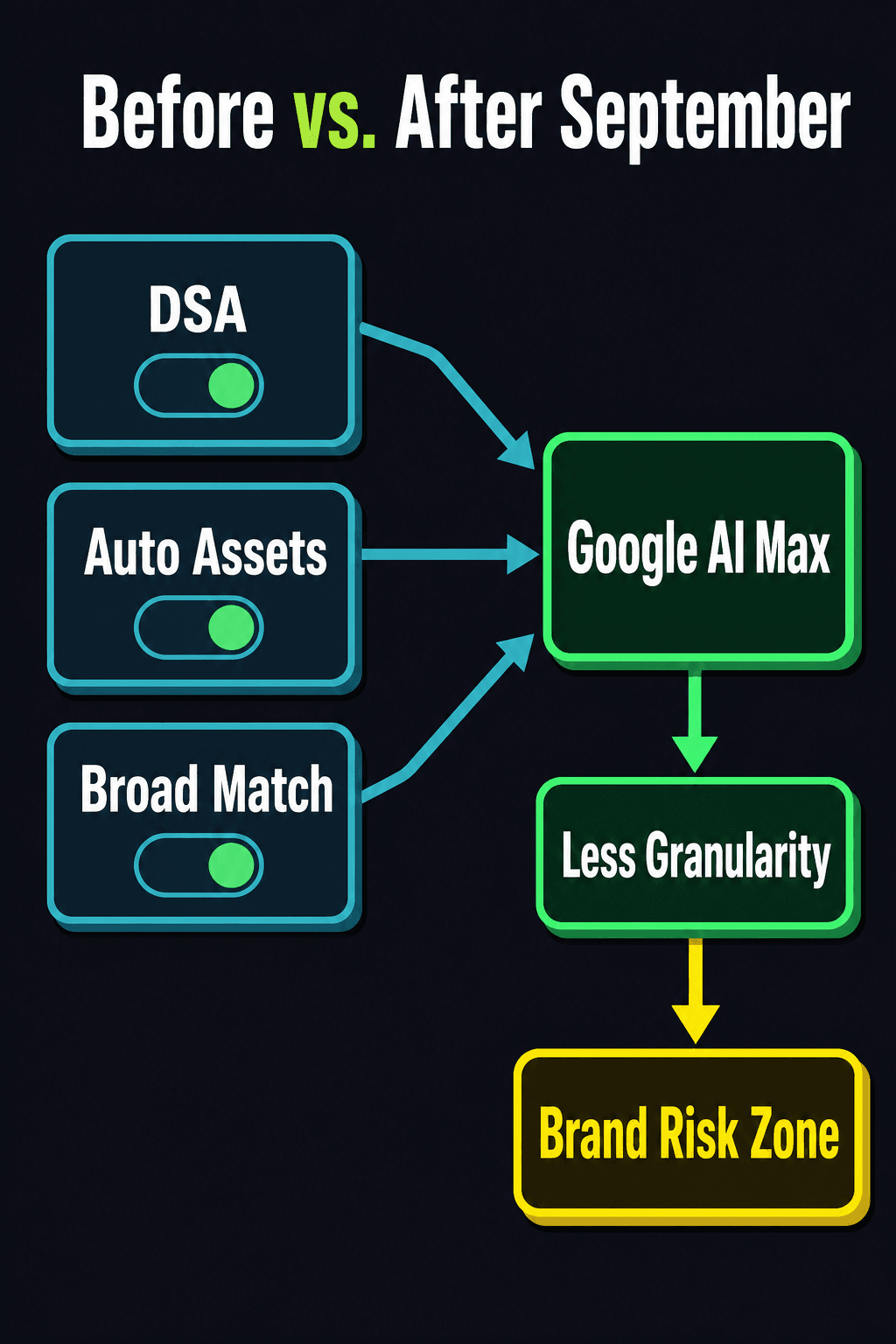
Google AI Max is Google's push to unify all Search automation under one roof. Until now, DSA, auto assets, and broad match worked as separate levers you could toggle, or not, based on your own judgment. Starting September, Google will fold these features into AI Max, reducing individual controls in the process.
In theory, the pitch is clean: more signals, better performance, and you barely have to touch a thing. Google has been pushing this narrative through its official Ads blog for years. And in some contexts it actually holds, prospecting campaigns with volume, rich audience signals, and enough headroom for the algorithm to learn.
The problem is Google applies the same playbook to every scenario. And your brand campaign is not a prospecting campaign with margin to spare.
ROAS, Brand Traffic, and Cannibalization: The Numbers Google Doesn't Highlight
What managers with beta access are reporting is not exactly cause for celebration, and to be clear, these are community PPC reports, not an official Google study:
- ROAS drops of up to 35% on brand campaigns migrated to AI Max, anecdotal figures circulating in forums, not official data, but the pattern shows up consistently across multiple accounts
- Branded traffic cannibalization: AI Max captures conversions that were already yours through organic or direct, artificially inflating its own attribution
- Inconsistent brand controls: the options for protecting your brand within AI Max don't operate with the same granularity as classic Search controls
Automation fails quietly. That's the brutal part. If you don't have solid conversion tracking and an attribution model that separates signal from noise, you'll be looking at pretty numbers in Google's dashboard while bleeding budget in the real world.
This is just business, plain and simple: the more you automate, the more inventory your campaigns consume, the more you spend. Their goal is for you to spend more. Yours is to spend smarter. Guess how often those two align. If you want to understand how automated bidding logic has evolved in this context, the analysis on Smart Bidding's strategic shift in Google Ads is essential reading.
Protect Your Brand Campaigns Before Migrating to AI Max

If you manage brand campaigns, especially if your business depends on a tight ROAS, here's the bottom line: don't activate AI Max on brand without solid conversions and fully audited tracking in place.
That means:
- Real conversion tracking. Not proxies, not inflated micro-conversions designed to make the dashboard look good
- An attribution model that tells you what's incremental and what you would have gotten anyway without spending a cent
- Clean historical data to benchmark against
Without this, you're flying blind. And Google is not going to be the one to flag that something's wrong, because from their dashboard's perspective, everything will look just fine.
Use Google's Own Experiments to Get Ahead Now
Now for the practical side. Google just launched asset experiments in Performance Max, a feature that lets you test changes with real data before scaling. Exactly what you need to arrive at September with numbers in hand, not guesswork.
The play is straightforward: before the migration becomes mandatory, run controlled experiments. Test AI Max on a contained segment of your campaigns. Measure with your own metrics, not Google's. Compare against the control group. And only scale if the data justifies it.
It's using Google's tools against Google itself. They give you the testing ground, use it before they take away the option. If this approach resonates, automating with AI without reviewing each step applies the same logic to a different channel and is worth a read.
Watch the calendar. September seems far off, but if you need to set up experiments, collect statistically meaningful data, and make informed decisions, the time to start is now. Not in August, when half your team is on vacation and the other half is putting out back-to-school fires.
AI Max will get better over time, no doubt. But the issue isn't the tool itself, it's that Google wants you to activate it immediately, across the board, without validating anything first. More inventory consumed, more revenue for them. Same as it ever was.
Whether you're a freelancer or an agency, you are the filter. Test before you migrate, measure with your own numbers, and push back when the data doesn't support the move. The dashboard doesn't get a vote.
Do you already have a plan for September, or are you going to let Google make the call for you?