
You ask your agent for a date picker. It gives you a library, a wrapper, custom styles, and a discussion about time zones. You only needed <input type="date">. Ponytail for Claude Code turns that frustration into a ruleset: before writing code, the agent must check whether it can build nothing, reuse what already exists, or solve the task with a native feature.

TL;DR: The Straight Answer
- What it is: an open skill that applies a YAGNI ladder before the agent writes code.
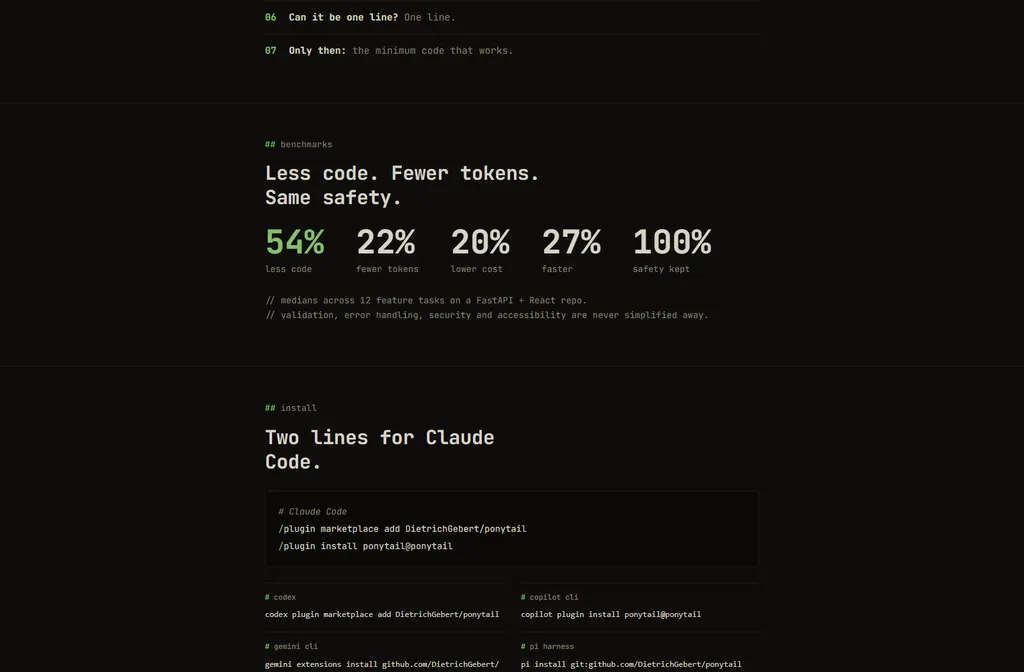
- What it claims: in its benchmark, the median result was 54% less code, 22% fewer tokens, 20% lower cost, and 27% less time while preserving safety checks.
- What convinces me: it puts a concrete rule where "keep it simple" is usually an intention the agent forgets.
- What I do not buy: those percentages are not universal. They change with the model, task, and measurement method.
- The score: 82/100. Very useful as a brake on overengineering; a bad idea as a religion applied to everything.

In my adaptation of these rules for a savings mode, leaving it always on with GPT-5.5 increased reasoning tokens by 39%. That is why I use it on demand and to govern what gets built, not the entire conversation.
DaniIn this article
| Profile | Data |
|---|---|
| Project | DietrichGebert/ponytail |
| License | MIT |
| Reviewed state | Version 4.9.0; 137,254 stars; 7,369 forks; reviewed September 14, 2026 |
| Agents | Claude Code, Codex, Copilot CLI, Gemini CLI, Pi, OpenCode, Cursor, Windsurf, Cline, Kiro, Zed, and others; the project summarizes support as 14+ agents |
| Price | Free and open source |
| Score | 82/100 |
How Ponytail Works in Claude Code
Coding agents have a strange incentive: demonstrate work. Even when the request is small, they have enough context to invent layers, utilities, abstractions, and dependencies. The result may work, but it adds failure surface, maintenance, and review time.
Ponytail inserts a mandatory stop. Its ladder asks, in order, whether the feature needs to exist, whether the repository already solves it, whether the standard library can do it, whether the platform has a native feature, whether an installed dependency is enough, and whether the solution can be one line. Only then does it allow the minimum code that works.
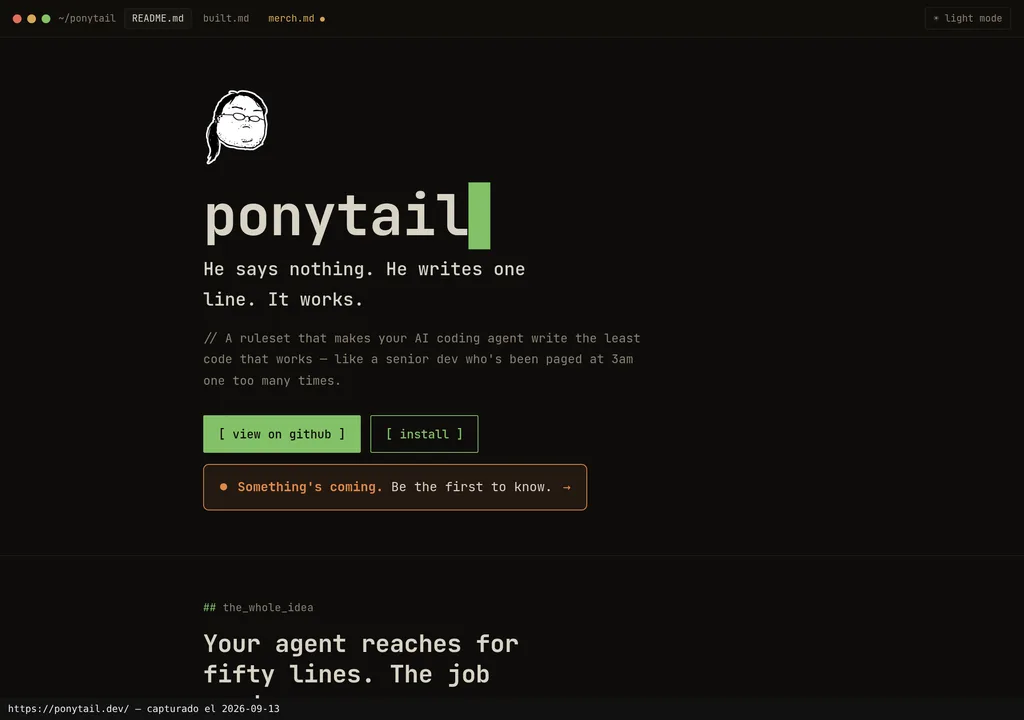
The idea is not new. YAGNI has warned developers for decades not to build what they do not need. What is new is packaging it so the agent sees it in every session, with lite, full, and ultra intensities plus commands for reviewing diffs, auditing repositories, and tracking debt.
How to Install Ponytail in Claude Code
Claude Code takes two marketplace commands:
/plugin marketplace add DietrichGebert/ponytail
/plugin install ponytail@ponytail
You can then keep full as the normal behavior, drop to lite so the skill merely names the shorter alternative, or use ultra when you want it to challenge part of the requirement. Installation differs on other agents, but the core remains a rules file.
This is why Ponytail can work better than appending "keep it simple" to each request. The phrase is not smarter. It is persistent, has a stable place in the workflow, and is backed by review commands.
Using Ponytail in Real Marketing Work
I would not use it to write an ad or landing-page copy. I would use it when an agent touches the machinery behind marketing: forms, analytics events, page generators, connectors, automations, and small internal tools.
Suppose you ask for a date field in a campaign form. Without a brake, the agent may install a full picker, create a component, add styles, and manage state the browser already handles. Ponytail pushes it to check whether the native field covers the actual need. Less code means fewer things to test when the campaign launches tomorrow.
It is also useful during review. /ponytail-review looks for overengineering in the current diff, while /ponytail-audit widens the scan to the repository. Neither replaces technical review. They provide one specific lens: remove complexity that buys no outcome.
Useful video: Better Stack tests Ponytail, explains the YAGNI ladder, and confronts the plugin with the short-prompt critique. It runs 10:07 and includes a practical demonstration. Limit: it is still a creator test, not an independent controlled study.
Ponytail Benchmarks: Code, Tokens, and Cost
The 54% headline needs a surname: it is the median the project publishes across 12 tasks on a FastAPI and React repository. The same table claims 22% fewer tokens, 20% lower cost, 27% faster delivery, and preserved safety across its test suite. These are interesting results, not a physical law for every model and repository.
Scott Logic's Colin Eberhardt pointed to the central problem in the first benchmark: a seven-word YAGNI instruction could come close to Ponytail or even beat it. The project's response was good. Its current agentic benchmark includes YAGNI and YAGNI one-liner controls, runs real Claude Code sessions against a seeded repository, and separates size tasks from safety tasks.
Even so, a minimalism rule can cut too far. The abstraction that looks redundant today may be tomorrow's correct extension point. The answer is not to disable judgment but to choose an intensity and review the solution. Ponytail is a brake, not the steering wheel.
What Users Say About Ponytail
Recent conversation confirms that the problem resonates more strongly than the benchmark's fine print. From August 14 to September 13, the research pass found 66 relevant items: 13 Reddit threads, 18 X posts, 4 YouTube videos, 17 TikTok videos, 4 reels, 2 Hacker News stories, and 8 LinkedIn posts. Reddit returned partial coverage because of rate limiting, so those totals are a floor, not a census.
There are two points of agreement. First, agent overengineering is a real and recognizable pain. Second, much of the amplification repeats the creator's percentages as if they were universal. The useful response is not "install it now" but to test it on your own tasks and compare the diff.
Is Ponytail Worth Installing in Claude Code?
Ponytail earns 82/100. It turns a good intention into persistent behavior, has a memorable personality, and responded to a reasonable critique by improving its benchmark. Its main benefit is not token savings. It makes the agent justify each layer before writing it.
I would install it for teams suffering from inflated diffs, start with lite or full, and measure size, time, cost, and defects on real tasks. If you only want the idea, try a short YAGNI rule first. If you want persistence, modes, and audit commands, Ponytail adds a genuine product layer.
Frequently Asked Questions About Ponytail
Does Ponytail always reduce code by 54%?
No. That figure is the median in the project's benchmark across 12 tasks in a FastAPI and React repository. Your result depends on the model, task, and existing codebase.
Is it only for Claude Code?
No. It has a dedicated Claude Code installation plus adapters or rules for Codex, Copilot CLI, Gemini CLI, Cursor, Windsurf, Cline, Zed, and other agents.
Does it save tokens?
It can reduce output tokens and cost when it prevents unnecessary code. Reasoning models may spend more internal effort. Measure total usage in your own workflow.
Can it make code worse?
Yes, if minimalism removes a necessary abstraction, tests, or safeguards. The project reports preserved safety and accessibility in its benchmark, but your review remains mandatory.
Is it better than writing "follow YAGNI"?
Not always. An independent critique found that a short instruction could match or beat the first benchmark. Ponytail adds persistence, intensity modes, review commands, and repeatable integration.