Remember when Google used to ask before reaching into your wallet? Me neither. But this time they've outdone themselves: starting July 15, if you're running Demand Gen campaigns optimized for view-through conversions on Discover, your billing switches from CPC to CPM. Automatically. Without your signature on anything. And the only way to reverse it is to disable VTCs, which essentially forces you to rework the entire optimization logic of your campaign.
TL;DR: Google is changing the billing model for Demand Gen campaigns with view-through conversions on Discover: from cost-per-click (CPC) to cost-per-thousand impressions (CPM), effective July 15. The change is automatic and silent. If you don't audit your campaigns before that date, you'll be paying per impression without ever having chosen to.
In this article
What Are View-Through Conversions and Why Do They Matter Now
View-through conversions (VTCs) are conversions attributed to an ad the user saw but never clicked. Someone sees your ad on Discover, keeps scrolling, and three days later buys on your website. Google says: "that was thanks to me."
VTCs have always been a debatable attribution model. They make sense for branding, an ad can influence without a click. But they're also the go-to tool for any ad platform looking to inflate results. How do you prove that purchase wouldn't have happened anyway? You can't. And that's exactly the model Google now wants you to pay for on a CPM basis.
According to Google's documentation on VTCs, these conversions are recorded when a user sees a display or video ad and then converts within the attribution window, without having interacted with the ad. The default window is 30 days. If someone glanced at your banner a month ago and buys today, that counts as your conversion.
Demand Gen Switches to CPM on Discover: What Exactly Changes
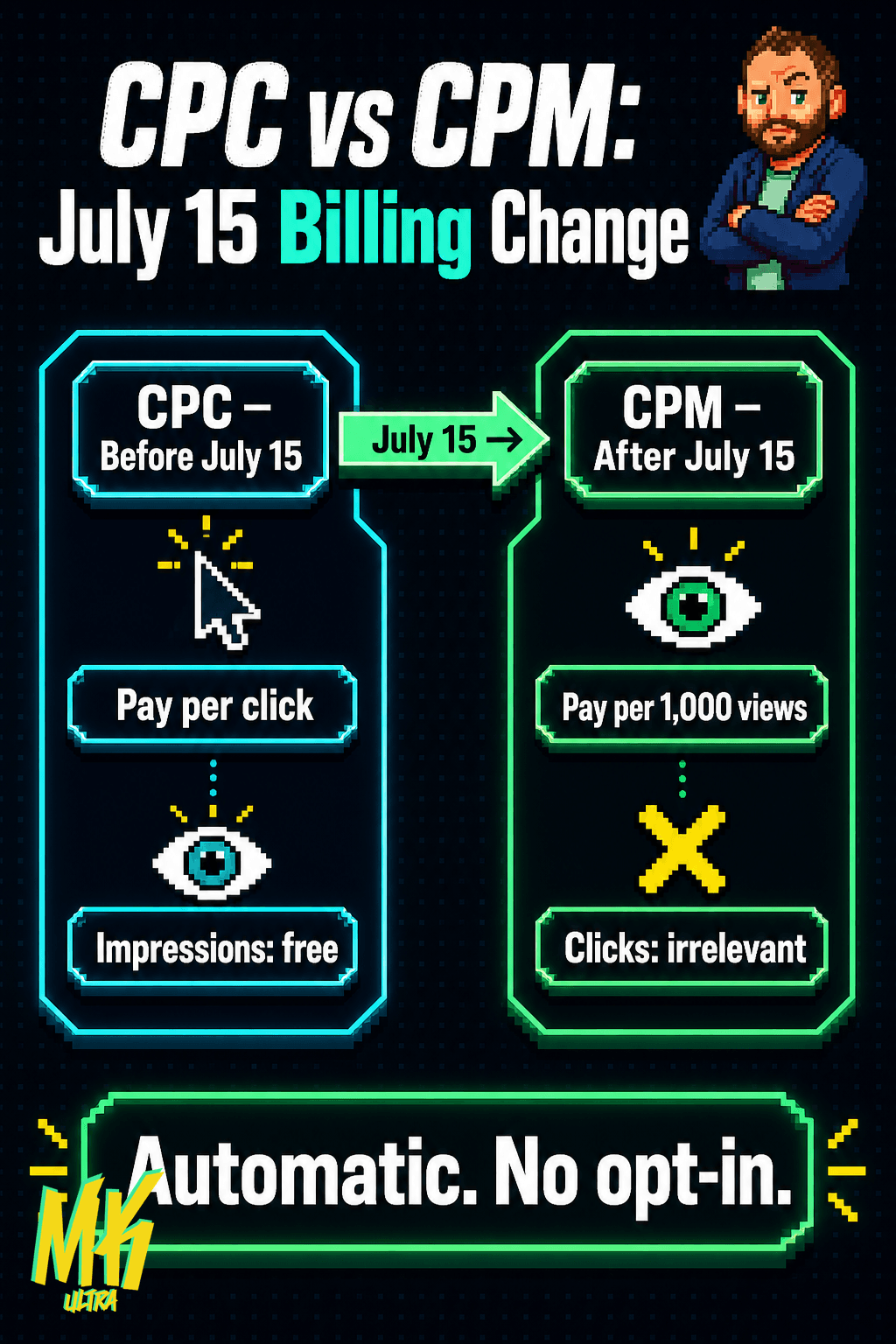
As Search Engine Land reports, Google will automatically change the billing model for Demand Gen campaigns with view-through conversion optimization enabled on Discover. From CPC (cost-per-click) to CPM (cost-per-thousand impressions).
Plain and simple: you used to pay when someone clicked your ad. Starting July 15, you pay when someone sees it. Whether they click or not. Whether they care or not. Whether they're actually engaged or just mindlessly scrolling their Discover feed while waiting for their morning coffee to kick in.
The change is opt-out, not opt-in. Google applies it by default. If you want to keep your CPC, you have to manually disable view-through conversions. But that alters the optimization logic of your entire campaign. It's like being told: "you can choose, but either way, you lose something."
Who Is Affected and How to Prepare Before July 15
This affects any advertiser running active Demand Gen campaigns on Discover with VTCs enabled in their conversion settings. And here's the critical part: VTCs are often enabled by default in Google Ads conversion actions. You could be affected without even knowing it.
To audit your account before July 15:
- Go to Google Ads > Goals > Conversions
- Review each conversion action used by your Demand Gen campaigns
- Check whether view-through conversions are enabled and what attribution window is set
- Decide: does VTC data actually mean anything real for your business model?
If you sell impulse-buy products with short decision cycles, VTCs probably give you nothing reliable. If you're running pure brand awareness with large budgets, it might make sense, but the decision to pay CPM should have been yours, not Google's.
Export a conversion report segmented by type (click-through vs. view-through). If VTCs account for a high percentage of your reported conversions, you need to understand what happens to your metrics if you disable them. If you decide to keep VTCs and accept the CPM model, document your reasoning, when someone asks in September why the numbers changed, you'll want that answer on record.
Google has a track record of forcing changes on active campaigns without asking permission. If you manage accounts with multiple campaign types, it's worth reading how to protect your brand campaigns from Google AI Max changes, the pattern is identical: opt-out modifications that require proactive auditing to stay in control.
Why CPM on Demand Gen Benefits Google, Not Advertisers

CPM benefits the inventory seller. Not the buyer. With CPC, Google only charges when your ad drives a measurable action, a click. With CPM, they charge for showing the ad. Full stop. Every impression that was previously free (because nobody clicked) now generates revenue.
Google frames it as an operational improvement: by pairing VTCs with CPM, the campaign gets more optimization signals. More data, better algorithm. The usual pitch. It sounds compelling in a product announcement. What they're actually doing is monetizing Discover more aggressively.
Google has been running the same playbook for years: pushing toward automated bidding models where advertisers have progressively less control. The Smart Bidding shift in Google Ads follows the same pattern: Performance Max, automated bids, and now this change in Demand Gen. The direction is clear: you put in the budget, Google decides how to spend it.
The billing model is almost beside the point. What's really at stake here is control. Every time Google tells you a change is "to improve your performance," ask the obvious question: whose performance? You have until July 15. What you do with that window is on you.