AI has been eating other people's content for free for years. According to Cloudflare, its crawlers request pages between a hundred and tens of thousands of times for every visitor they send back. That is not an exchange, it is an all-you-can-eat buffet. Cloudflare Monetization Gateway opens a third way: charge per request.

TL;DR: The No-Nonsense Summary
- Cloudflare Monetization Gateway: a new layer that lets you charge for access to pages, APIs, datasets, and MCP tools, for any client, human or AI agent.
- x402 protocol: stablecoin payments (USDC, Open USD) built on the HTTP 402 Payment Required status code. No external gateways, settlement in under a second.
- Granular pricing: from fractions of a cent per web search to $2 per image generation, with a pay-on-success model included.
- Status: waitlist open for Cloudflare customers. Not GA yet.
In this article
What Is Cloudflare Monetization Gateway and Why Now
Cloudflare Monetization Gateway is a monetization layer that lets any site owner behind Cloudflare charge for access to their resources: web pages, datasets, APIs, and MCP tools. Payments settle in stablecoins (USDC and Open USD) via x402, an open protocol developed with more than 25 industry leaders and built on the HTTP 402 Payment Required status code.
The announcement landed on July 1, 2026, and the timing is no coincidence. Cloudflare has already confirmed that on September 15 it will enable AI crawler blocking by default across all sites on its network. First the barrier, now the toll booth. When you already control the gate, putting a cash register next to it was only a matter of time.
The agentic web already reshaping how search works does not consume content the way a human does, it extracts, processes, and rarely comes back. The binary choice of "block or give it away for free" left the most obvious option off the table: putting a price on it.
How the x402 Protocol Works, Step by Step
x402 handles payment within the HTTP request itself, no redirects to external gateways, no intermediate forms. Everything happens in the same flow:
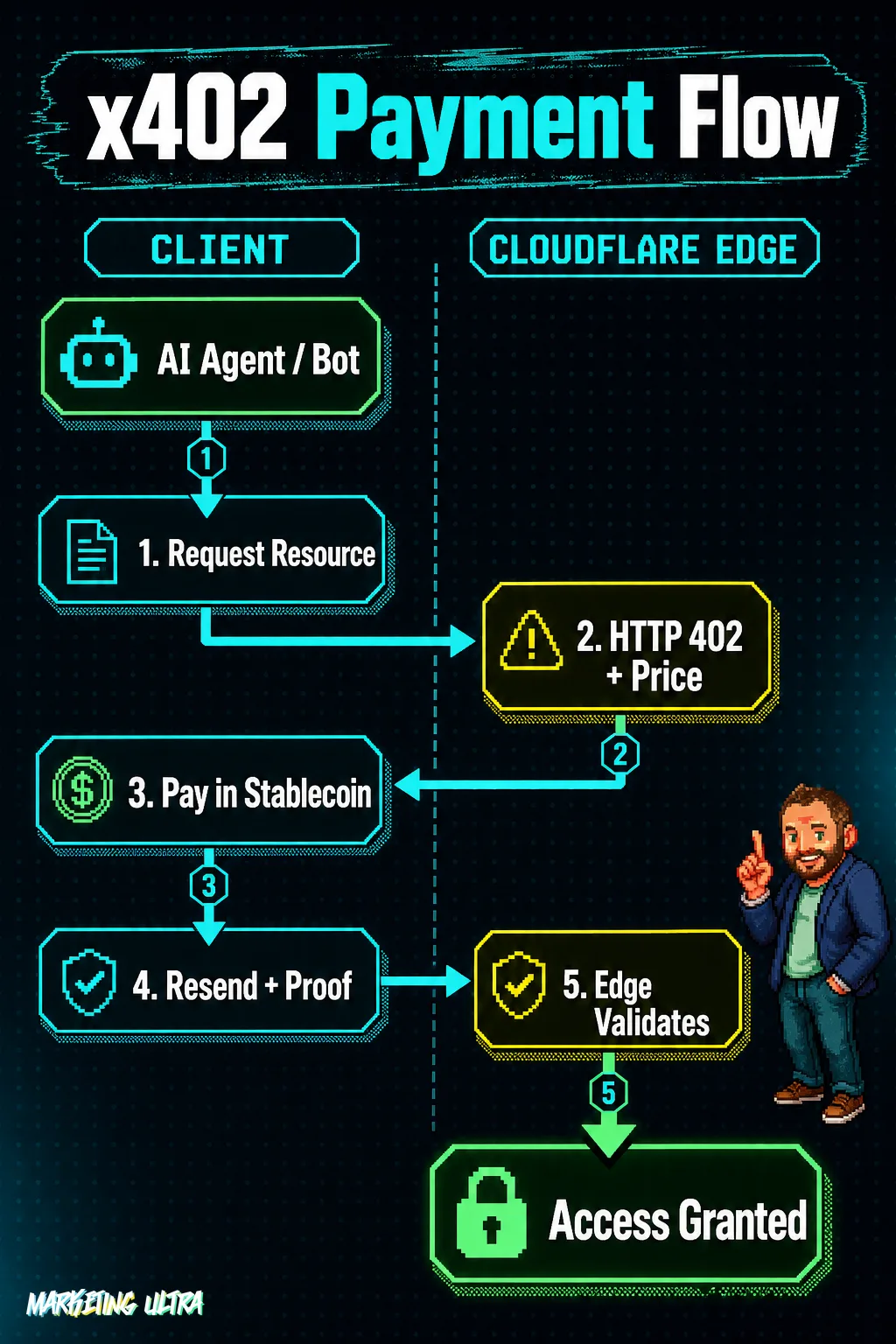
- A client (AI agent, bot, or human) requests a protected resource.
- Cloudflare responds with a 402 and the pricing details.
- The client pays in stablecoin.
- It repeats the request with proof of payment.
- Cloudflare validates the payment at the edge and grants access.
Settlement in under a second with negligible fees, according to Cloudflare. Configuration is managed from their dashboard, the API, or Terraform. The system also supports Web Bot Auth for verified agent identity: you decide not only how much you charge, but who you charge and who you block outright.
The product is on an open waitlist for Cloudflare customers. It is not GA yet, but signing up costs nothing.
Pricing Models: From Fractions of a Cent to Pay-on-Success
The granularity that Cloudflare Monetization Gateway enables is the most significant part of the announcement. No all-or-nothing paywalls. You set prices per resource, per volume, and even per outcome, down to the megabyte. The examples in the official announcement make it concrete:
- A fraction of a cent per web search, billed per call.
- $0.001 base plus $0.01 per MB on an upload endpoint.
- $0.99 for a resolved support escalation, charged only if the work succeeds.
- Image generation with variable pricing up to $2.
- $0.01 per GET or POST request on defined routes.
Pay-on-success is the standout feature: you only get paid if the job gets done. That aligns both parties around actually delivering results, something a classic paywall never considers. You can also intercept 401 responses to require payment from unauthenticated users. In practice: you can monetize content you are currently giving away to bots with zero control.
Who Pays, and What Happens When They Decide Not To?
Here is the part the announcement does not put in bold. Cloudflare Monetization Gateway puts a price on your content. But the one paying is a software agent. And an agent can choose not to pay.

If a crawler sees a 402 and the cost exceeds the value it gets from your page, it will move on to another free source. Or to one that charges less. The internet does not have a shortage of content, it has a shortage of GOOD content. That distinction determines whether the 402 acts as a toll booth or a scarecrow.
If you publish filler or easily replaceable content, the agent will go find the free version. It will not think twice. But the publisher who has data nobody else has, or a tool with genuine value, can charge for every single request. And if you already automate content with AI agents, picture the reverse scenario: those same agents paying to consume yours.
The other open question: stablecoins. In Europe, crypto regulation is a compliance minefield. A publisher in the UK or Germany who wants to collect micropayments in USDC is going to wrestle with tax obligations and regulatory requirements that Cloudflare will not resolve for them. x402 is technically elegant; the regulatory reality is considerably less so.
The underlying vision is an internet where autonomous software carries a wallet and buys resources without asking permission. It sounds like science fiction, but the protocol already exists and the infrastructure spans more than 330 cities. The waitlist is open.
First they let you block. Now they let you charge. Content stops being a public good by default and becomes a resource with a per-unit price. If you have something worth paying for and you know how to measure what AI engines consume on your site, this is the difference between giving your work away and getting paid for it. If you publish filler content, you already know where you stand.
Frequently Asked Questions About Cloudflare Monetization Gateway
What are stablecoins and why are they used for micropayments?
Stablecoins are cryptocurrencies whose value is pegged to a fiat currency, typically the US dollar (USDC and Open USD both maintain a 1:1 parity with USD). They are used in x402 because they enable instant micropayments with minimal fees, something traditional payment gateways cannot handle at the scale of fractions of a cent per request.
What is Web Bot Auth and what role does it play here?
Web Bot Auth is a verified identity system for software agents. In the context of Cloudflare Monetization Gateway, it lets you identify which bot is accessing your resources and decide how to treat it: charge some, block others, and let through the ones you want to allow for free.