Let's start where it stings: if your way of automating content with AI runs through your review at every step, you don't have a production line. You have a bottleneck with your own face stamped on it.
I know because I used to be that bottleneck. And because I got fed up.
The mantra gets repeated at every talk, every webinar, every LinkedIn thread: "AI is great, BUT it needs a human in the loop at every stage." It sounds responsible. It sounds mature. It sounds like someone who knows what they're doing.
And it's exactly what stops you from producing at scale. Let me prove it by walking you through what I built to automate content production with AI from start to finish.
In this article
The Pipeline That Automates AI Content Without Me Touching a Thing
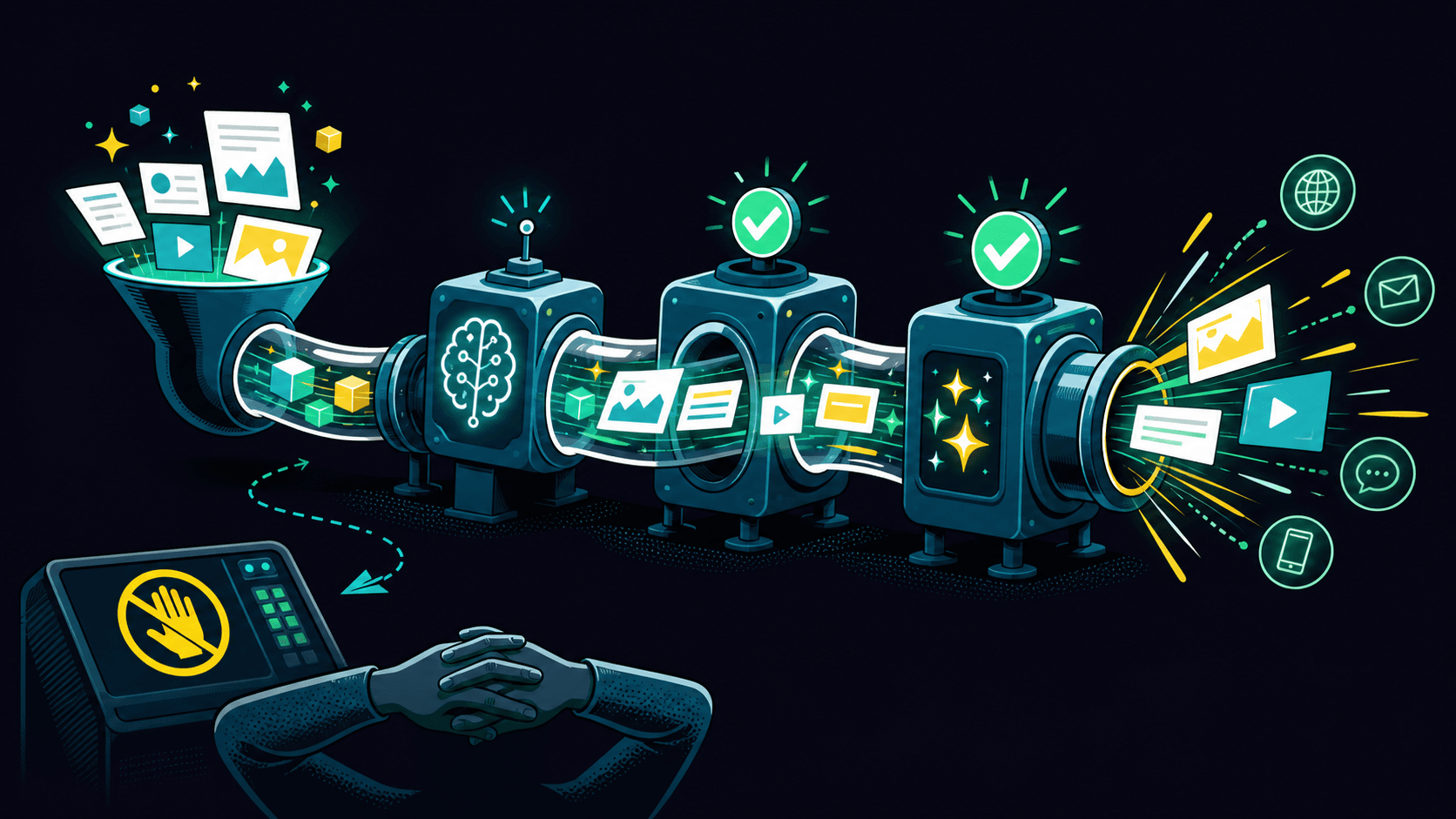
Here's the flow exactly as it stands right now, in production, publishing on its own.
One AI picks the topic. Another writes it. Another optimizes it for SEO. Another strips out that robotic, teleprompter-reading tone. Another reviews it. Another translates it. And it all goes live in Spanish and English without me approving anything.
Read that again: nothing.
This isn't magic or a weekend experiment. It's an assembly line where every link does one job and hands it off to the next. Like a factory. The difference is that in a real factory, nobody stops the belt every two feet so the boss can sign off on a single screw.
And here's the part almost nobody can wrap their head around: I removed the manual approval points on purpose. Not out of laziness. Out of strategy. Because this only scales once you stop being the final link. If you want to size up the challenge, look at the adoption pace laid out in McKinsey's State of AI report.
Quality Control That Doesn't Depend on Your Mood
The objection comes fast, and it's a fair one: "Sure, Dani, but if nobody reviews it you'll churn out one robotic mess after another."
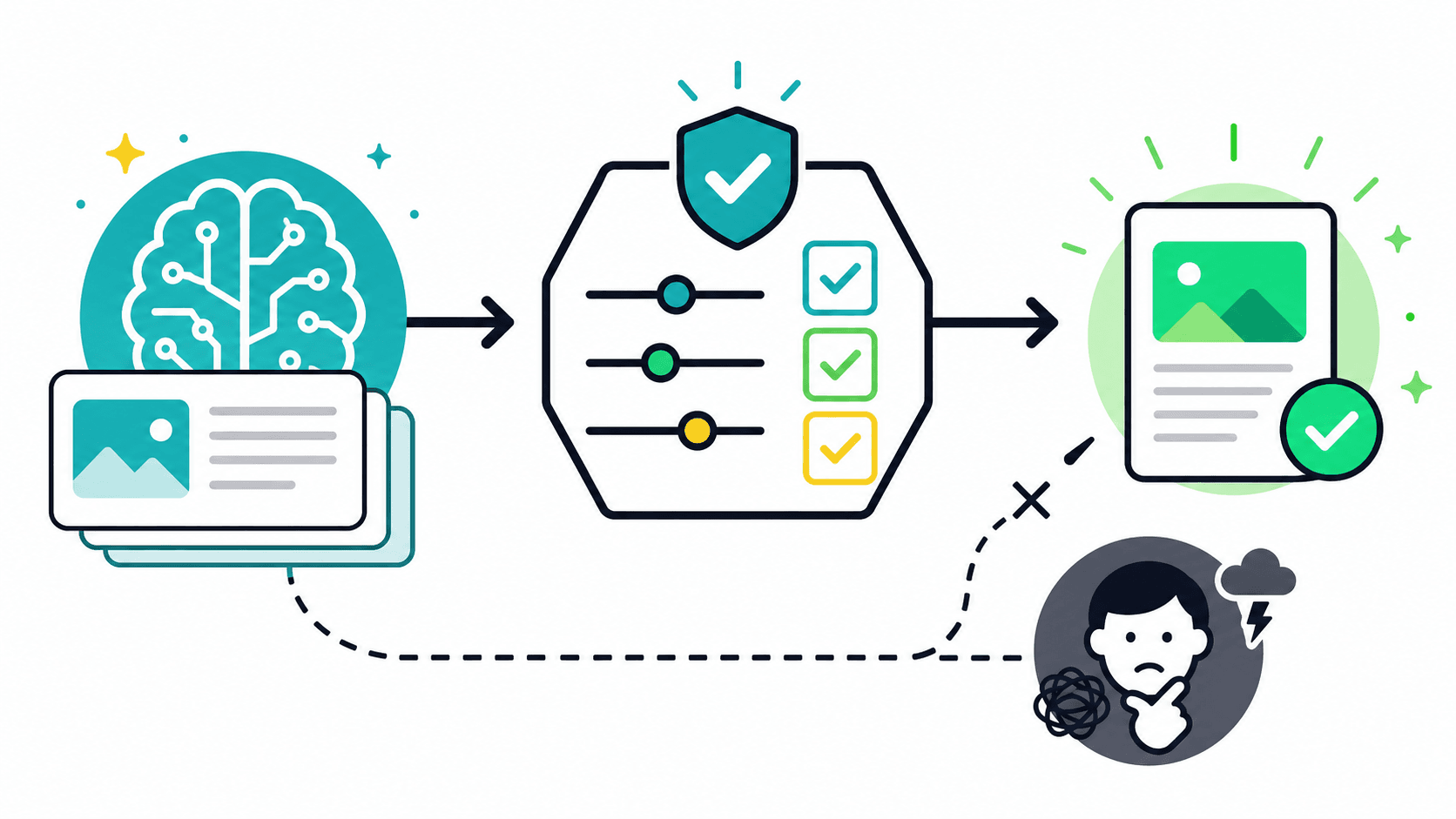
Correct. That's why the first thing I built wasn't the writer. It was the gatekeeper.
There's an automated quality check whose only job is to sniff out the smell of a machine. When a text reads like AI wrote it, those flat sentences, those "in today's landscape" openers, that instruction-manual cadence, it catches it and forces a rewrite before it ever sees daylight. Without me stepping in. Without anyone raising a hand.
Think about it calmly. What does a human do when reviewing a piece at six on a Thursday evening, with forty things still pending and cold coffee on the desk? They skim. They wave through whatever "looks fine." They let things slide. You do too, don't kid yourself.
The automated gatekeeper doesn't have a bad day. It's never in a rush. It doesn't approve something mediocre because it wants to go home. It applies the exact same standard to piece number 3 and to piece number 300.
Your human review is inconsistent by design. The machine's is boringly identical every single time. And for quality control, boring wins.
Why Every Manual Approval Kills the Business
This is the part people resist most, because it hits the ego head-on.
Every time you drop a manual approval point into a process, you create a spot where the work stalls waiting for you. And work that's waiting on you doesn't move. It piles up.
Are you a tidy, methodical person with a zero inbox and a clear head? Congratulations, you're in the 4% of the population. The rest of us are scattered, maxed out, and running twenty open tabs in both the browser and the brain, with all the cognitive cost that carries.
For us, an approval point isn't quality control. It's a black hole. Things go in and never come out.
- The article is ready, but it's waiting on your OK. And you're in a meeting.
- The translation is done, but it's waiting on your OK. And you're at lunch with a client.
- The post is perfect, but it's waiting on your OK. And it's Friday, and your head is already somewhere else.
Multiply that by every piece and every week. The result isn't "more quality." It's that you don't publish. Your wonderful system produces a quarter of what it could, because the limiting factor isn't the technology: it's you, standing frozen in the middle of the belt.
Removing the approval points wasn't letting go of control. It was relocating it. I pulled it out of my inbox (where it died) and built it into the process (where it works).
Mind you, there are systems where a human approval point is still non-negotiable, like when an AI can rewrite its own rules. But publishing an article isn't that case.
And If It Crashes Halfway, It Picks Itself Back Up
Another classic objection: "Okay, but these automated flows break, and then you've got a ghost mess you don't even know about."
I thought of that too. That's why the process survives crashes. If it goes down halfway, because an API fries itself, because a service hiccups, because stuff happens, and sometimes it's a single config detail that takes it down, it doesn't start from scratch or hang there begging for help. It resumes on its own from the exact point it stopped.
This matters more than it looks. A system that needs you babysitting it in case it crashes… is right back to depending on you. And we've already established that you are the problem. A system that gets itself back up is a system that genuinely doesn't need you.
And that, to me, is the only test worth applying: can this run without me for a full week? If the answer is no, you haven't automated anything. You've bought a digital pet that needs walking.
What You're Really Protecting When You Review Everything
I'll say it without anesthesia, because it's the whole thesis here.
Your obsession with reviewing everything doesn't protect quality. Quality is protected by a good control system, no matter who runs it. What your manual review protects is something else: your sense of being indispensable.
Reviewing makes you feel in charge. It gives you that hit of "this doesn't ship without my blessing." It feels good. It's human. And it's exactly what's holding your business back.
Because while you're signing off on commas, the competition is publishing. While you "give it one last pass," the market moves. And six months from now you'll have forty flawless articles you reviewed with loving care, and they'll have four hundred they let fly.
Don't get it twisted: this isn't about AI replacing human judgment. The judgment is there, plenty of it. It's in how I designed the pipeline to automate AI content, in what the gatekeeper counts as "sounding like a robot," in which topics get chosen. Human judgment gets applied once, in the design. Not four hundred times, by hand, on every single piece, when you're exhausted.
That's the difference between building a system and being one.
The Uncomfortable Question
I'll leave you with an exercise, and I mean it.
Take the tasks you review religiously every week. The ones that pass through your hands no matter what. And ask yourself, one by one, no cheating: do I review this because my review adds real, measurable value… or because I've always done it and letting go makes me nervous?
I'll spoil the result: most fall into the second group. You review out of habit, not value. Out of ego, not quality.
Spot those. Those are the ones you need to pull out of your inbox and drop into a system that does them better than you, every day, without waiting on you.
The day you do that, and actually automate content production with AI, your business stops being the size of you and starts being the size of your processes. And those are two very different things.
P.S. If after all this you still believe your manual review is irreplaceable, no worries. Your automated competitors deeply appreciate your commitment to artisanal craftsmanship.