Every two months someone publishes another "definitive Google Ads guide." Same recycled best practices, same promise that AI changes everything, same result: nothing you didn't already know. This Google Ads 2026 guide is about what actually works when you're managing real accounts with real budgets, and knowing when to tell Google no.

TL;DR: The No-Fluff Summary
- PMax dominates: it captures 60-70% of budget in competitive accounts, with a 4.64x ROI. Non-brand search still leads at 5.21x.
- Smart Bidding needs fuel: without 30 conversions per month and between $5,000 and $10,000 in budget, you're stuck in perpetual learning mode.
- CPC up, conversions down: CPC +13%, conversion rate -9%, median ROAS -10%. Unchecked automation inflates prices for everyone.
- Your landing page is costing you: landing page Quality Score impacts CPC by 30-50%. Optimizing it is the most direct path to better margins.
In this article
What Has Actually Changed in Google Ads in 2026?
Three changes that matter, and a lot of noise around them. AI Max is now a serious optimization layer for Search campaigns: Google shut down DSAs to push advertisers here, and anyone who hasn't migrated has been hemorrhaging control for months. Promotion Mode (still in beta) lets you temporarily loosen ROAS tolerance and inject extra budget during demand spikes without tearing apart your campaign structure. And since March 1st, daily budgets are calculated against a monthly baseline: if your ads only run on certain days, Google can double your daily spend as long as it doesn't breach the monthly cap.
That last one has real teeth. If you're checking the account daily, you'll catch it and adjust. If you're running the account on autopilot, it's a silent drain on your budget. As I've written before about how Google quietly reworked spend control via ad scheduling, there's a deliberate cynicism baked into this design.
And the "AI agents" inside Google Ads that everyone's calling a revolution? They're assistants. Useful for diagnosing performance drops, but they don't replace a manager who actually understands the client's business. And if they ever do (a big if), they'll optimize for Google, not for you.
Where Money Is Made in Google Ads (And Where It Evaporates)
Non-brand search is still the most profitable campaign type in Google Ads, with an incremental return of 5.21x. Performance Max is right behind at 4.64x. An analysis of 253 Marketing Mix Models puts real numbers on return by campaign type:
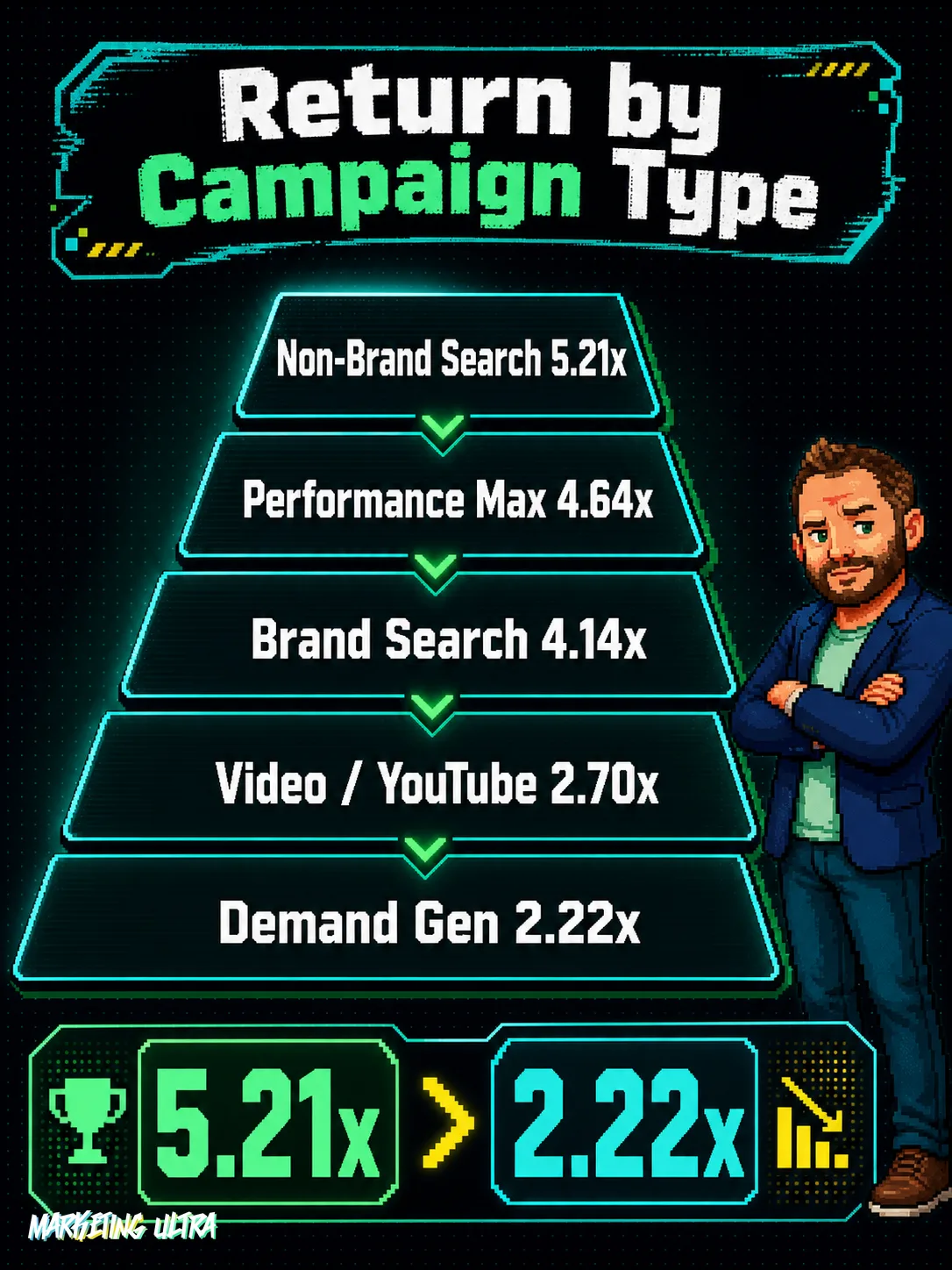
- Non-brand search: 5.21x
- Performance Max: 4.64x
- Brand search: 4.14x
- Video/YouTube: 2.70x
- Demand Gen: 2.22x
PMax now captures 60-70% of budget in competitive accounts. That tracks: it covers Google's full inventory and the AI optimizes bids in real time. But being the dominant format doesn't mean it runs itself.
The number that should keep you up at night: median ROAS dropped 10% in 2025, CPCs rose nearly 13%, and conversion rate fell 9.28%. Three indicators moving in the wrong direction simultaneously.
I'd bet that CPCs are rising precisely because more advertisers are letting AI bid without any supervision. More automated competition bidding blind inflates prices for everyone. And conversions are falling because the landing pages and value propositions in most accounts haven't been touched since 2022. Google's AI optimizes the bid. Your offer is still your problem.
Smart Bidding: Plenty of AI, Not Enough Common Sense
Smart bidding works. But it doesn't work on faith.
For a smart bidding strategy to exit learning mode and actually perform, it needs a minimum of 30 conversions per month. The optimal budget to sustain that is around $5,000, $10,000 per month. Below that threshold, the account gets trapped in perpetual learning mode: unstable performance, high CPA, and that nagging feeling that "Google Ads just doesn't work." It does work. But it needs fuel before you ask it for results, as I break down in the smart bidding and bidding strategy guide.
The playbook hasn't changed: start with "maximize conversions" without a target so the algorithm can learn, then shift to target CPA or ROAS once you have enough data. Nothing new there. What is new: starting August 17, 2026, Google will roll out improved performance predictions for budget-limited campaigns. Sounds good on paper.
But audit your CPA and ROAS targets before that date. If they're miscalibrated, the "improved" algorithm will optimize in exactly the wrong direction, just more efficiently. Which is worse.
Your Landing Page Is Costing You 30% More Than It Should
The landing page affects CPC by 30-50% through Quality Score. That's not opinion, it's how the Google Ads auction is built. And yet it's still the last thing that gets optimized (or the first thing that gets ignored).

The baseline requirements for any landing page receiving paid traffic:
- LCP (Largest Contentful Paint) under 2.5 seconds
- Form or CTA visible above the fold
- Main message aligned with the ad copy
- Verifiable social proof
- One dominant call to action
If you're spending €5,000 a month on Google Ads and your landing page takes 4 seconds to load, you're burning €1,500 to €2,500 in inflated CPC. It really is that simple. As I detail in the landing page and conversion optimization guide, the button and the value proposition are the last mile of your entire paid media investment.
The platform's AI is good, arguably the best in the industry for bidding and targeting. But it optimizes for Google, not for you. Automated recommendations, inflated optimization scores, factory-default settings: all engineered to get you to spend more.
Knowing when to say no. No algorithm automates that.