You spend years building your brand. Positioning, awareness. Trust. And one day you find out a competitor is showing up first when someone Googles your name. They haven't hacked anything. They haven't broken any rules. They've used three legal tactics Google Ads allows to siphon your branded traffic. And you never even noticed.

TL;DR: The No-Nonsense Summary
- DKI as a Trojan horse: competitors inject your brand into their ads without typing it manually, exploiting a loophole in Google's trademark policy.
- CPC inflated 2x to 5x: when competitors bid on your branded terms, you pay more for clicks that used to cost almost nothing.
- Defense is possible: always-on brand campaigns with exact match, weekly SERP audits, and ad copy engineered to neutralize each tactic.
- Google always wins: more bidders in the auction = higher CPCs for everyone. Don't expect them to close the loophole.
In this article
How Competitors Steal Your Branded Traffic on Google Ads
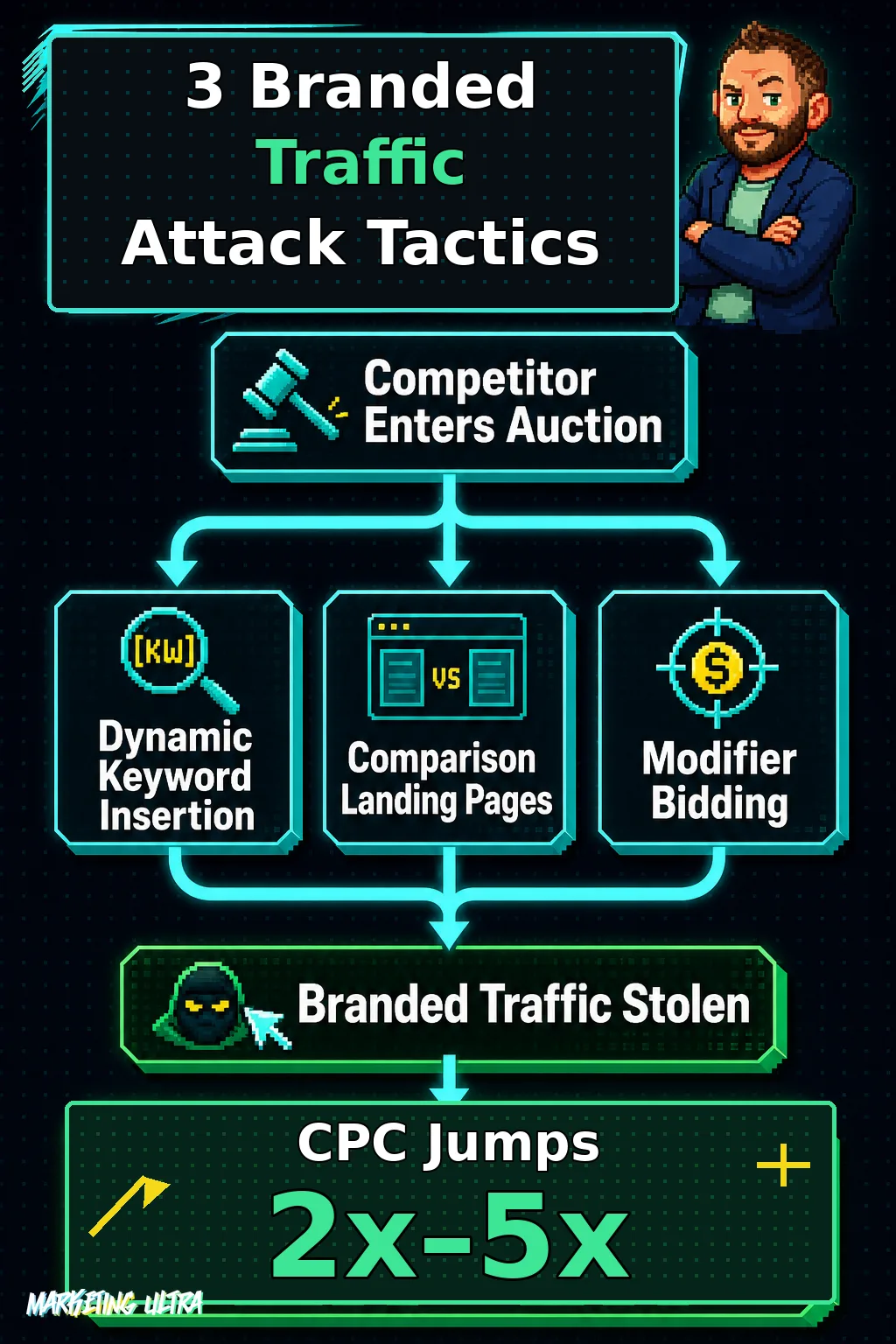
Branded traffic in Google Ads means searches where users include your company name. Real-intent clicks, cheap to win, and high-converting. Until a competitor decides to enter the auction. Search Engine Land has documented three tactics that make it possible without violating any policy.
1. Dynamic Keyword Insertion (DKI)
DKI is a Google Ads feature that automatically inserts the triggering keyword into ad copy. A competitor bids on "Acme CRM Software," enables DKI, and Google injects your brand into the competitor's headline. The user sees something like "Looking for Acme CRM Software? Try Competitor X." Your brand. Their ad.
Google's trademark policy prohibits using a third-party brand name in ad text. But DKI sidesteps that rule: the insertion is automatic, not manual. Convenient, right?
2. Comparison Landing Pages
Pages styled as "Competitor Y vs. Your Brand: Which Is Better?" Google allows your brand name on a landing page (unlike in the ad itself), so rivals build pages optimized to intercept anyone comparing options. The ad doesn't mention your name. The page does. And it's engineered to make you look like the inferior choice.
3. Brand Bidding with Modifiers
Not bidding on your name outright, that would be too obvious. Competitors go after the long tail: "[Your Brand] alternative," "[Your Brand] pricing," "[Your Brand] vs. Competitor." These are bottom-of-funnel searches with high purchase intent, and Google allows them because the competitor's ad doesn't mention your brand. The user does.
How Much Does Competitor Brand Bidding Cost You?
It's not just the stolen clicks. It's that the clicks you keep get a lot more expensive.
When a competitor enters the auction on your branded terms, your CPC can jump 2x to 5x. If you were paying $0.30 per branded click, you might suddenly be at $0.90 or more. Multiply that by thousands of clicks per month. Competitive bidding can divert up to 30% of high-intent traffic, and those diverted clicks convert 30% to 60% worse for the competitor. But they're no longer yours.
The macro context doesn't help either: the average CPC on the Search Network was $2.96 in Q1 2026, and costs rose 12.88% year-over-year in 2025 across 87% of industries. Your own branded terms were the last refuge for cheap clicks. Not anymore.
Who Benefits? Google. Always Google
Here's what you won't read in any Search Engine Land article: Google has zero incentive to close these loopholes. Every competitor bidding on your brand is one more participant in the auction, and more bidders mean higher CPCs for everyone. Google earns more, you pay more, your competitor pays more. The only one who always wins is the one running the auction.
Sound familiar? It's the exact same pattern we saw with the ad scheduling change: moves that, coincidentally, always end up padding the bill. The same underhanded scheme, dressed up as a "feature." I'd bet there's more than one person at Google rubbing their hands together every time a new competitor discovers these tactics.
How to Bulletproof Your Brand Campaigns
Can you do something about it? Yes. A hands-on account manager can neutralize most of these attacks. But it takes ongoing work, no set-it-and-forget-it here.

Weekly SERP Audits
Search your brand in incognito mode and vary the location. Check your Auction Insights reports to spot which competitors are bidding on your terms and at what impression share. Also watch for suspicious traffic patterns these tactics can surface in your search terms reports. The moment you spot a new name, investigate their ad and their landing page.
Always-On Brand Campaigns
Keep exact match brand campaigns running 365 days a year. Your Quality Score on your own branded terms should be high (it IS your brand), which gives you a lower CPC and a privileged position. If you're running Smart Bidding strategies, consider a Target Impression Share bid strategy to make sure you appear FIRST, every time.
Your ad copy needs to neutralize each tactic:
- Against DKI: put your brand name unmistakably in your first headline. No ambiguity about whose ad is the official one.
- Against comparison pages: use ad extensions (sitelinks, callouts, price extensions) to dominate as much SERP real estate as possible.
- Against modifiers: build dedicated ad groups for "[Your Brand] + alternative/pricing/vs" with copy that speaks directly to that intent.
Make Copying You Expensive
A high Quality Score makes it costlier for competitors to outrank you. Your own comparison pages ("Why choose us?") strip away ammunition from rivals. A strong brand earns you a CTR that Google rewards with better position and lower CPCs. The auction matters, but your best defense is a user who already knows who you are before they even search.
If you're not watching your branded terms every week, your competitor already is. And Google, meanwhile, is delighted with the auction.
Frequently Asked Questions About Branded Traffic in Google Ads
Can I file a complaint with Google if a competitor uses DKI with my registered trademark?
You can submit a trademark complaint through Google Ads. Google may restrict the use of your trademark in third-party ad text, but DKI operates in a gray area: the insertion is automatic, not manual. What Google will never do is prevent a competitor from bidding on your branded keywords. Bidding is open; the restriction only applies to visible ad text.
Is it worth investing in brand campaigns if I already rank first organically?
Yes. Without an active brand campaign, a competitor can occupy the ad position above your organic result. The cost is low (your Quality Score on your own terms is high) and the risk of skipping it is handing the top visible slot to a rival who is actively bidding on your name.