You ask the same model to think up the plan, critique it, and then execute it. That's like letting your creative director review their own work and sign off on their own budget. Putting Codex and Claude Code head-to-head on your plan is the most direct way to catch holes before you write a single line of code. And no, you don't need to be an engineer to set it up.

TL;DR: The no-fluff summary
- Grill Me Codex: a skill that pits Claude and Codex in critique rounds until they converge on a solid plan.
- 5 rounds max: one model proposes, the other tears it apart, repeat. If there's no agreement after five iterations, it closes and works with whatever plan has emerged.
- The core principle: a single model planning and executing has blind spots it can't see itself. Two different perspectives catch them.
- Reproducible without the original skill: the pattern is simple and you can set it up with a structured prompt in any code agent.
In this article
What Is "Grill Me Codex" and Why Two Models Beat One
Grill Me Codex is a skill built by chase.h.ai that automates a simple pattern: put two models in a debate about your plan until they both agree. The idea comes from Matt Pocock's "Grill Me" skill, which already forced Claude to question its own plan before executing. The Codex version takes it a step further: the critique comes from a model with a different training background.
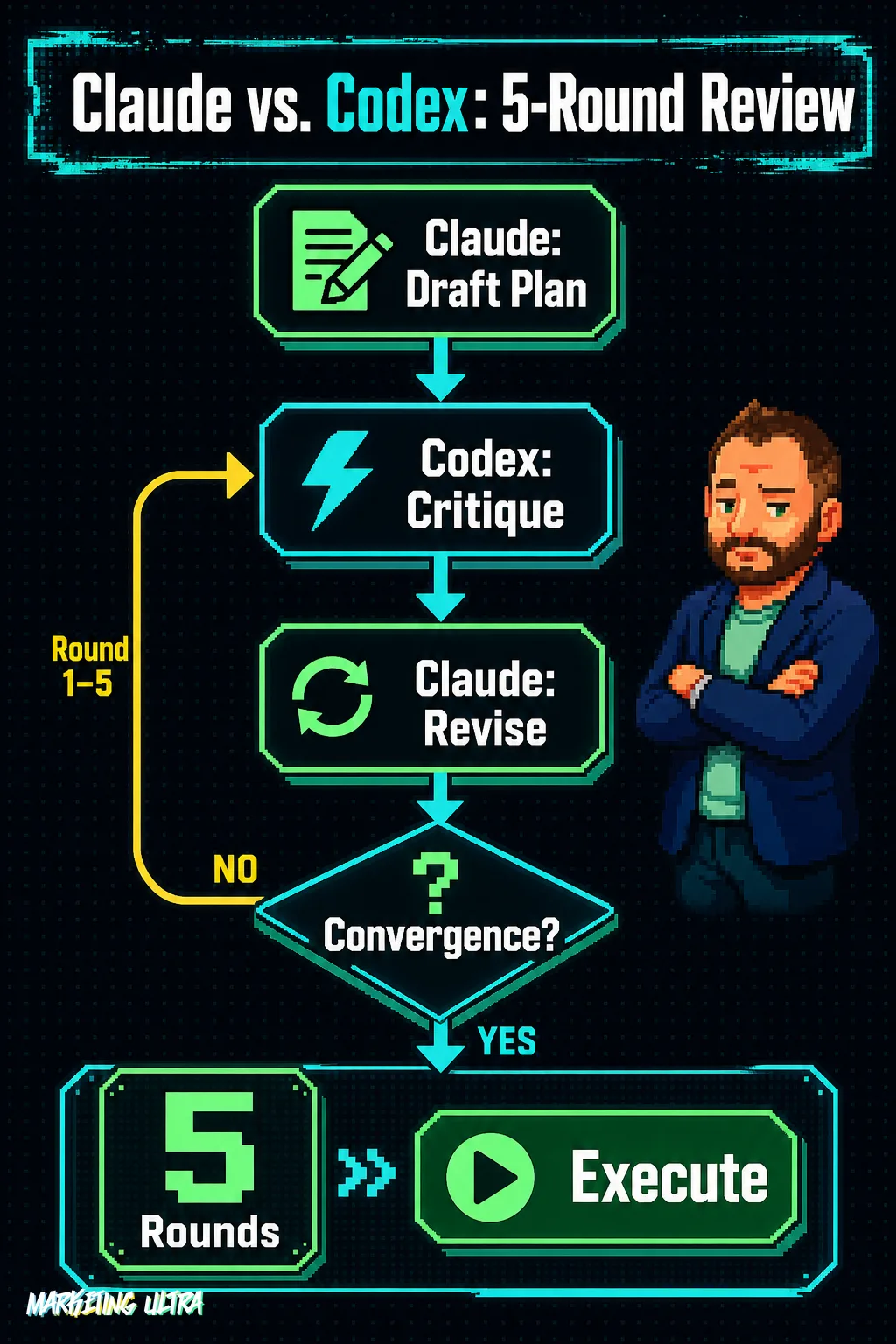
The flow is straightforward. Claude builds a plan for your project. That plan gets handed to Codex (OpenAI's GPT-based coding agent), which tears it apart, flagging weaknesses, overlooked dependencies, edge cases. Claude takes the critique, revises what makes sense, and defends what doesn't. Back and forth, five rounds max or until both converge.
Once there's agreement, the plan moves to execution. By default, Claude Code handles it, though the flow is editable: you can assign execution to Codex or a smaller model if that suits you better.
Why a Single Model Planning Alone Is a Trap
A language model that plans, critiques its own plan, and then executes it has a structural problem: its blind spots are consistent. If its training leads it to underestimate the complexity of a database migration, it'll underestimate it when planning AND when reviewing. There's no counterweight.
In any serious agency, a project passes through at least two heads before it's executed. The person who thinks it up isn't the one who signs off on it. Not out of distrust, because two brains trained differently see different things. Same deal with models.
Claude and GPT have different biases. From what we've tested, Claude tends to be more conservative on architecture, more thorough on edge cases. GPT tends to be more aggressive about pushing fast solutions, sometimes skipping steps. When you put them against each other, Claude catches GPT's shortcuts and GPT catches Claude's over-engineering. The plan that comes out of that friction is almost always more realistic than what either would produce alone.
We've been applying this in our AI automation pipelines from day one: separate generation from validation. Never trust the first result without a second pair of eyes, human or another model.
How to Build Your Own Cross-Model Review
You don't need chase.h.ai's exact skill to apply the pattern. What you need is a code agent (Claude Code, Cursor, Windsurf) and access to a second model via API or CLI. The flow is reproducible with a well-structured prompt.
The key is separating roles clearly: one model proposes, the other ONLY critiques. If you mix roles ("plan it and tell me what's wrong"), you're back to the original problem. The critique has to come from outside, with no prior context from the reasoning that led to the plan. That's what makes the review honest.
Five rounds is a solid cap. In our experience, the first two rounds are where the real value is. By round three, if there's still no convergence, the project is probably under-defined, you need to scope it down before pushing further.
And this scales to any complex decision, not just code. Each model has a domain where it shines: using them as adversaries instead of interchangeable tools is what turns AI into a serious process rather than a coin flip with extra steps.
Copy this and paste it into Claude Code, Cursor, or your favorite code assistant:
Act as a planner. Generate a detailed plan for [describe your project]. Then send that plan to Codex (or GPT-4 via API) with this prompt: "Critique this plan. Flag weak points, hidden dependencies, and edge cases. Do not propose solutions, only problems." Collect the critique, revise your plan, and repeat for up to 3 rounds or until convergence.
No coding knowledge required. The assistant handles installation, configuration, and testing.
What Nobody Tells You About Adversarial Review
There's a real risk in this approach that the original video doesn't mention: premature convergence. Two models can "agree" on something wrong simply because they share a training bias (Stack Overflow data from the same era, for example). Agreement is not a quality guarantee. It's a signal, not proof.

I'd argue the most valuable part of this pattern is the objections that come out of the early rounds. Those initial critiques are what force you to think about what you'd taken for granted. Even if you end up dismissing them, having to defend your plan against them means you understand the problem better.
That's exactly why the learn-by-breaking approach with agentic AI fits so well here: the value is in the fight itself.
If you're using AI for complex projects and still asking a single model to do all the thinking, you're leaving money on the table. The AI that actually pays off is the one that makes you defend your answer before it runs.