Building a rigid process around Claude today is like bolting furniture to the floor of a moving train. Claude 2027 does not require guessing the next model: it requires designing processes that can change without breaking. The data points to faster progress, yes. And your dependencies can become outdated at breakneck speed.

TL;DR: The No-Nonsense Summary
- Measured acceleration: METR estimates Anthropic improved certain capabilities 1.9 times faster than in the previous period.
- Limited scope: the study examines well-specified tasks; it does not prove equivalent gains across every business process.
- Dangerous dependency: tying rules, formats, and controls to one specific version of Claude turns every update into a headache.
- Adaptable architecture: your own evaluations, structured outputs, controlled versions, and a fallback path handle change better.
In this article
In this article, Claude 2027 is a planning scenario for processes that will still work throughout 2027. Anthropic has not announced a model by that name or promised to double its pace of progress every year.
What do we really know about Claude 2027?
Anthropic already uses Claude actively in its own R&D, and METR has measured likely acceleration. That is where the evidence ends. Whether the trend continues through 2027, or carries over to your customer support, content, or automations, remains to be seen.
The independent METR assessment lasted eleven weeks, from August 12 to October 29, 2026. It included internal data, training metrics, results from internal models, and interviews with Anthropic staff.
Its central estimate is a 1.9x acceleration in the trend of the internal AECI index since October 2025. The 95% confidence interval ranges from 1.5x to 2.8x, and METR acknowledges it would not be surprised if the real figure were 1.3x or 3x.
The fine print matters: these are capabilities on well-specified tasks. The report itself warns that this index may not cleanly represent real-world impact. Translating “faster improvement” into “my automation will be twice as good” would be putting the statistics in a headlock.
Anthropic reported that, in August 2026, Claude led 26% of measured model R&D work and collaborated or led in more than 90%. It had no full autonomy in any of the categories assessed.
METR considers it likely that intensive AI use explains most of the current acceleration. It also acknowledges considerable uncertainty and other important factors, especially in late 2025. That is much more interesting than the easy headline that “AI is improving itself.” And much less comfortable.
What changes when you build processes on Claude?
The expiration date of your assumptions changes. A limitation that justifies ten manual rules today may disappear; a useful behavior may shift in an update and break the workaround you built around it.
Building an isolated automation is the easy part. The hard part is connecting it to data sources, controls, other reports, and real decisions. The more pieces you connect, the more expensive it becomes to mistake a temporary Claude quirk for a system guarantee.
Knowing an AI’s weaknesses tells you how to prompt it, where it will break, and what you should not delegate to it. The mistake is turning those current weaknesses into permanent architecture.
I would pay particular attention to four dependencies: parsing free-form text with brittle expressions, assuming a specific version will always be available, putting business logic inside one giant prompt, and letting “the latest model” into production without your own testing.
I would also avoid relying on the Claude interface for a critical process. Your process should communicate through your own layer, one that can switch models, retain logs, and stop a run. If Claude improves dramatically tomorrow, you update that layer. If it gets worse for your specific use case, you roll back.
This affects content too. For related reading, see how to automate AI content without reviewing every step: scaling is not about hiding review; it is about putting controls where the cost of an error demands them.
How to design a workflow that absorbs Claude’s evolution
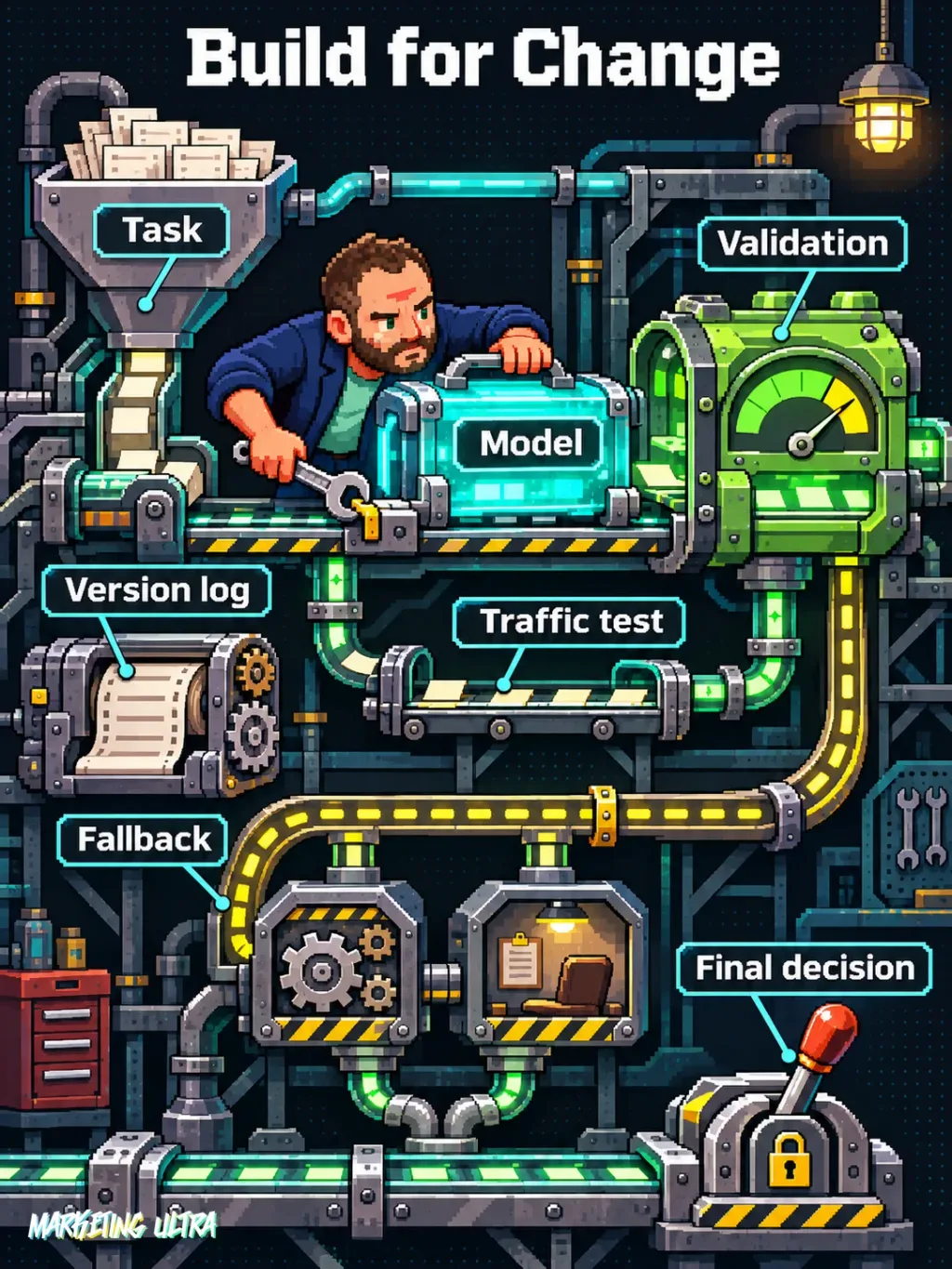
An adaptable workflow separates the task, the model, validation, and the final decision. That lets you change one component without rebuilding the whole thing.
I would apply five deeply unglamorous, highly useful measures:
- Version prompts, model, and configuration for every run.
- Request structured results and validate fields before using them.
- Keep a fixed set of real cases with acceptable answers and serious failure cases.
- Test new versions on a small share of traffic before migrating.
- Define an alternative: another model, a conventional rule, or human review.
Evaluations should measure your business, not the model’s showmanship. What would I look at? In customer support: incorrect replies, escalations, and compliance. In content: accuracy, voice, and citations. In automation: completed tasks, silent failures, and total cost. A model can rise on a public benchmark and still fall flat exactly where it hurts you.
Migration should not happen in the heat of the moment either. For related reading, see why a Claude improvement does not justify a blind migration: compare first, replace second, and you may avoid spending a week putting out fires.
Copy this and paste it into Claude Code, Cursor, or your favorite coding assistant:
Audit my current workflow with Claude using the documentation at https://docs.anthropic.com/.
Separate the model, prompts, and validations; add versioning, structured outputs, and a fallback path.
Create a test using 10 real cases, and do not change production until you show me the comparison.
Review the proposal before applying it. Installation, configuration, and testing depend on your workflow and the permissions available.
Anthropic’s acceleration comes with fine print too
METR found no major algorithmic, compute, or data bottlenecks for the following twelve months. Its confidence in that conclusion is low, and it admits there may be significant limitations it did not detect.
There is another uncomfortable detail: Anthropic could unilaterally withhold non-public information, several relevant findings were omitted, and much of the analysis used Claude. AP’s coverage notes both the approximate acceleration and those caveats.
My reading is simple. Falling behind carries risk, sure. But building a carnival of automations because the new model gives a beautiful demo, and nobody has considered who is accountable when it fails, carries much more.
Claude 2027 may be far more capable than today’s Claude. Great. If your process is well designed, you will gain capability without tearing the company apart. If it relies on twenty tricks, one free-form response, and blind faith in the provider, every improvement becomes a roulette wheel. That is not innovation. It is technical debt with glitter on it.