Everyone compares ChatGPT and Claude as if they were the same tool with a different logo. They're not. ChatGPT Work and Claude Cowork tackle opposite phases of the editorial process, and treating them as interchangeable will cost you hours, quality, or both. I've had both running in production for a while now, and the difference is stark.

TL;DR: The No-Fluff Summary
- ChatGPT Work: speed and volume. Fast ideation, drafts, and data analysis with built-in Python. The engine that gets things moving.
- Claude Cowork: editorial depth. Massive context window, brand consistency, and iterative revision. Your quality partner.
- The common mistake: comparing them on the same task. One fires up drafts, the other elevates them.
In this article
What does ChatGPT Work solve, and what does Claude Cowork solve?
ChatGPT Work is OpenAI's work mode: rapid ideation, data analysis with built-in Python, drafts in seconds. If you need to classify 500 keywords by intent from a CSV or generate 20 headline variations, ChatGPT blazes through it. Its advanced data analysis feature lets you upload spreadsheets and run code directly, something Claude doesn't offer right now. HubSpot documents it well: speed and versatility for scaling repetitive content and SEO tasks.
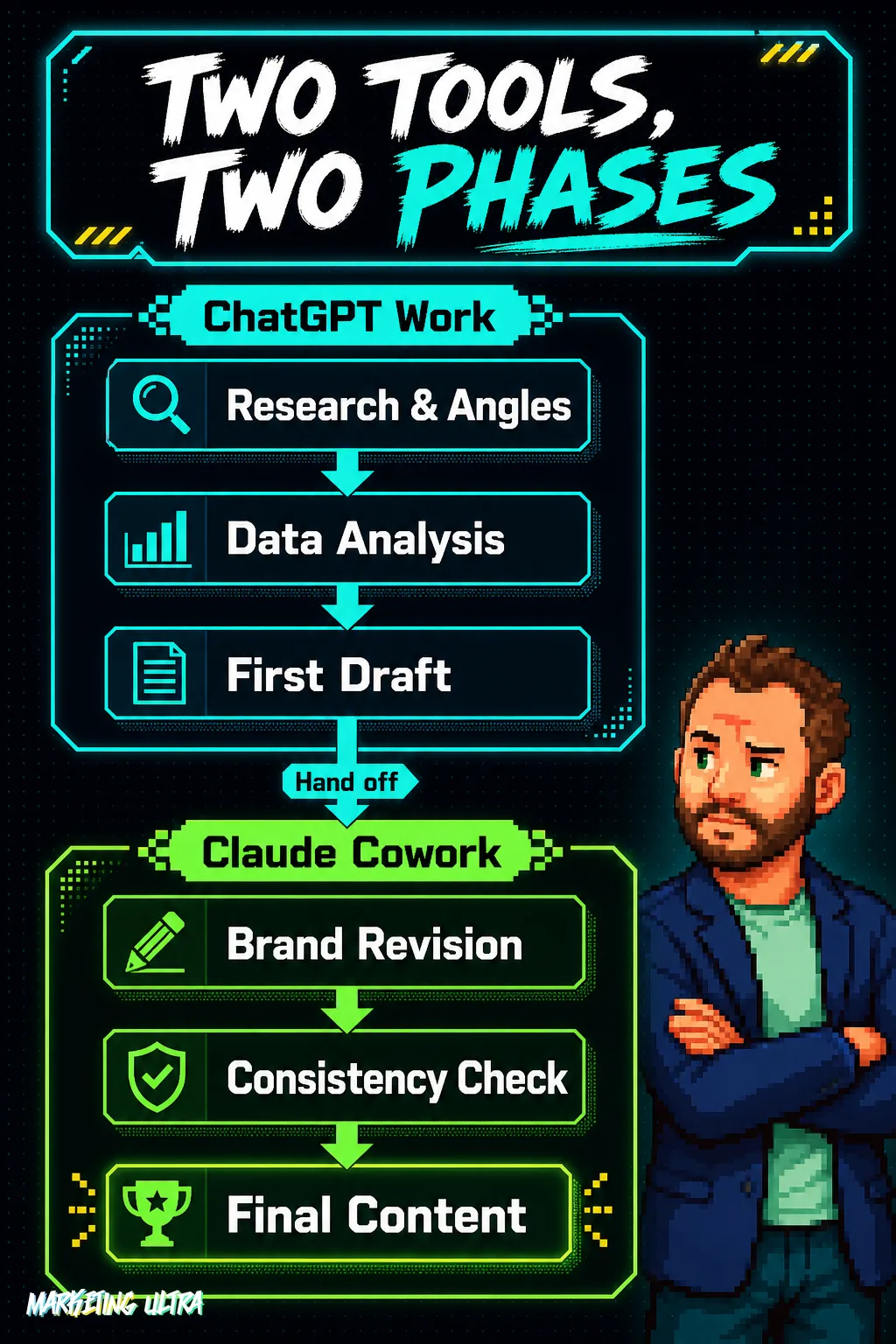
Claude Cowork is Anthropic's bet on deep editorial collaboration: a context window of up to 200K tokens (you can feed it an entire book without losing the thread) and iterative revision with brand consistency that other models simply can't match. If you've already tried Claude Cowork on mobile, you know what I mean: it's a writing partner, not just another chatbot.
The real difference? It doesn't matter which one "writes better" on a 200-word test. What matters is what problem you're actually facing.
For content marketing, this is critical. ChatGPT Work helps you scale production: generating briefs, segmenting data, building outlines. Claude Cowork makes sure that production doesn't sound like it rolled off an assembly line, which, by the way, is exactly what Google penalizes.
The trap of comparing them on the same task
Asking both to write the same text only tells you which one handles that specific task faster. And that's exactly what most online comparisons do.
In a real editorial workflow, you don't ask both for the same thing. ChatGPT is the engine that gets things moving: it breaks through writer's block and generates raw material. Claude Cowork is the partner that sits with you to polish the output, it keeps your brand voice consistent across 3,000 words, catches inconsistencies, and makes sure the last paragraph still sounds like you, not like a machine. Chances are, most people who say "Claude is better" or "ChatGPT is better" are using them for exactly the same thing.
ChatGPT gets you the first draft in minutes. Claude Cowork turns it into something publishable. Different phases. Comparing them on the same task is like comparing a drill with sandpaper: both work with wood, but if you try to sand with a drill, you'll wreck the piece.
And one more thing: Claude's context window isn't just about reading long documents. It means you can load your style guide, three previous articles, and the day's brief, and the output comes out aligned with your brand from the very first iteration. With ChatGPT, that level of personalization takes significantly more effort, and it still loses coherence in longer texts. Other marketing professionals reach the same conclusion.
When I use each one in my real workflow
ChatGPT comes in at three points in my workflow: initial research (I throw a topic at it and it surfaces angles I hadn't considered), data analysis (Search Console CSVs, keyword segmentation), and generating quick variations for headlines, meta descriptions, or hooks.

Claude Cowork steps in once the piece has a shape. I pass it the draft along with my voice guide, and it makes sure the result sounds consistent, flags weak sections, and holds the editorial line. If you're automating your content production, as we cover in the AI content automation guide, Claude is where quality is actually won or lost.
Google rewards genuine experience and original voice within its E-E-A-T framework. ChatGPT produces fast, but without supervision it sounds generic. Claude lets you inject your judgment into every paragraph, and that's what makes the difference in rankings.
Can you do everything with just one? Yes. Is it optimal? Not even close.
ChatGPT alone gives you volume without soul. Sticking exclusively to Claude means quality at the cost of burning twice the hours. Put them together, and the workflow clicks. One caveat: this applies today. Six months from now, capabilities will have shifted. Your competitive edge is your judgment, not the software you're using.
The question "ChatGPT Work or Claude Cowork?" is the wrong question. What matters is knowing when to bring each one in.
If anyone sells you on the idea that ONE AI handles everything, be skeptical. AI scales the work. The judgment is yours. And without judgment, scaling just means producing garbage faster.