You lose a major account. You look around for someone to pick up the phone and save the situation. No one. And the worst part isn't that it happened: the worst part is that you spent years building exactly this. Your org chart doesn't reflect a mission: it reflects inertia on a payroll.

TL;DR: The no-nonsense summary
- Inertia dressed as an org chart: most agencies design roles around whoever is already there, not around what the mission actually needs.
- The blocking role: that "senior strategist" title you created to retain someone is now blocking the door to the talent you actually need.
- The founder trap: if no one can replace you, you haven't built a company. You've built a dependency.
- Foxhole loyalty: keeping people who stay by default is accumulating risk, not managing a team.
In this article
The Role You Made Up to Keep Someone Around
Every agency has one. That "senior digital strategist" title that appeared in the org chart one random Tuesday. It didn't come from a needs analysis. It came from an uncomfortable conversation: "Sarah's been here six years, she's not quite director material yet, but if we don't give her something she'll walk." So you gave her a title.
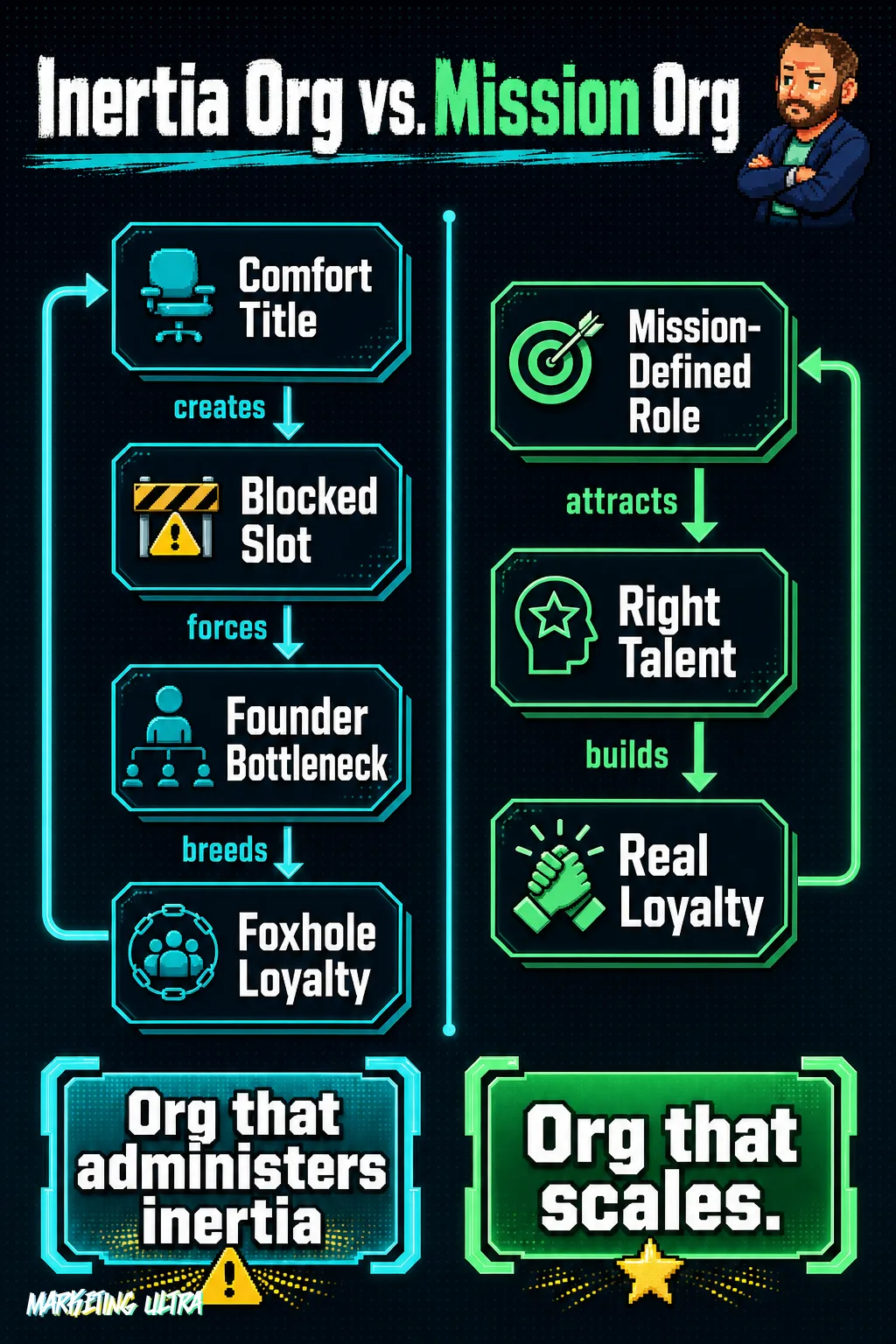
The problem isn't Sarah. Sarah might be genuinely good at what she does. The problem is that the role now exists, draws a salary, takes up a seat in every meeting, and, most importantly, blocks outside talent from coming in. When a slot is already filled (even as a stretch), nobody approves a new hire for that gap.
According to industry data, average turnover at marketing agencies was already around 25% in 2016, and the trend has only climbed since. Agencies bleed talent constantly, but instead of designing roles that attract the right profiles, they reshape roles around whoever stays. Every two years, a reshuffle. In five, an organizational Frankenstein where nobody knows what anyone does or why.
And the person who could actually pull you out of the hole? They're at a competitor. Because your slot was already "filled."
The accidental manager who ends up leading a team without the tools or the calling for it is, more often than not, the direct symptom of this problem. You handed them management responsibility because it was their turn, not because they knew how to manage.
Nobody Knows What Anyone Does (and You're Plugging Every Gap)
"Somehow it works." The most dangerous sentence any agency founder can utter.
It works because you're there. Something breaks, you fix it. A client blows up, you take the call. Every important decision eventually flows through you. There's a name for this: the founder trap.
The business can only grow as far as your own physical and mental capacity will take it. Without clear processes and roles that actually mean something, everyone on the team is flying blind and you become the GPS for everything. Burnout, repeated mistakes. Decisions that sit still unless you push them. Your phone rings on a Saturday morning. It's always you.
The brutal part is that it masquerades as a virtue. "The founder is incredibly hands-on." No. The founder hasn't built a system that runs without them. That's a very different thing.
In my experience, this dependency comes from fear. Pure and simple. Designing a mission-driven structure means making uncomfortable decisions. Telling someone their role no longer makes sense. Hiring people who know more than you in certain areas. Letting go of control. Most founders prefer familiar chaos to the order that demands confrontation. I'd wager that half the agency org charts out there wouldn't survive an honest audit of "why does this role exist?"
Real Loyalty vs. Foxhole Loyalty
There are two types of loyalty in an agency, and confusing them costs you dearly.

Real loyalty is someone who grows with you because the mission genuinely matters to them. They have options, could leave at any time, and choose to stay. They push without being pushed.
Then there's foxhole loyalty: someone who's still around because nothing better has come along. Yet. The day a 15% raise lands in their inbox, they're gone without a second thought. And you're left with a gap you didn't see coming that nobody else can cover.
And do you know what happens when you only retain the people who don't move? Nothing moves. Everything stagnates.
If your team isn't growing because roles are clogged by people who hold them "just because," the real talent gets frustrated and walks. You end up with the ones who have nowhere else to go. And an organizational inertia that gets more expensive by the day while your competitors are actually making moves.
Only 30% of family businesses in Latin America have a formal succession plan, according to data from PwC and KPMG. At marketing agencies, the figure would be enough to make you cry. Nobody thinks about what happens when Sarah leaves. Or worse: when you leave.
Build the Agency You Need, Not the One You're Comfortable With
There's a brutal exercise very few founders actually do. Pull up your org chart. Erase every name. Then ask yourself: "Would I create this role if I were starting the agency from scratch today?" If the answer is no, you have a role that exists out of inertia, not necessity.
Knowing how to let people go well and with a clear plan is just as important as knowing how to hire. Redesigning structure sounds like layoffs, but the real issue runs deeper: for years we've been crafting custom titles to fit existing people instead of finding the right people to fit the right roles. It sounds obvious. Almost nobody does it.
Stop asking "do I have a good team?" The question that actually matters is: "Have I designed the structure my mission needs, or the one that was most comfortable to manage with whoever I had on hand?"
If the honest answer is the second one, you're not leading an agency. You're administering inertia. And inertia only lasts so long. Until you lose the account you couldn't afford to lose.