You take your best developer, the one who solves what nobody else can, and sit them in a conference room to give feedback and manage conflicts between junior staff. Congratulations: you've just created an accidental manager. You've just lost your top performer. And on top of that, you haven't gained a good leader either.
An accidental manager is an outstanding technical professional promoted into a leadership role on the back of their individual performance, with no management training and no real say in the matter. At Marketing Ultra, we've spent years watching this pattern destroy talent inside agencies and digital teams.
I've seen this so many times it genuinely hurts. It's one of the saddest things I witness in this industry.

TL;DR: The no-nonsense summary
- 82% with zero training: the vast majority of managers never received a single leadership course. They got the job by being great technicians, not by knowing how to multiply other people's output.
- You lose twice: by promoting the wrong way, you lose your best performer AND gain a leader who never wanted the role. The team goes into freefall.
- 28% avoidable turnover: nearly one in three employees leaves a company because of their direct manager. In agencies, where turnover is already high, this is lethal.
- The fix exists: senior technical career tracks that don't require managing people. Almost no one implements them.
In this article
Why the Promotion System Manufactures Accidental Managers
The promotion system manufactures accidental managers by design. It's built to reward one thing and demand something completely different. And nobody stops to count the cost.
The number is staggering: according to the Chartered Management Institute, 82% of current managers have never received any leadership training. Not a course. Not a mentor. Not so much as a basic guide on how to give feedback without it sounding like a dressing-down in front of the whole office.
And why? Because promotion systems are designed to reward the person who does their own job best. Not the person who's best at multiplying the work of others.
Those are two completely different things.
In agencies, this pattern is endemic. The best copywriter becomes creative director. The best dev becomes tech lead. The best account handler becomes head of accounts. And suddenly you have someone who was extraordinary at one very specific thing, sitting through alignment meetings, reading reports they don't know how to interpret, and navigating difficult conversations nobody ever prepared them for.
The result isn't that the team "runs a bit rough." The result is that you lose your best technical performer, gain a leader who never wanted the role, and the team goes into freefall. You've turned a person who probably loved their job into a hollow shell of what they used to be.
Two for the price of one. Just backwards.
The First 90 Days of the Accidental Manager
The first 90 days of an accidental manager are a predictable disaster. You see it coming. Everyone sees it coming. And nobody stops it.
I've lived through this cycle more times than I can count. Three acts, like a disaster with a script.
Act one: the ambiguity. The brand-new manager doesn't know where their authority begins and ends. Can they make budget decisions? Hiring decisions? Priority calls? Nobody told them. So they do what anyone would do: nothing. They defer. They escalate everything upwards. The team, who once had a decisive peer, now has a boss who needs permission to breathe.
Act two: the feedback that never comes. Delivering difficult feedback is one of the hardest leadership skills to master. And it's the first one you need. When a junior is going off the rails, when a project smells like it's about to burn, when someone needs to hear that their work isn't cutting it, the accidental manager doesn't know how to handle it. So they avoid it. Or they blurt it out badly, at the wrong moment, and leave a trail of demotivation in their wake. One practical note: if you're in this situation, at least transcribe your meetings with local AI. Keep a record of what was said, without sending your audio to any cloud.
Act three: the void. The team senses there's no direction. And they fill it with noise. Internal politics. Mini power struggles between those who think they should have been promoted instead.
And then what happens?
They leave. Not the role. The company.
Gallup research has been pointing to the same finding for years: the relationship with the direct manager is one of the top drivers of talent attrition. 28% of employees have left a company because of it. In agencies, where turnover is already high, this isn't a problem. It's a haemorrhage.
You're losing talent not because you pay too little or the project is boring, but because you put the wrong person in charge. Someone who, let's be honest, probably doesn't want to be there either.
Because some of the hardest chapters in leadership rarely get talked about. At Marketing Ultra we've covered one that most people avoid: how to let someone go without breaking your team's trust. Another mess nobody ever prepares the accidental manager for.
What Is a Senior Technical Career Track, and Why Does Nobody Use One?
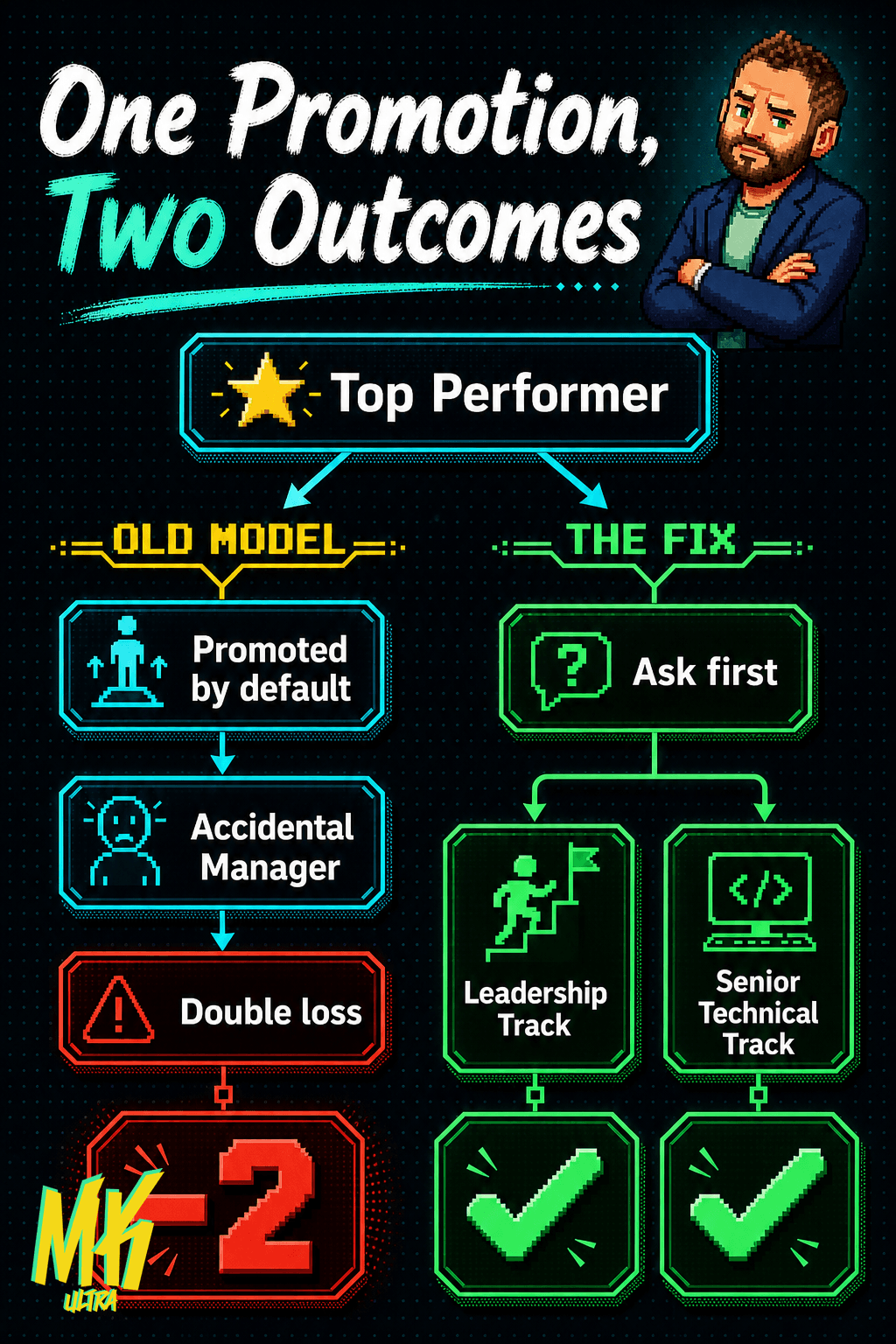
A senior technical career track lets a professional grow in responsibility, impact and salary without ever having to manage people. It sounds like common sense. Almost nobody has one in place.
Here's what actually frustrates me. Because this problem has a solution. And it's a solution almost nobody implements.
It's called a senior technical career track. And it boils down to something very simple: creating a professional growth path that doesn't run through managing people.
Your best dev wants to keep being a dev, but with more responsibility, more impact and better pay? Perfect. Create a principal engineer role, a staff engineer role, a technical architect. A role where their experience and judgment multiply the team's output without them ever having to deal with the headaches of people management.
Your best copywriter wants to grow? Fine. Creative director doesn't have to mean managing a team. It can mean defining brand voice, mentoring junior writers from a craft perspective, and leading creative quality, without ever opening a holiday-tracking spreadsheet in their life.
Leadership is a unique skill set. It has nothing to do with being a great technician. And placing someone in a leadership role when they don't have those skills is shooting yourself in the foot as an organization. Plain and simple.
This is something Harvard Business Review's research on leadership development has been documenting for years: technical potential and leadership potential are independent dimensions. Assuming they go hand in hand is one of the most expensive talent mistakes organizations make.
What's at the root of all this? Two very simple things. Not asking. And assuming that because someone is great at their job, they must automatically be the one who should be in charge.
To be clear: I'm not saying a great technician can't be a great leader. There are people who have both, and they're extraordinary. What I'm saying is that the management promotion cannot be the default reward for strong technical performance. Because if the only thing you have to offer your best people is a seat where they're going to suffer, the problem is with your organization.
Ask Before You Promote: The Rule Almost Nobody Follows

Before promoting any professional into a management role, ask them if they actually want to manage people. If the answer isn't an unequivocal yes, stop. It's the most obvious rule in leadership, and the one most consistently ignored.
Next time you have a star performer on the team and feel the urge to promote them into management, pause. Ask them what they want. Ask whether managing people excites them or gives them hives. See whether they have the skills, or at least the genuine desire to develop them. And if you don't have a plan B for someone who wants to grow without leading people, build one.
Before another accidental manager turns a happy professional into a miserable shadow of what they used to be.
I've seen it too many times. Every single time it's left me feeling the same way. And the cause has always been the same: nobody asked.
Frequently Asked Questions About the Accidental Manager
What exactly is an accidental manager?
An accidental manager is an outstanding technical professional who is promoted into a leadership role without specific training, and in many cases, without having chosen it. The promotion arrives as a reward for their individual performance, not as a result of any ability to manage people or teams.
How many current managers have received leadership training?
According to the Chartered Management Institute, 82% of current managers have never received leadership training. That means only 2 in every 10 managers steps into the role with any formal preparation for managing people.
How can I avoid creating accidental managers in my organization?
The solution rests on two pillars: asking every professional whether they actually want to lead people before promoting them, and implementing a senior technical career track that allows professionals to grow in responsibility and pay without needing to manage teams. Almost no company has both in place simultaneously.
What is the difference between an accidental manager and a leader who chooses the path?
A leader who consciously chooses, or trains for, that path develops the skills to multiply other people's talent and finds genuine purpose in the growth of their team. The accidental manager arrives at the role because they were the best technician, not out of vocation or training, and typically suffers in the position just as much as the people they lead.