Google Ads has been signaling this for years. Every Google Marketing Live, every quiet update, every feature quietly retired. The bridge to AI stopped being a pretty investor slide long ago. You're crossing it right now.
And most people are crossing it blind.

TL;DR: No Fluff, Just the Facts
- The interface is no longer the lever: Google Ads in 2026 is won or lost outside the dashboard: in the data you feed the algorithm.
- Microconversions and lead scoring: Accounts that perform tell the system what each lead is worth. The ones that don't are shooting in the dark.
- AI Max and AI Mode change the rules: A new AI-powered search campaign model. No keywords, no safety net.
- Expect conversion drops: Moving from keywords to AI has an unavoidable transition cost. Intent is inferred, not read.
In this article
Google Ads in 2026: The Bridge of No Return
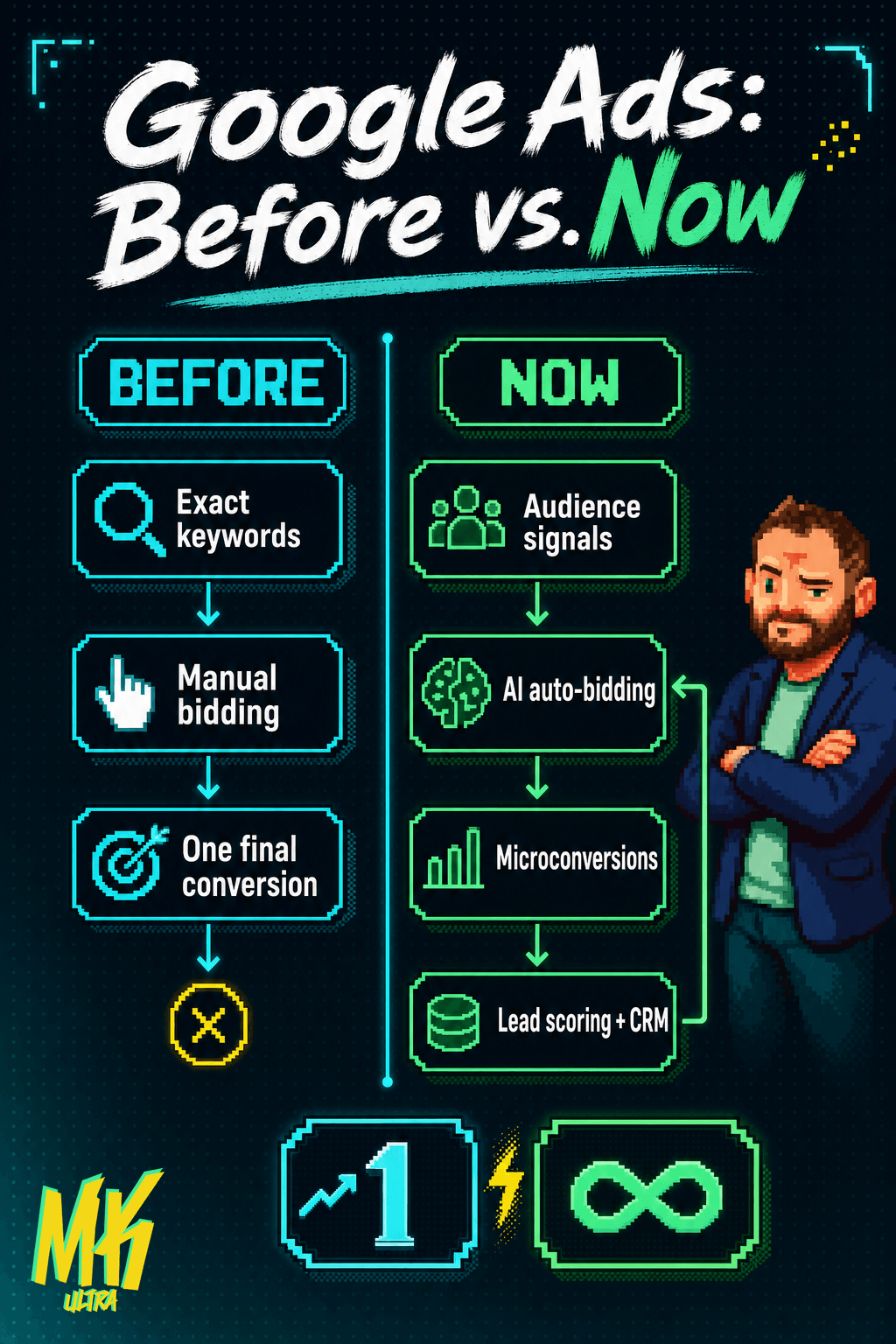
The Google Ads ecosystem in 2026 has something most people would rather not see: the platform no longer optimizes the way it did two years ago. Campaigns built on tight keyword structures, precision match types, and manual bidding are being swallowed by a system that makes more and more decisions for you.
And you know what's funny? Most managers are still optimizing the interface. Moving little levers. Tweaking bid percentages.
As if the game were still the same.
It isn't.
The lever of success in Google Ads today isn't in the interface. It's in what you feed the algorithm.
Microconversions and Lead Scoring: The Real Lever
The worst-kept secret in Google Ads is also the most boring thing you can imagine: conversion management.
I'm talking about microconversions. Lead scoring. Telling the algorithm WHAT happened and, more importantly, how much it was worth.
Google has been pushing toward this ever since it launched enhanced conversions and CRM data imports. But most advertisers are still using a "thanks for your form" as their only conversion signal. It's like giving a GPS the address "somewhere in the US" and expecting it to take you straight to the restaurant door.
The accounts that genuinely perform are the ones feeding the system quality data: which leads turned into clients, which ones were dead ends, how much revenue each one generated. Microconversions like form starts, deep scroll events, or interactions with a product configurator give the algorithm the context it needs to bid with actual criteria. Not on blind faith.
This is the game now. And whoever doesn't get it is going to burn through budget without ever knowing why.
AI Max, AI Mode, and the Death of the Keyword
Here's the big one.
Google has been rolling out AI Mode, its conversational AI-powered search experience. With it come ads integrated directly into AI-generated responses. AI Max campaigns go in exactly that direction: fewer keywords, more audience signals and creative.
The result? A brutal model shift.
The keyword, for all its flaws, had one thing going for it: we could detect transactional intent with surgical precision. Someone searched "buy running shoes size 10" and you knew exactly what they wanted and where they were in the funnel.
That's dissolving.
In an AI-generated results environment, intent is interpreted, not read. And that interpretation belongs to Google, not you. We lose control and visibility. And worst of all: we can no longer know for certain why someone clicked on our ad.
And here's the thing, AI Max campaigns are going to carry much more weight precisely because of this. They're the ones that let you operate inside the AI Mode ecosystem, influencing how you show up in those responses. Whoever learns to handle them first holds the advantage. The rest will be playing catch-up, as always.
Conversion Drops in Google Ads: What's Coming and How to Prepare

I'll be direct because someone has to say it: over the coming months, we're going to see conversion drops across many advertisers.
Not necessarily because campaigns are getting worse, but because the model is changing. Moving from a keyword-based ecosystem, where intent was explicit, to an AI-driven one, where intent is inferred, has a transition cost. Unavoidable.
Zero-click searches have been growing for years (just check your own Search Console data). AI Mode is going to accelerate that trend. More users resolving their questions without leaving the AI-generated response. Fewer clicks. And the clicks that do arrive with far less defined intent.
This isn't the apocalypse. But you need to prepare.
Audit your conversion structure. If you're only measuring the final conversion, you're flying blind. Implement microconversions, import quality data from your CRM, assign real values to each lead type. The algorithm is only as good as what you give it.
On AI Max: don't wait for Google to activate them by default in your account (because it will, heads up). The sooner you understand what signals they use and how to constrain their behavior, the less the transition is going to hurt.
And the interface? Optimization in 2026 happens in your CRM, in your tracking setup, in the data you generate outside the platform. The dashboard dials matter less and less.
The Manager Isn't Dead. The Lazy Manager Is.
Google Ads isn't dying. Let the record show. What's dying is one way of running it: the one that lived on exact match keywords, manual bids, and 200-campaign structures. That era isn't coming back.
What's coming is a game where data outweighs clicks and a well-measured conversion is worth more than the perfect keyword. The manager who does the behind-the-scenes work will always beat the one who only touches the interface.
And if anyone's selling you on the idea that Google Ads runs itself with AI and autopilot, watch out. Because it's exactly the opposite: the more AI Google injects, the more human work you need to make it work for you, not against you.