HubSpot activated a feature that shared contact data between customer accounts to enrich their prospecting. It reversed course within days. And the conversation closed with a collective shrug, "well, they walked it back, it's not that serious." But that's not the point: the feature existed, it was built and ready, and paying customers were the product without knowing it. There it is. The damage is done.

TL;DR: The No-Fluff Summary
- Contact Discovery: HubSpot was cross-referencing data between customer accounts to enrich prospecting. Without explicit consent. It reversed course within days after the backlash.
- Breeze Assistant: In May 2026, HubSpot launched agentic capabilities that query live campaign data. More AI, more access to your data.
- Structural problem: This is not a one-off HubSpot mistake. Every SaaS platform with integrated AI needs the data you generate to improve its product.
- Checklist: Five concrete questions to audit what data you hand over to each tool, and whether the deal is actually worth it.
In this article
What Happened with HubSpot's Contact Discovery?
Contact Discovery was a HubSpot feature that allowed sharing contact data between customer accounts to enrich their prospecting databases. Your CRM was feeding someone else's. Without explicit consent. The backlash was immediate and HubSpot reversed course within days.
Credit where it's due for the speed of the response. Everything else, though, is a problem.
Because a feature like that doesn't get built over a weekend. It's designed, developed, tested, and deployed. Someone approved it. An entire team worked on it. The question nobody seems to be asking: how long had they had it ready? And more importantly: what other features like this are sitting in the pipeline, waiting for the "right" moment?
Breeze Assistant: More Agentic AI, More Access to Your Data
Breeze Assistant, HubSpot's AI assistant, now queries live campaign data with agentic capabilities. That means the AI isn't just answering questions, it's making decisions, accessing your performance metrics, your audience segments, your historical data. HubSpot announced this in May 2026 as a product improvement.
Know what happened? Nobody blinked.
When the label says "AI" and the promise is "automate and optimize," we throw the doors wide open. The same company that was sharing data between accounts a few weeks earlier was now expanding its AI's access to your live campaigns. But this time it came wrapped with a bow, so the narrative shifted. It's the same dynamic we discussed when Google launched Gemini personalization: they offer you a smarter AI in exchange for your data. Yes, the improvement is real. What they don't tell you is what it actually costs.
This Is How AI-Powered SaaS Works, HubSpot Just Got Caught First
Contact Discovery was what came to light. But the business model of any SaaS platform with integrated AI carries a structural incentive to use your data. They all do it. The difference is that some hide it better than others.
Google has been feeding its automated bidding with advertisers' conversion data for years. Meta does the same with Advantage+. Salesforce improves Einstein using the CRM data of paying customers. I'd bet there isn't a single serious platform with an AI layer that isn't doing this to some degree.
The question isn't whether they do it. It's whether they tell you clearly, and whether the value you get justifies the trade.
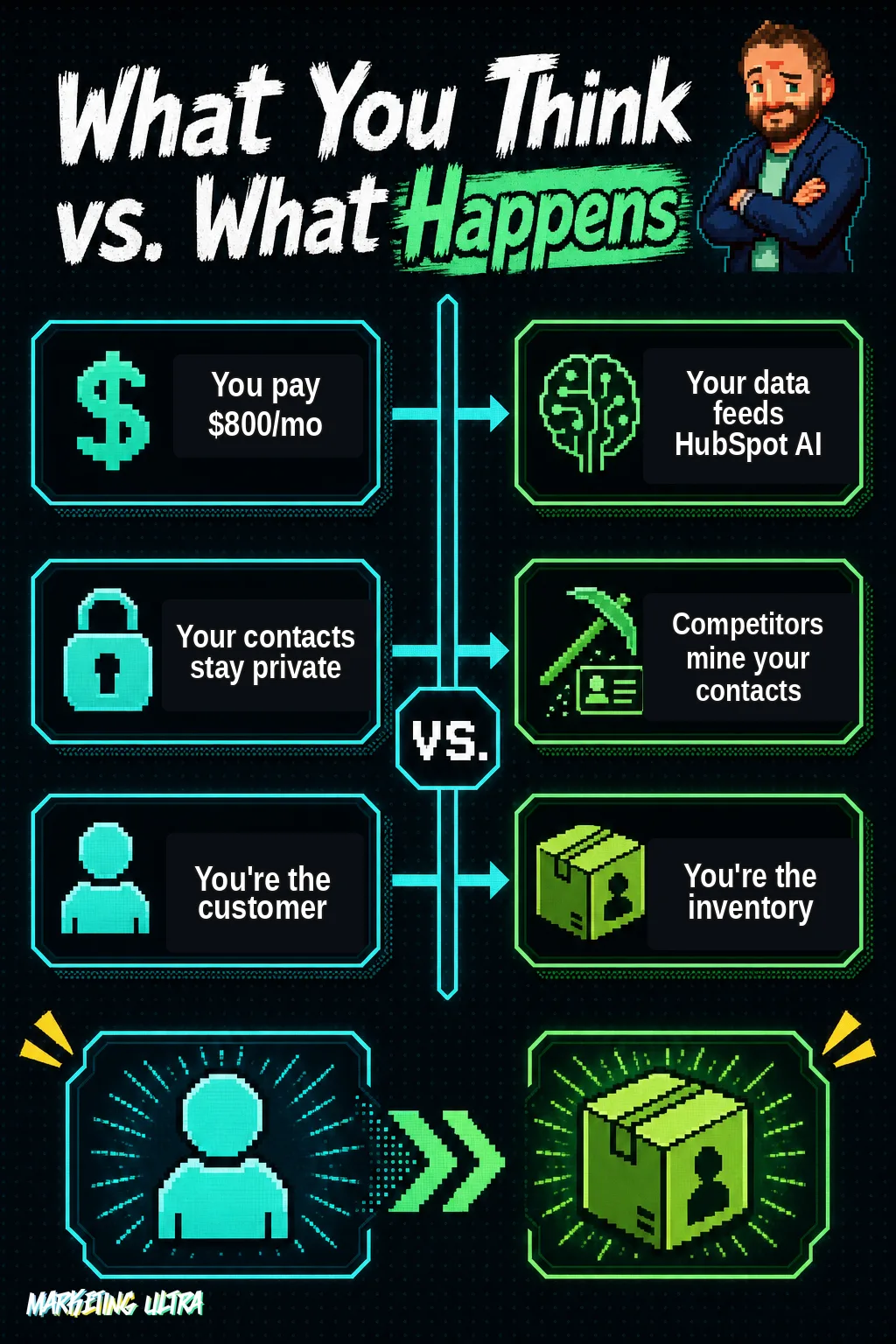
And to be clear: I'm not saying it's always wrong. Google Ads' smart bidding needs your conversion data to work, and the returns usually justify it. What's maddening is the opacity. When you're paying $800 a month for a tool and discover your data is part of the real price, you have a trust problem.
If you run an agency, the stakes multiply. You're managing third-party data. If your tool cross-references it, aggregates it, or uses it to train models, you could be breaching confidentiality agreements without even knowing it. And in an industry where client trust is everything, that's a live grenade. As I cover in the guide to AI content automation at scale, agents with agentic capabilities are a powerful tool. But the more autonomous they are, the more data they need. And the more critical it becomes to know exactly what you're feeding them.
Checklist: What Data Are You Handing Over to Your Tools?
This is what I review before onboarding any new tool at the agency. You don't need a law degree. But you do need to read and ask questions.

- Do the terms of service allow your data to be used for AI training? If the answer is yes, or if it's unclear, that's your first red flag. Look for clauses around "product improvement" and "aggregated data."
- Is there a real, accessible opt-out? Not a toggle buried on page 47 of the advanced settings. A visible, documented option that actually works.
- Is data shared between accounts or with third parties? Contact Discovery was exactly this. Ask before you find out from a Martech article.
- What data does the AI layer actually access? An assistant analyzing aggregate metrics is one thing. One that accesses individual contacts, emails, or user-level conversion data is a completely different game.
- Can you export your data and delete it when you leave? Portability is the litmus test. If you can't take your clean data with you, it was never really yours, it belongs to the platform.
The bottom line is simple: does it pay off? Sometimes yes. Sometimes the trade is fair and the tool gives back more than it takes. But when the platform uses your data to sell a product to your direct competitor, hello again, Contact Discovery, the equation breaks down completely.
Your Data Is Your Asset, Not Their Raw Material
HubSpot walked it back, yes, but tomorrow another Contact Discovery will surface with a new name and better packaging. The tension between improving the product and respecting the data of paying customers isn't going away, because that's how the model works. And the only real barrier between your data and their algorithm is you.
Read the terms. Ask the five questions. And whenever a tool promises you "AI that gets smarter with use," ask yourself: smarter on what data?
If the answer is yours, and nobody has explained that clearly, you're not the customer. You're the inventory.