There's an unwritten rule in Google Ads: whenever they give you something for free, read the fine print. Google just updated Asset Studio with multimodal AI capable of generating images, video, and ad copy without leaving the platform, and launched it into general availability. It sounds like a creative revolution. And in some ways, it is. But if you've been fighting with this platform for years, you know Google doesn't hand out tools out of the goodness of its heart.

TL;DR: The No-Fluff Summary
- Asset Studio with multimodal AI: Google embeds Gemini and Veo inside Google Ads to generate images, video, and ad copy directly within the platform.
- Video from static images: the most powerful feature. Turns product photos into YouTube video ads, no production crew needed.
- One-click A/B testing: instant creative variations for Performance Max, Demand Gen, and similar campaigns.
- EU availability: GA globally, but no explicit confirmation for Europe. Don't assume it's live for you.
In this article
What Actually Changes in Asset Studio with Multimodal AI?
Asset Studio is the creative asset creation and management tool built into Google Ads. Until now it worked as a repository: you uploaded images, organized them, reused them across campaigns. Useful, functional, boring. What Google has done now is inject its generative AI models (Gemini, Veo, and family) to turn it into a full creative production hub.
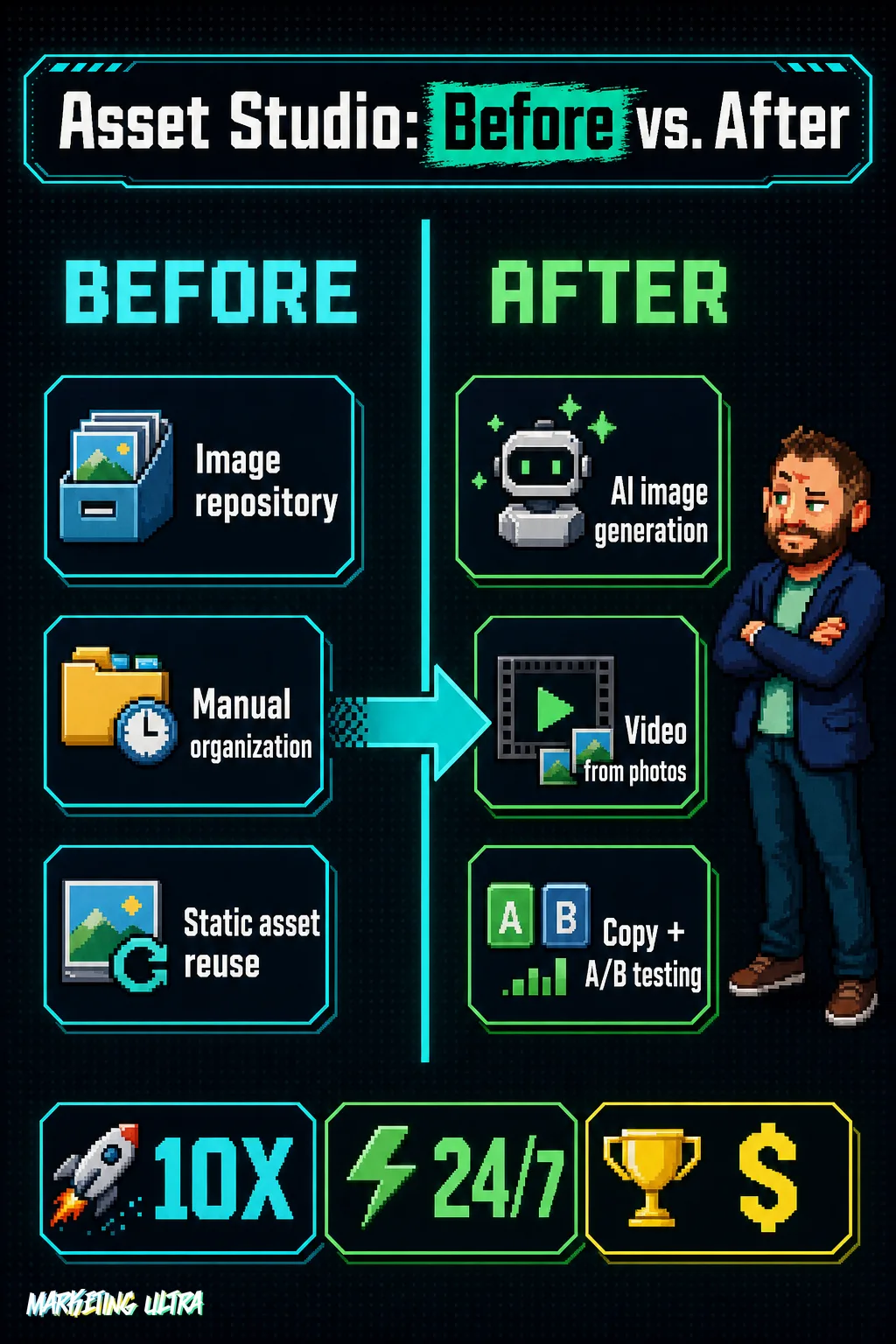
The features landing with this update, according to Google's official announcement, touch almost everything you need to produce:
- Text-to-image generation: describe what you need and the AI generates it. It also creates lifestyle scenes from existing product photos, with realistic backgrounds and contexts that preserve the original's fidelity.
- Text-instruction editing: change backgrounds, add or remove elements, resize for different formats. No Photoshop, no external designer.
- Video from static images: probably the most significant new feature. Animate images, generate horizontal and vertical video for YouTube, even add voiceovers. For anyone without a production budget, this changes the game.
- Ad copy generation: generates copy based on brand guidelines, your website, and campaign objectives.
- One-click A/B testing: launch creative variations to find what works, without spending days in production.
Everything comes with SynthID, Google's digital watermark that identifies AI-generated content. And assets are created, in theory, "policy-ready": the AI tries to comply with advertising policies from the first draft. In theory.
Who Does Asset Studio Actually Make Sense For?
If you need creative volume and don't have a design team behind you, this will matter. But pay attention.
Small businesses with tight budgets stand to gain the most. If you manage Performance Max or Demand Gen campaigns, you know these formats eat through assets: they need images, videos, and copy in quantities a small team simply can't sustain. Asset Studio dramatically lowers that barrier to entry.
For agencies, the value is speed. Generating ten creative variations in minutes and letting data beat gut instinct is exactly what separates the manager who optimizes from the one who launches and prays.
Where you need to be careful is quality. Just because the AI can generate a video doesn't mean it should be your final piece. AI produces "correct" results without breaking a sweat, but "correct" and "memorable" are VERY different things. If your brand lives and dies by a strong visual identity, Asset Studio gives you the first draft, not the finished piece.
More Free Tools, More Lock-In
This is where I put on my Google skeptic hat. Because the pattern keeps repeating.

Google has been running the same play for years: it gives you increasingly powerful tools inside its ecosystem, and each tool ties you in a little tighter. Smart Bidding took away manual bid control. Performance Max took away distribution control. The ad scheduling change quietly removed an indirect brake on spend. And now Asset Studio wants you to produce your creatives inside Google Ads too.
See the pattern? Every piece you hand over to Google is a piece you stop controlling.
I'd bet the average advertiser ends up using Asset Studio as a creative autopilot: generate, launch, forget. And Google is perfectly fine with that, because the more assets you feed into the machine, the easier you make it for the algorithm to spend your budget. The account manager who actually cares will use these tools as an accelerator: generate with AI, filter with judgment, test before scaling anything. The performance gap between those two approaches is going to be stark. It's the same story as Smart Bidding: the tool is good, but only if someone's at the wheel.
Availability in Spain and the EU: unconfirmed. Google is presenting Asset Studio with multimodal AI as globally available, rolling out "globally in English this summer." But the official source does not explicitly confirm it's live in Spain or the European Economic Area. If you manage accounts in Europe, don't assume: check your account and wait for official confirmation before planning anything around this feature.
Asset Studio with multimodal AI is the most substantial update to hit the creative side of Google Ads in 2026. It lowers barriers and accelerates production at a level that used to cost serious money. But the judgment is still yours. And it had better stay that way.