xAI has released Grok 4.5 in open beta, and Elon Musk, with his trademark modesty, has dubbed it "Opus class." Aggressive pricing, competitive speed, and a strong push into agentic workflows, with one continent-sized asterisk: if you're in the EU, you can only watch from the sidelines for now. Here's what's actually worth paying attention to behind the announcement.

TL;DR: The no-fluff summary
- Pricing that turns heads: $2 per million input tokens and $6 per million output tokens. Cheaper than most models in its class.
- Speed and context: 80 tokens per second and a context window of up to 256,000 tokens (500,000 in some configurations).
- Cursor partnership: trained on real coding sessions. xAI is betting on agentic workflows, not just chat.
- EU locked out: the EU AI Act blocks access. No firm date for European availability.
In this article
What Grok 4.5 Actually Brings to the Table
Grok 4.5 is xAI's latest language model (xAI being Elon Musk's artificial intelligence company), launched in open beta on July 8, 2026, with improvements focused on cost, speed, and agentic capabilities. xAI positions it as its most powerful model to date. So far, the standard playbook.
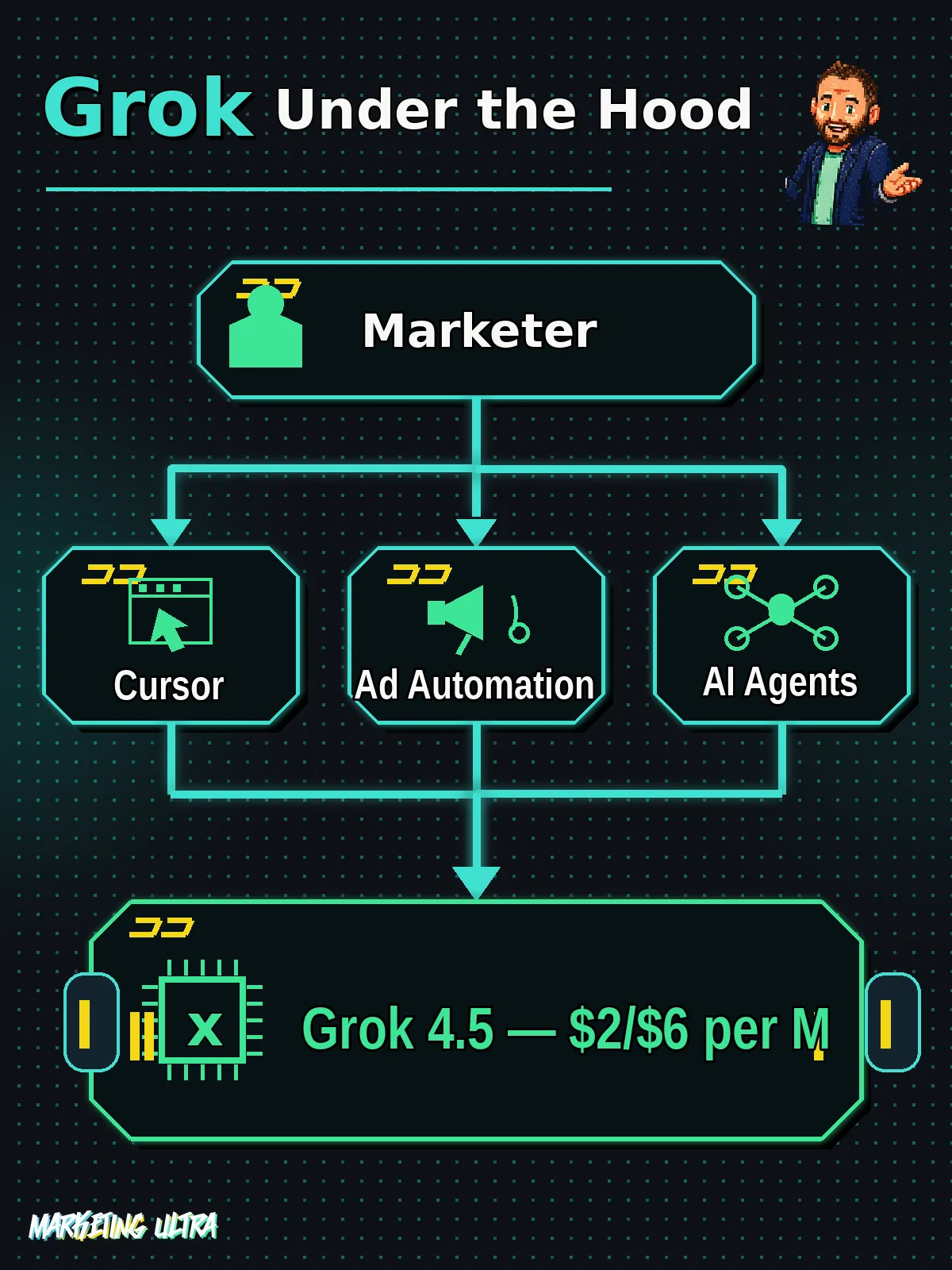
What does stand out is the pricing: $2 per million input tokens and $6 per million output tokens. For anyone running text automation at scale, campaigns with hundreds of variations, recurring reports, this shifts the cost equation. A model that scores 5% lower on a benchmark but costs 60% less per operation wins in production. Every single time.
On speed, it clocks 80 tokens per second with a 256,000-token context window (up to 500,000 in specific configurations). Accuracy on professional judgment tasks has jumped from 35% to 52%, according to Forbes.
But the real story is elsewhere: the Cursor partnership. Grok 4.5 was trained on data from real coding sessions, which lets it understand multi-file codebases and maintain coherence across long sessions. Why should you care about that if you're not a developer? Because it reveals xAI's actual strategy: they don't want you using Grok directly. They want the tools you already use, code assistants, automations, AI agents, to run on Grok under the hood. The marketer doesn't interact with the model; they interact with what gets built on top of it.
The pricing move has "standard playbook" written all over it. It's the same play Google ran with its Flash models: enter cheap, capture volume, then scale. When a model costs half the price, the barrier to trying new things drops. And trying new things with real data is the only way to know whether a tool is actually worth your time.
What Can Marketers Actually Do with Grok 4.5?
When Grok 4.5 reaches the EU, if it does, I see three real use cases.
Ad copy automation. With that context window and that cost per token, producing ad variations at scale for Google Ads, Meta, or email becomes more economically viable. If you're generating 200 headline variations a month for performance testing, the difference between $2 and $10 per million tokens isn't trivial. It's the difference between being able to test and not being able to. That said, the model is just one piece of the process: without a solid workflow behind it, plugging in an LLM and crossing your fingers doesn't work.
Campaign data analysis. Synthesizing performance reports, spotting patterns in historical data, building complex models in spreadsheets. If it delivers on what it promises, the time savings are real.
E-commerce assistants. The improvements in conversation and agentic capabilities point toward chatbots that go beyond "How can I help you today?", personalized recommendations, issue resolution, dynamic product descriptions.
To be clear: all of this is potential. Until you test a model against your data, your campaigns, and your actual accounts, it's just press release copy. When a model sounds too good in the announcement, it tends to come in a notch lower in production. Benchmarks measure ideal conditions; you work with the chaos of 14 active campaigns and a budget that doesn't leave room for experiments.
EU Locked Out: The AI Act Gets in the Way
As of July 10, 2026, Grok 4.5 is not available in the European Union. The reason: the EU AI Act classifies it as a general-purpose AI model with systemic risk, and xAI has not yet completed the compliance requirements.

Sound familiar? It's exactly what happened with Gemini 3 Flash: an interesting model, a splashy launch, and everyone in Europe watching from the stands. Always one step behind.
xAI says it expects to open EU access by mid-July 2026. But "we expect to have it ready soon" in Big Tech language usually means "maybe July, maybe October." No firm date.
EU Availability: Not confirmed
As of the date of publication (July 10, 2026), Grok 4.5 is not available in the European Union. The EU AI Act imposes compliance requirements that xAI has not yet met. The company indicates EU availability "by mid-July," with no firm date. Announcement source: TechCrunch.
Is Grok 4.5 Worth Watching?
Yes, but without urgency. Grok 4.5 has its merits: the pricing is among the most competitive in its class, and the speed holds up. The agentic push with Cursor makes strategic sense.
The thing is, we've seen this script before. New model, glowing benchmarks, promises of a revolution. What will actually determine whether Grok 4.5 matters for marketers is much simpler: does it reach Europe? When? How does it perform on your Google Ads account and your content workflow?
Until then, work with what you have. And if it turns out to deliver when it finally lands, welcome aboard.