An Instagram post with 74 comments makes it sound simple: cancel your $200/month Claude subscription, install a repo, and swap Opus 5 for DeepSeek V4 Flash in 3 minutes. The promise reeks of pure clickbait, but the tool underneath it deserves five real minutes of your time.

TL;DR: The No-Fluff Summary
- Codex-router: an open-source proxy that plugs external models (DeepSeek, Kimi, Grok) into Codex's selector as subagents.
- Raw savings: DeepSeek V4 Flash costs ~$0.22/M input tokens vs $5 for Opus 5. About 23x less.
- Setup: install via Homebrew or a guided script, done in minutes. Not magic: you need API keys and judgment.
- Real risk: community project, not an official product. Your credentials flow through it.
In this article
What codex-router is and what problem it solves
Codex-router is an open-source proxy that lets you use DeepSeek V4 Flash and other external models as subagents inside Codex, OpenAI's engineering agent platform.
Codex added subagents in March 2026: a main agent that delegates subtasks to secondary agents running in parallel, each in its own isolated session. It works great for exploring large codebases or shipping features in phases. The catch: natively, it only accepts OpenAI models.
Codex-router solves that by acting as a local proxy. It intercepts Codex's requests and routes them to whichever provider you choose. DeepSeek, Kimi, Grok, or even Claude show up in the selector as if they were native. Installation is via Homebrew or a guided script, and LiteLLM handles translating each request to the target provider's protocol. Three minutes is optimistic, but you're not losing an afternoon either.
DeepSeek V4 Flash vs Opus 5: the numbers that sting
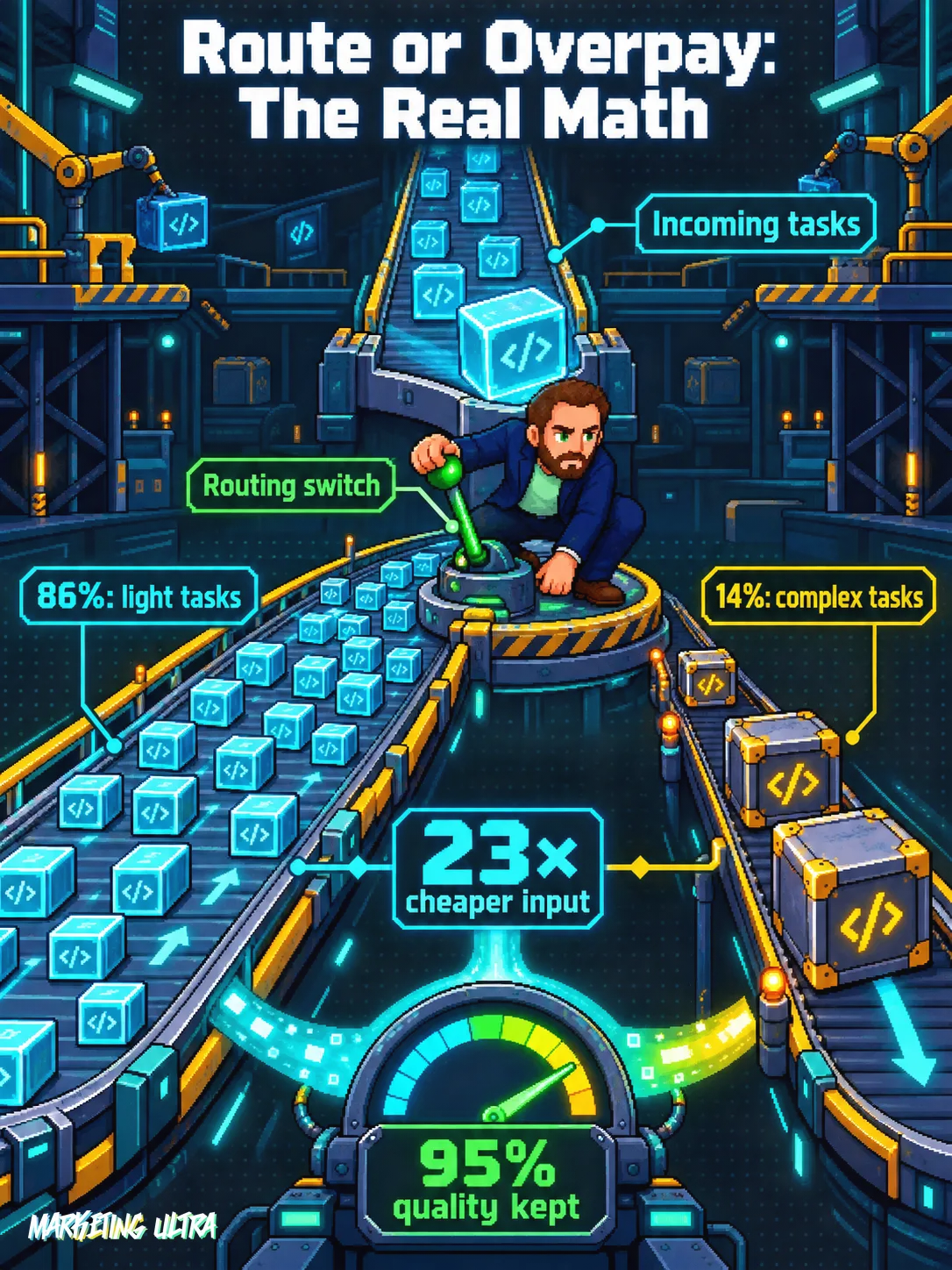
DeepSeek V4 Flash costs about 23x less than Claude Opus 5 on input tokens and 38x less on output. Twenty-three times. Those are the numbers that matter.
Pricing as of August 2026, according to OpenRouter:
- DeepSeek V4 Flash: $0.22 per million input tokens, $0.66 per million output tokens (off-peak hours).
- Claude Opus 5: $5 per million input tokens, $25 per million output tokens.
DeepSeek V4 Flash is a Mixture-of-Experts (MoE) model with 284 billion total parameters, but only activates 13 billion per inference. Context window of one million tokens. On raw benchmarks it doesn't match Opus 5 on most tasks, but the price gap is so enormous the question flips: which tasks actually NEED the expensive model?
On TikTok, a video by @jceronch with over 50,000 views on using DeepSeek V4 Flash for free with OpenCode nails it in one comment: "deepseek v4 flash is cracked, massively underrated model."
Model routing: the idea that actually matters
The concept is straightforward: classify each task by complexity and send it to the model that gives you the best quality-to-price ratio for that job. It's not about "replacing" the expensive model, it's about stopping to use it where you don't need to.
A study presented at ICLR 2025 (RouteLLM) showed this strategy can cut inference costs by 85% while maintaining 95% of GPT-4 quality. Only 14% of queries needed the frontier model. The rest were handled by lightweight models.
I've been making this case for a while when talking about how to automate AI workflows intelligently: the most powerful model is irrelevant if you don't have a system that decides when to use each piece. Same story as when you decide when to use ChatGPT vs Claude. Classifying intent, formatting, confirming short actions: cheap model. Complex reasoning and architectural code? That's when you bring out the heavy artillery.
What the Instagram post doesn't tell you
Now for the part I actually care about: what gets left out of the carousel.
First: you're not "canceling" anything. Codex is OpenAI's product. To use it you need their access or their API. Codex-router doesn't replace Codex, it adds external models to it. If your workflow stays on Codex, you're still paying OpenAI.
Second: codex-router is a community project, not a product with official support or continuity guarantees. Your API keys for DeepSeek (or whichever provider you use) pass through that proxy. The repo says credentials are handled in isolation. You decide how much you trust a README.
And third, the thing I'd bet nobody explains in an Instagram carousel: multi-subagent workflows consume MORE tokens in total than a single-agent run. Each subagent launches its own tool cycle. You save per token, yes, but you spend more tokens. The net savings depend on what proportion of tasks you can migrate to cheaper models without the final output quality dropping. And that requires measuring. Not assuming.
Copy this and paste it into Claude Code, Cursor, or your favorite coding assistant:
Install codex-router from https://github.com/duolahypercho/codex-router, configure DeepSeek V4 Flash as a subagent using my DeepSeek API key, and run a test task that classifies 10 issues from a repo by priority to verify the routing works.
No coding skills required. The assistant handles installation, configuration, and testing.
Teams of models, not lone models
The Instagram headline doesn't matter. What matters is the trend underneath it: we're moving away from looking for "the model that does everything" toward building model teams where each one handles its lane at the right price. Same logic as a human team, you don't put your creative director on traffic reports.

Codex-router is a young tool, with the limitations of a community project. But the idea behind it is gaining ground. If you manage AI workflows at volume, and if you're reading this, you probably do, test it in a controlled environment and measure the real savings before making any decisions.
The question is no longer whether you can use cheap models as subagents. Of course you can. The question is whether you'll do it with judgment or blind faith in an Instagram post.
Frequently asked questions about DeepSeek V4 Flash as a subagent in Codex
What is Mixture-of-Experts and why does it lower inference costs?
Mixture-of-Experts (MoE) is a neural network architecture that splits the model into specialized "experts" and only activates a subset per inference. DeepSeek V4 Flash has 284 billion total parameters but only activates 13 billion per query, which cuts computational cost without sacrificing the model's overall capacity.
Does codex-router only work with DeepSeek?
No. It supports multiple providers: DeepSeek, Kimi, GLM, Grok, Claude, and GitHub Copilot. LiteLLM translates each request to the target provider's native protocol, letting you mix models by task within the same Codex workflow.