Auditing a Google Ads account by hand takes hours. Auditing twelve advertising platforms at once, with a health score and every finding backed by its source, sounds too good to be free. Claude Ads is an open source skill that promises exactly that from Claude Code. What does it actually analyze, and where does the “set it up yourself” part begin?

TL;DR: The No-Nonsense Summary
- Open Source & MIT: free, forkable, no external server. Runs in your Claude Code session.
- 12 platforms: Google Ads, Meta, TikTok, LinkedIn, Amazon, YouTube, Microsoft Advertising and five more, each with a dedicated auditor.
- Read-only by default: changes nothing in your account without explicit approval and multiple security controls.
- Requires your data: account exports or API access. Installation alone audits nothing.
- 9,471 GitHub stars (September 2026): high developer interest; independent evidence of real-world use is still scarce.
In this article
| What it is | Open source skill that audits Google Ads, Meta, TikTok and 9 other platform accounts with 0-100 scoring and a prioritized action plan, all from Claude Code. |
|---|---|
| Official website | https://claude-ads.md/ |
| Repository | repo |
| License | MIT |
| Price | open source |
| Alternative to | Manual PPC audits and periodic advertising account reviews |
| GitHub Stars | 9,471 |
| Launch Year | 2026 |
| Maintained by | AgriciDaniel (individual) |
| Platforms | Claude Code (plugin), Codex, Gemini, Cursor, Windsurf, Goose; Linux, macOS, Windows |
| Requirements | Claude Code; CPython 3.11 or 3.12; Playwright (web capture); WeasyPrint and Pango (PDF) |
| Integrations | Google Ads, Meta Ads, YouTube Ads, LinkedIn Ads, TikTok Ads, Microsoft Advertising, Reddit Ads, Snapchat Ads, X Ads, Apple Ads, Amazon Ads, Pinterest Ads |
Reviewed on 2026-09-22
This tool is included in these collections: Marketing skills for Claude Code and Codex · Skills for Claude Code, Codex and Coding Agents by Task
The Problem It Solves
Claude Ads automates advertising spend auditing across up to twelve platforms, with findings classified by confidence level and sources in plain sight.
Anyone managing paid media across more than two platforms knows the drill: open Google Ads, review search terms, jump to Meta, peek at TikTok to check nothing has gone off the rails. Each platform with its own dashboard, its own logic, its own metrics disguised as something else. Every manual audit is time you are not spending on optimization.
Periodic audits are not optional. As we covered in the complete Google Ads guide, an unreviewed account bleeds budget while nobody watches the drain. But doing them manually across twelve platforms is unworkable for a small team. And SaaS alternatives tend to be paid, proprietary, and rely on a black-box score where you cannot see how the grade was calculated.
Claude Ads takes a different approach: an open source skill with a dedicated auditor for each of the twelve platforms it covers. Everything on your machine, nothing on someone else’s server.
Getting Started
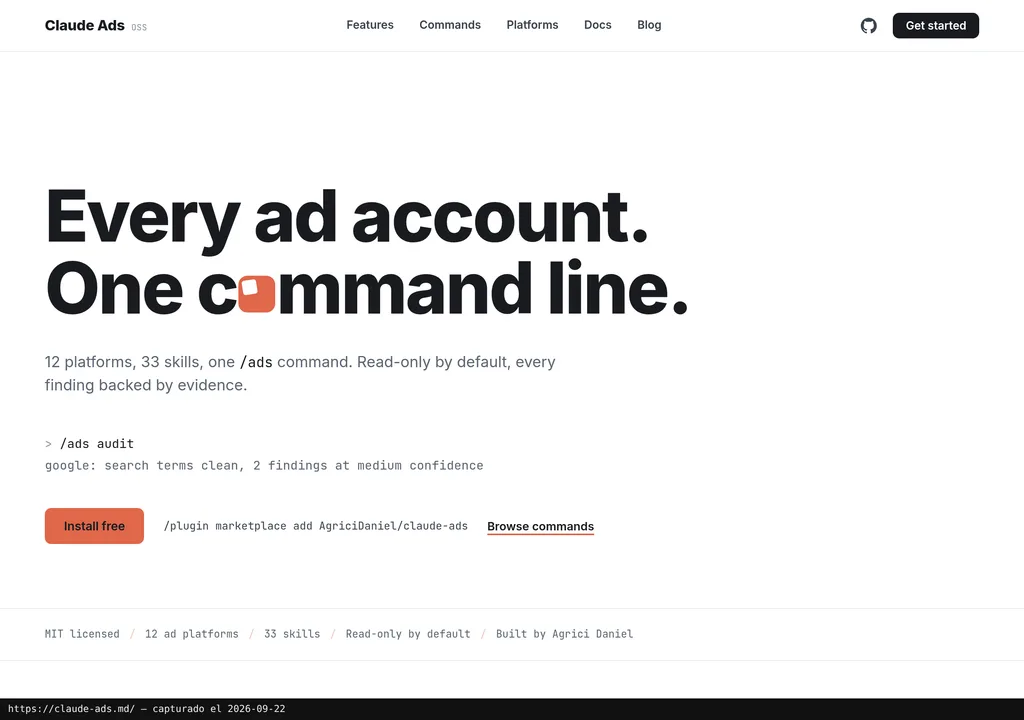
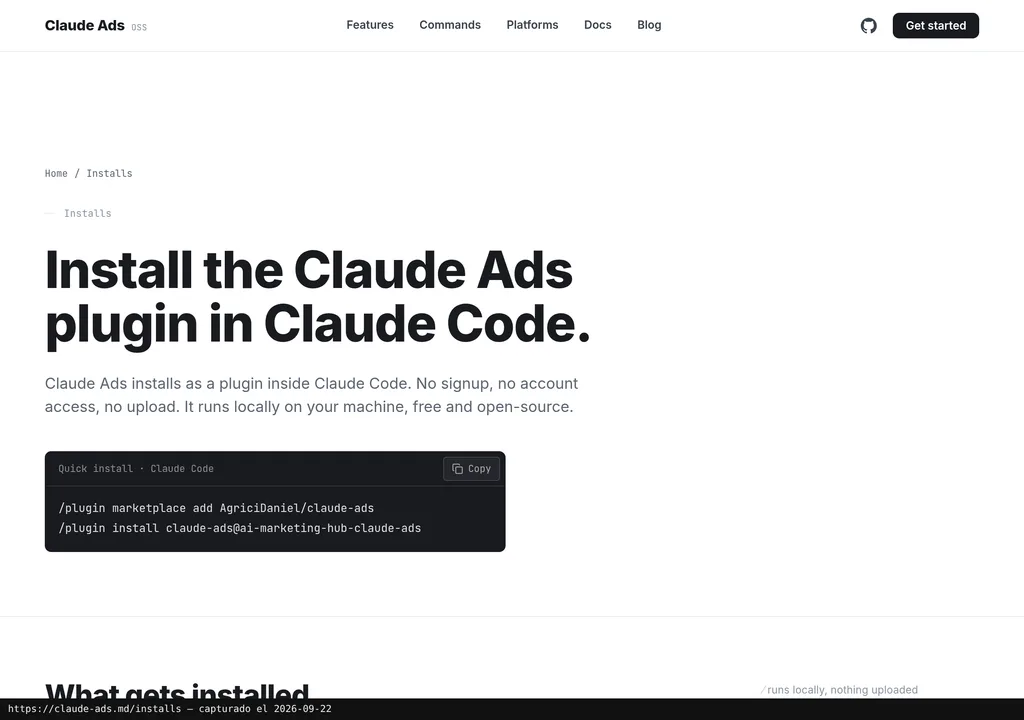
Installation runs from Claude Code using two plugin-system commands, no compilation, no external services to spin up.
Claude Code is the canonical environment. Other agents (Codex, Gemini CLI, Cursor, Windsurf, Goose) can consume the skill files if their runtime supports it, but the official documentation only guarantees the full experience in Claude Code. Technical requirements: CPython 3.11 or 3.12. Optionally, Playwright for web captures and WeasyPrint with Pango for PDF reports.
The quick route:
/plugin marketplace add AgriciDaniel/claude-ads
/plugin install claude-ads@ai-marketing-hub-claude-ads
You can also clone the repository and run bash install.sh --source=local. Once inside, /ads setup creates the client profile with KPIs and privacy constraints. Then /ads audit launches a full or platform-specific audit.
Copy this and paste it into Claude Code, Cursor or your favorite code assistant:
Install Claude Ads from https://github.com/AgriciDaniel/claude-ads, run /ads setup to configure my Google Ads account and launch /ads audit google to see the health report with prioritized findings.
No coding required. The assistant handles installation, configuration and testing.
Using It in Real Marketing
Where does this fit? An agency or freelancer managing paid media across several platforms with no full day to spare for auditing each one.
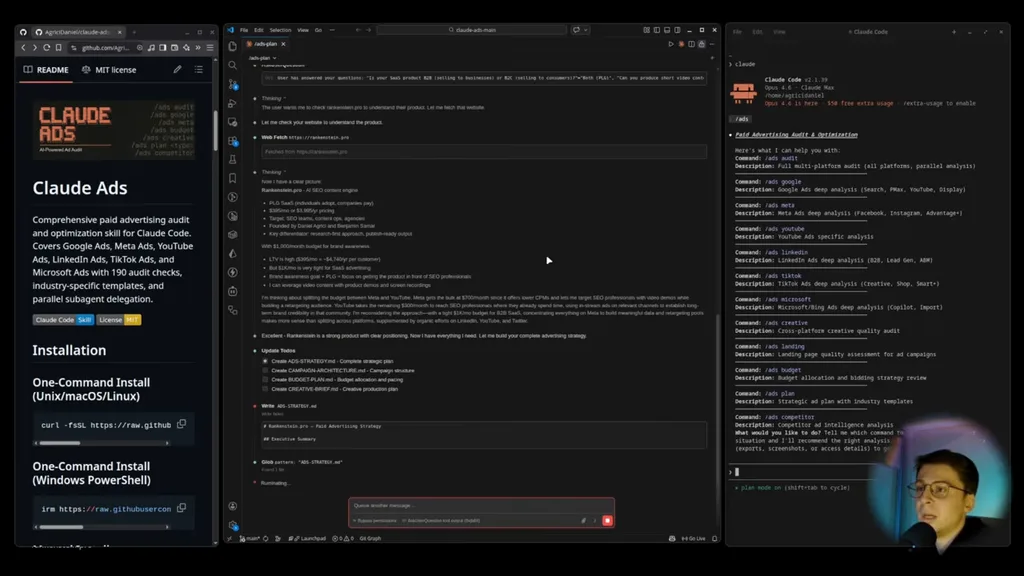
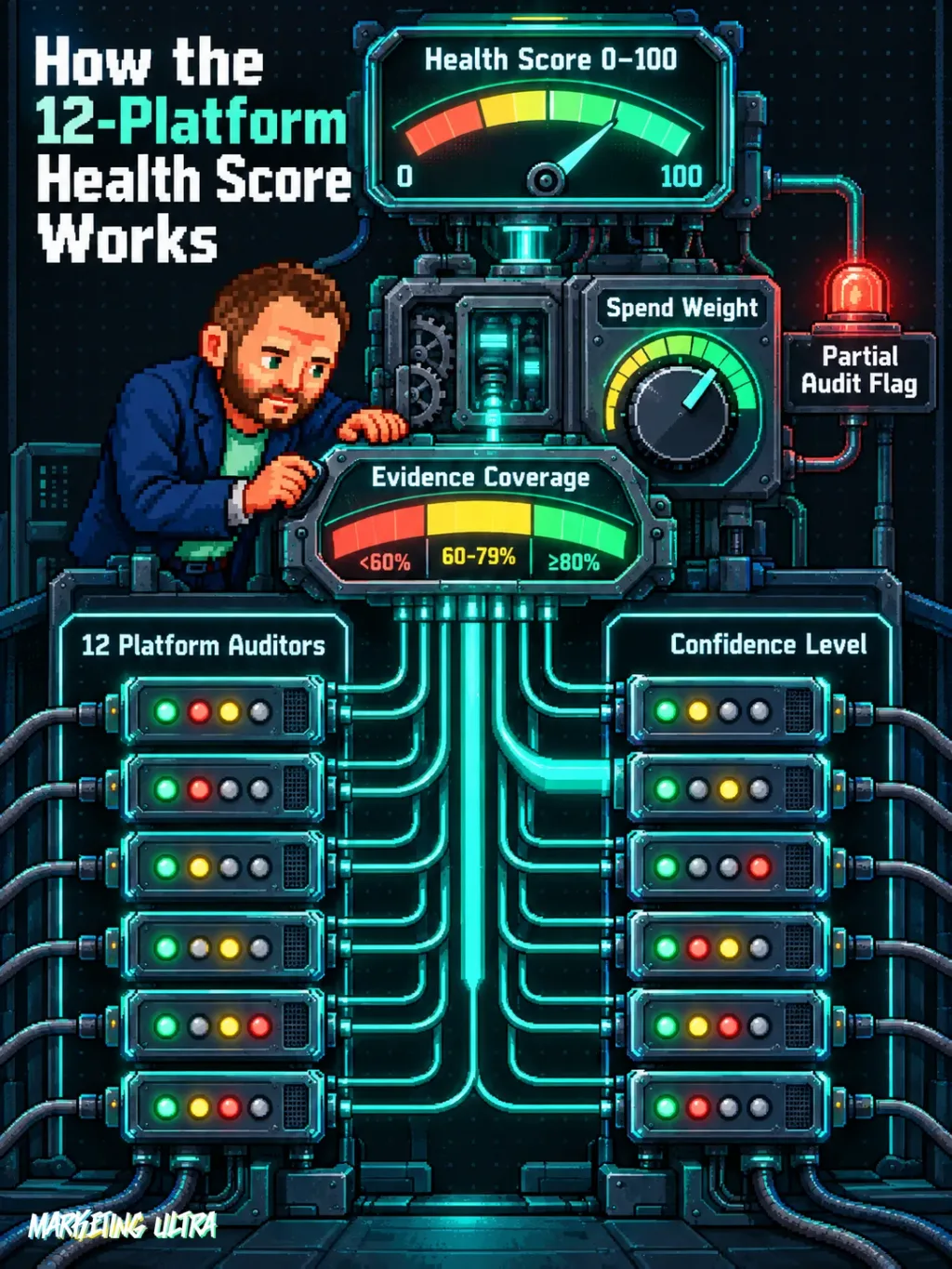
The documented workflow: connect account exports or read-only API access, run /ads audit and the system deploys one auditor per platform. Google Ads, Meta Ads, TikTok Ads, LinkedIn, Amazon, YouTube, Microsoft Advertising, Reddit Ads, Snapchat, X Ads, Apple Ads and Pinterest Ads. Each returns findings with a confidence level and a health score from 0 to 100, weighted by spend, the platform where you spend most carries more weight in the final grade. Output is delivered as JSON and rendered in Markdown, HTML or PDF.
Note: we have not run this audit on our own accounts. What follows describes what the repository documents, not a first-hand test.
The architecture can be independently verified: if an auditor fails, the audit is marked as partial. It is NEVER presented as complete when it is not.
In an industry where the platforms’ own optimization scores tend to inflate good news, and nudge you to spend more along the way, a tool that shows its sources and admits what it does not know is already a different animal. That is where Claude Ads’ real value probably lies: visible logic.
The catalog goes beyond auditing: 33 skills covering planning, creatives, spend monitoring and controlled tests, all under the same read-only policy.
What They Do Not Tell You
Read-only by default does not mean it works on its own after installation. Claude Ads needs real data from your accounts: exports or API access. Without that, the skill exists but audits nothing.
Account operations (budgets, bids, launches) require connectors, data and explicit authorization with multiple controls: account IDs, a human-readable diff, owner approval and remote state verification. If you expect “install and it works,” you will hit a wall.
The 9,471 GitHub stars (as of September 2026) reflect developer community interest. They do not prove ROAS improvements, do not equal installs, and do not mean thousands of agencies are running it in production. Curiosity, not adoption.
Compatibility with other agents (Codex, Gemini CLI, Cursor, Windsurf, Goose) is stated in the README but without any published functional proof outside Claude Code. If your environment does not go through Claude Code, there are no guarantees.
Alternatives
The direct alternative to Claude Ads is manual PPC auditing: opening each platform, reviewing metrics, documenting findings and prioritizing actions. It is what most of us do. It works, but it does not scale.
There are SaaS audit tools (Optmyzr, Adalysis, Opteo for Google Ads), paid and focused on one or two platforms. Claude Ads is open source, covers twelve and runs locally. The trade-off: you need Claude Code, comfort with the command line and patience to set up access for each platform.
Within the ecosystem of marketing skills for code agents, Corey Haines’ Marketing Skills covers a different angle (strategy, content, positioning), not ad account auditing. They are complementary, not substitutes.
Verdict
Multi-platform paid media auditing is a headache. Most teams put it off until the budget has already burned. Claude Ads aims directly at that problem.
On paper it looks good: independent auditors per platform, investment-weighted scoring, confidence-rated findings, read-only policy. A lot of paid media managers would want something like this if they knew it existed.
What is missing is independent evidence. There are no agency reviews explaining how it changed their workflow, no published comparisons, no threads saying “saved me X hours.” There are stars and an impeccable README, but not a single documented use case.
For anyone working with AI agents applied to marketing, Claude Ads deserves a spot on your radar. Install it, connect a test account and run /ads audit, that is how you find out whether it catches anything your manual review misses. Just do not expect miracles. A skill does not replace the professional who tends the account.
Frequently Asked Questions About Claude Ads
Does Claude Ads need access to my ad accounts?
Yes. Claude Ads works on account exports or read-only API access. Installing the skill does not by itself grant access to any platform: you manage and authorize permissions yourself.
Does it work in Cursor, Codex or other code agents?
Claude Code is the canonical environment and the only one with a guaranteed experience. The README declares compatibility with Codex, Gemini CLI, Cursor, Windsurf and Goose, but there is no published functional proof outside Claude Code.
What is the 0-to-100 health score?
A composite score made up of individual checks (pass, fail, unknown, not applicable), weighted by spend: the platform where you spend most carries more weight. With 80% or more evidence coverage the score is firm (graded); between 60% and 79% it is marked provisional; below 60% the system considers it insufficient evidence.