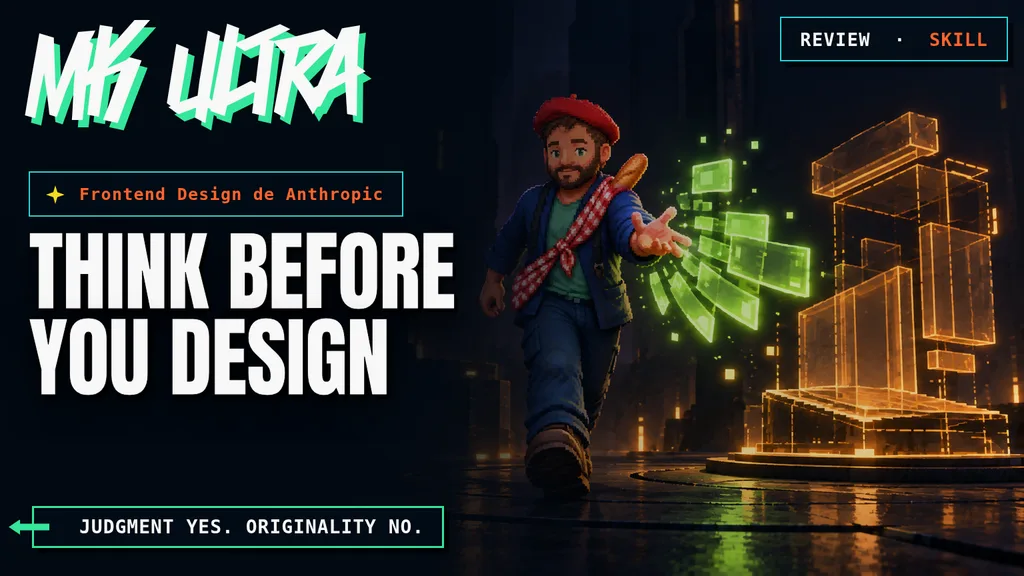
You ask your coding agent to build a landing page and it delivers something that looks like it was pulled from a 2016 Bootstrap tutorial. Default colors, generic typography, zero visual judgment. Anthropic’s Frontend Design is a free skill that tries to solve exactly that: giving your agent art direction before it touches a single line of CSS.

TL;DR: The No-Nonsense Summary
- What it is: an official SKILL.md from Anthropic’s anthropics/skills repository. Free, compatible with Claude Code, Claude.ai, and the Claude API. Per the Agent Skills standard, also compatible with Codex and Cursor.
- What it does: forces the agent to plan palette, typography, and composition before generating frontend code.
- Key limitation: does not guarantee original design. Without a detailed brief and references, results tend to repeat.
- License: proprietary (Anthropic Commercial Terms), not open source in the strict sense.
In this article
| What it is | Skill that turns Claude Code into an art director: plans palette, typography, and composition before writing code, avoiding the generic AI aesthetic. |
|---|---|
| Official website | https://github.com/anthropics/skills/tree/main/skills/frontend-design |
| Repository | repo |
| License | Proprietary, Anthropic Commercial Terms of Service, All rights reserved |
| Price | free |
| Alternative to | Default CSS templates and manually written style prompts for coding agents |
| GitHub stars | 177,464 |
| Launch year | 2025 |
| Maintained by | anthropics (organization) |
Reviewed on 2026-09-23
This tool is included in these collections: Design skills for Claude Code and Codex · Skills for Claude Code, Codex and Coding Agents by Task
The Problem It Solves
Coding agents are good at generating functionality. Forms that submit, modals that open and close without a hitch. The problem comes when the result has to convince visually.
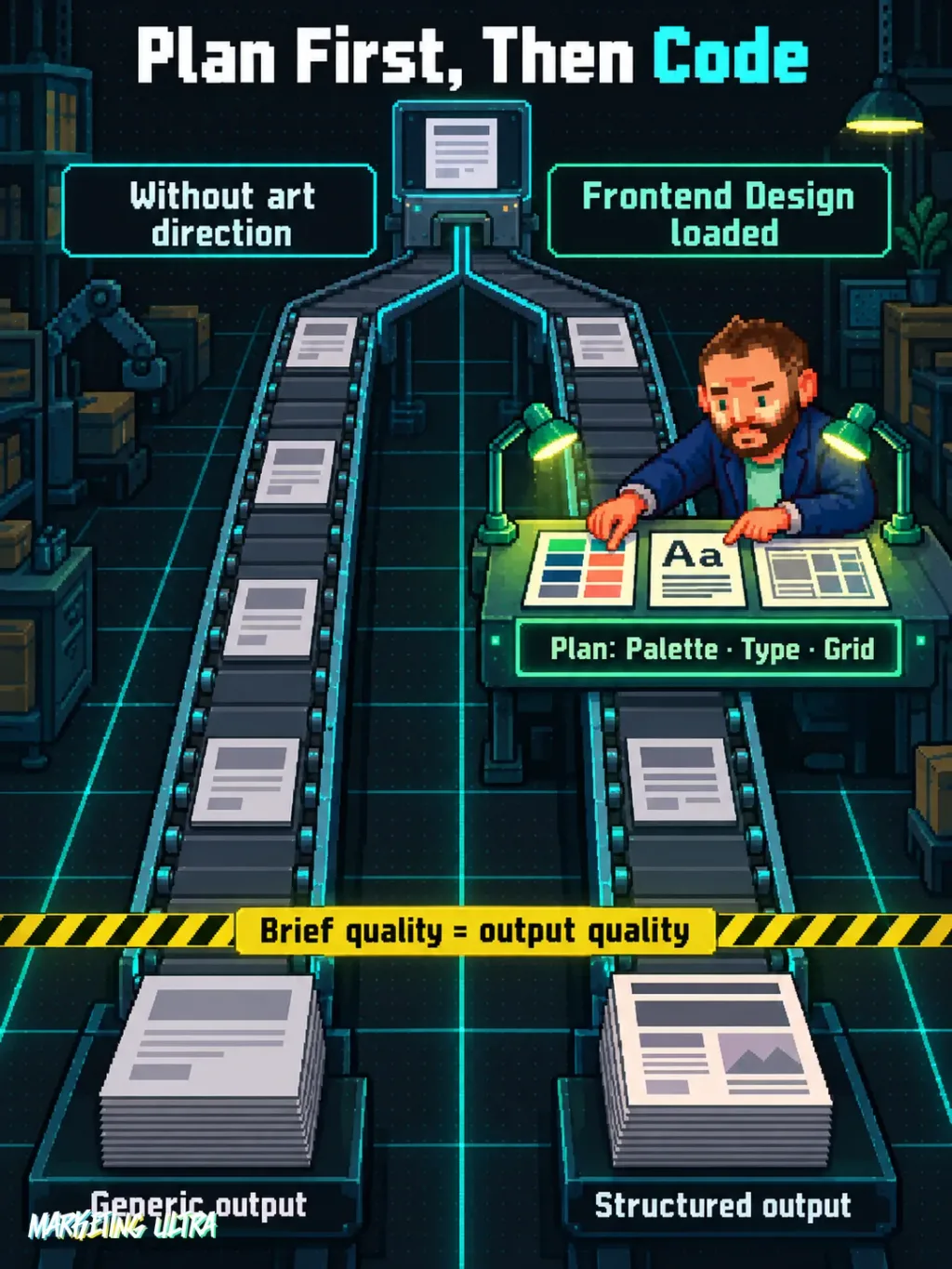
Without design instructions, an agent applies what it knows: default values, safe palettes, layouts that take no risks. The result works. And it is forgotten within three seconds. For a marketing team that needs to prototype landing pages fast, that is a real problem. You are not going to present a prototype to a client if it smells machine-generated.
And asking “make it prettier”? That does not work. Without structured aesthetic criteria, the agent improvises. Frontend Design targets that gap: it is a SKILL.md file from the official anthropics/skills repository that loads into the agent and gives it art direction instructions. It makes the agent think about how the page is going to LOOK before writing code. Like an art director briefing a junior on a mockup.
Getting Started
Frontend Design lives inside the official anthropics/skills repository on GitHub. It is not a standalone application or a heavy plugin: it is an instruction file the agent loads dynamically.
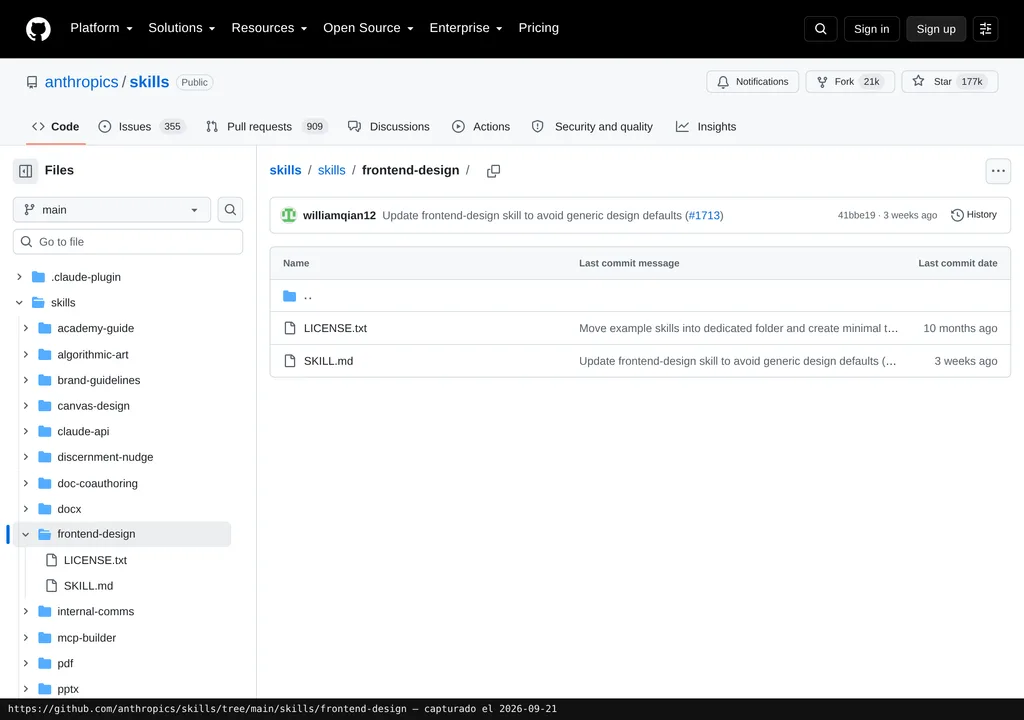
In Claude Code, you first register the repository as a plugin marketplace and then install the skills package:
/plugin marketplace add anthropics/skills
/plugin install example-skills@anthropic-agent-skills
You can also do it by browsing the marketplace from Claude Code. In Claude.ai it is already available for paid plans, and it can also be used via the Claude API.
Once installed, you do not need to invoke it with a special command. Ask the agent to design an interface and the skill activates. The README documents compatibility with Claude Code, Claude.ai, and the Claude API. Codex and Cursor are compatible per the Agent Skills standard.
Copy this and paste it into Claude Code, Cursor, or your favorite coding assistant:
Register the skills repository with /plugin marketplace add anthropics/skills and install the package with /plugin install example-skills@anthropic-agent-skills. Then create a landing page for [describe your product here] planning the full visual direction before writing any code.
No coding knowledge required. The assistant handles installation, configuration, and testing.
MCP for Frontend Design de Anthropic
Frontend Design is NOT an MCP server. It is a skill. They are different mechanisms. Do not mix them up.
Skills are instruction files (SKILL.md) that the agent loads to improve at specific tasks. MCP (Model Context Protocol) connects the agent to external tools and data: Figma, databases, APIs. Giving the agent design instructions has nothing to do with connecting it to a design tool.
As of this review (September 2026), there is no official MCP integration for Frontend Design. If you need to connect your agent to external design tools, that requires a dedicated MCP server. I have not been able to verify an undocumented integration: if one exists, official sources do not mention it.
Using It in Real Marketing
The most direct scenario: prototyping landing pages for campaigns. You need to test three page variants for a seasonal promotion. Without a design skill, the agent generates something functional but flat, with the aesthetic that anyone who has ever generated a website with AI recognizes instantly. With Frontend Design loaded, the flow changes: the agent plans first (visual hierarchy, spacing, palette) and executes after.
Does it work? There is no independently verifiable evidence as of today. The logic says yes: an agent with structured design instructions has to produce a better result than one without them. But without testing it on your project, it is theory.
The important nuance: the result depends brutally on what you give it. A generic brief (“build me a SaaS landing”) will produce a generic design with or without the skill. This applies to any AI agent applied to marketing: the tool amplifies what you give it, it does not invent what you withhold. Those who know how to give the agent the right instructions will make all the difference.
We did not run a local test for this review. Conclusions are based on official documentation and available sources.
What They Do Not Tell You
The anthropics/skills repository has racked up an impressive star count on GitHub. But those stars belong to the whole monorepo, which contains dozens of different skills. There is no public adoption metric specific to frontend-design. Do not confuse the package’s overall popularity with validation of one particular piece.
The foreseeable risk: without a design system of your own feeding the agent, results tend to look alike. The skill gives you criteria, but not originality. If you always ask for the same thing without references or a proprietary palette, you will get variations on the same theme.
While many skills in the repository are Apache 2.0, Frontend Design uses the Anthropic Commercial Terms of Service, all rights reserved. You can use it, but it is not open source in the strict sense. If you are thinking of forking or adapting it to your workflow, review the terms before investing hours.
Alternatives
The direct alternative is what Frontend Design tries to replace: manual style prompts written by hand every time you ask an agent for an interface. It works if you are consistent, but it does not scale and forces you to repeat instructions in every new conversation.
UI UX Pro Max Skill is a third-party skill with a similar approach but independent of Anthropic. We have analyzed it in detail and it is worth comparing if you are evaluating options.
A word of caution: Claude Code /design is a proprietary feature integrated directly into Claude Code, not an open skill. They are different products with different philosophies, one is an instruction file you load yourself, the other is a native product capability. Do not confuse them. If you want the full picture, our guide to design skills for coding agents puts them in context together.
Verdict
Anthropic’s Frontend Design does one thing well: forcing the agent to think before it designs. That alone separates it from the raw “build me a landing page.” It is free, installation is straightforward, and compatibility with Claude Code, Codex, and Cursor makes it accessible to anyone prototyping interfaces with agents.
But it is not magic. Without a decent brief and visual references, the result will still smell like AI. The proprietary license limits what you can do if you want to adapt it, and the absence of its own adoption metrics makes it hard to know how many people actually use it. My bet is that the real value is in the idea it plants: a coding agent NEEDS structured design instructions before it starts generating HTML. That will remain true long after this SKILL.md becomes outdated or someone surpasses it.
Does it replace a designer? Not even close. But for prototyping with agents, it is worth a try.
Frequently Asked Questions about Anthropic Frontend Design
Is Frontend Design the same as Claude Code /design?
No. Frontend Design is an open skill (SKILL.md) from the anthropics/skills repository that you load into your agent. Claude Code /design is a proprietary feature integrated directly into Claude Code. They are completely different.
Does Frontend Design generate a complete design system?
No. It plans the visual direction for each specific task, but does not create a persistent design system that evolves with your brand. Each conversation starts from scratch unless you provide design guidelines as additional context.
What is the Agent Skills standard?
Agent Skills is an open format for packaging instructions that coding agents load dynamically. Each skill is a folder with a SKILL.md file (YAML metadata plus Markdown instructions). Compatible with Claude Code, Claude.ai, and the Claude API. Per the Agent Skills standard, also compatible with Codex, Cursor, and other agents.