The Knak report spells it out: 70% of enterprise marketing teams are already using AI in their production workflows. Emails, landing pages, creatives, everything ships faster. And 69% still measure success with click-through rate (CTR). The industry has automated speed, but hasn't updated the scoreboard: it's producing twice as much using the wrong ruler.

TL;DR: The No-Fluff Summary
- Faster production, frozen measurement: 70% of enterprise teams use AI to produce content, but 69% still measure with CTR.
- Only 41% measure what matters: revenue or influenced pipeline. The rest report vanity metrics.
- GA4 pours fuel on the fire: GBRAID and gad_ parameters get stripped, and paid sessions show up as organic or "(not set)".
- The problem is systemic: we've automated a measurement system that was already broken. AI just floored the accelerator.
The Knak Report: AI Speeds Up, Metrics Don't
Measuring AI ROI in marketing requires, at minimum, knowing what you're actually measuring. And according to the latest state of marketing production report, most teams don't.
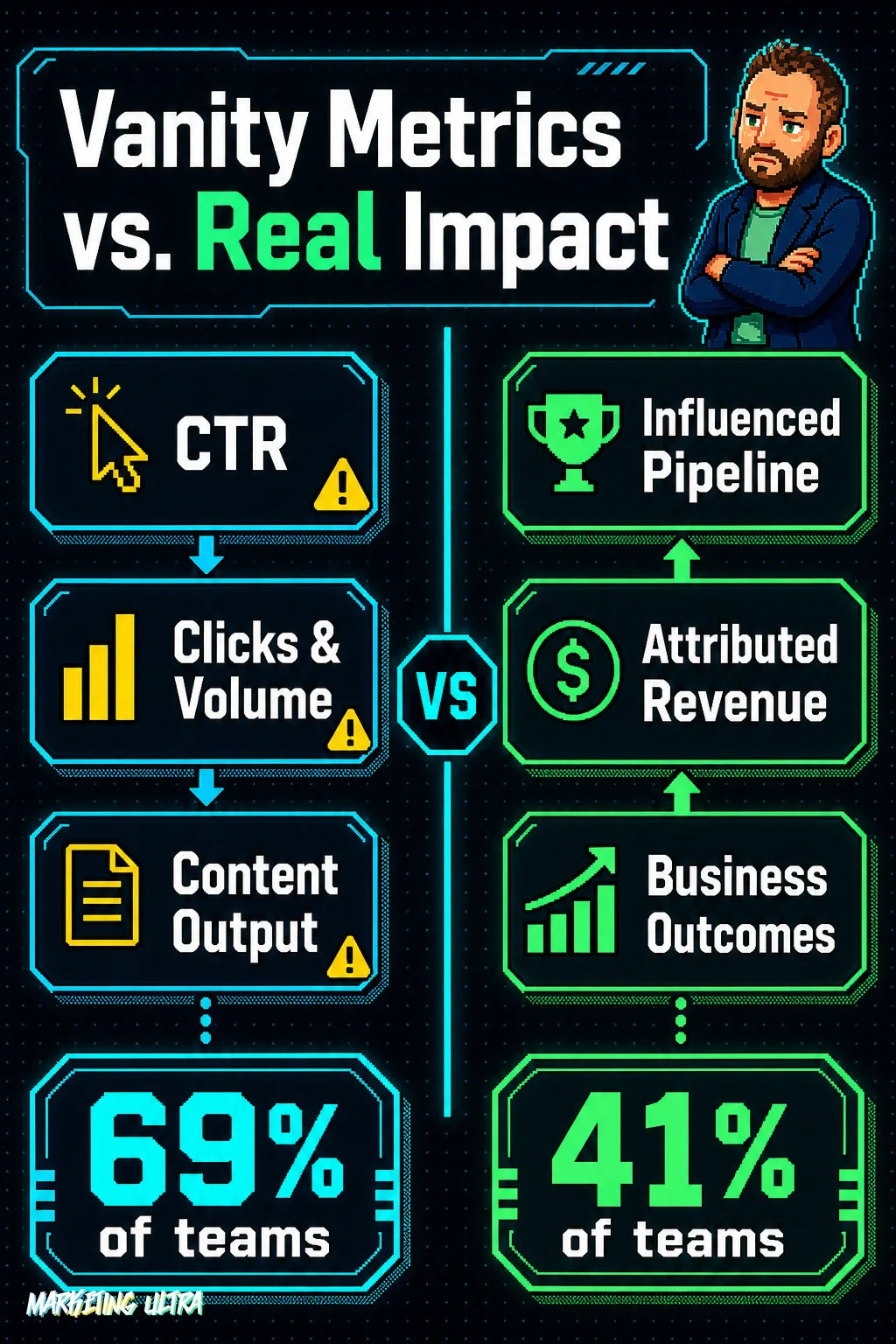
The numbers: 70% of enterprise teams have integrated AI into production. The efficiency promise holds up on the "getting things done" side. But only 41% measure generated revenue or influenced pipeline. The rest are still anchored to CTR as their star metric.
Know what that means? We're producing more pieces, faster, and feeding them into a funnel nobody audits. It's like bolting an F1 engine onto a car with no speedometer. Very fast, sure. But you have no idea where you're going.
The report underscores this: 85% of enterprise teams still miss campaign deadlines. More tools, same bottlenecks. That should set off alarm bells.
Measuring CTR in 2026 Is Counting Applause, Not Ticket Sales
CTR tells you someone clicked. Full stop. It doesn't tell you whether they bought, converted, or bounced after three seconds. It's the world's most comfortable metric because it ALWAYS goes up when you produce more. More emails, more clicks. More landing pages, more clicks. That's arithmetic, not strategy.
Here's the trap: AI amplifies what you were already doing. If you were measuring poorly, now you measure poorly at scale. Your reporting system was already leaking before you plugged an LLM into your production workflow. All AI has done is scale the mess.
I'd wager a large chunk of those teams reporting "AI success" are reporting volume, not impact. And volume without profitability is noise, expensive noise, because it burns team hours, API tokens, and tool budgets that nobody questions as long as CTR looks good on the monthly dashboard.
The problem has a name: inertia. Teams adopted vanity metrics a decade ago and nobody stopped to ask: "Hold on, does this actually tell us if we're making money?" The answer is no. But changing metrics means changing the conversation with leadership. And that's a lot less comfortable.
GA4 Drops Parameters and You Lose Attribution
There's more. GA4 has its own attribution crisis sitting on the table right now.
Google has activated a GA4 diagnostic (from July 30, 2026) that flags the absence of GBRAID and gad_ parameters in ad click URLs. These aggregate identifiers are what maintain attribution when GA4 can't use GCLID or DCLID parameters, or when the user has denied advertising data consent.
What happens when they're missing? Paid sessions get reclassified as organic or "(not set)". Just like that, no warning. Your paid media campaign drives traffic and conversions, but the report shows the user arriving on their own.
Back to Knak. If you automate production to generate more traffic, but your measurement tools fail to attribute it correctly, the result is perverse: you produce more and measure worse. And as we discussed when Google brought back Data Studio, having the tool doesn't mean you have it solved if the data feeding it is already dirty.
How to Measure AI ROI in Marketing Without Fooling Yourself
First: stop measuring AI by what it produces and start measuring it by what it generates. Sounds obvious. The Knak report shows it isn't obvious to 59% of enterprise teams.

Before you claim "AI is working," ask yourself a few questions:
Are you measuring revenue or clicks? If your performance report doesn't include influenced pipeline or attributed revenue, you're measuring activity, not outcomes, and activity without results has a technical name: spending.
Is your attribution working? Check whether your paid media campaigns are correctly passing GBRAID and gad_ parameters. If not, part of your investment disappears into GA4's "(not set)" bucket and you're making decisions on incomplete data. If you run campaigns in Google Ads, this is the first thing you should audit.
Are you producing more, or producing better? Speed without quality is spam with good typography. If AI lets you launch ten landing pages a week but none of them outperform the one you hand-built last month, what's broken is your judgment, not your tools.
In our AI content automation guide we hammer this point: a tool is only as good as the process around it. If your measurement process is a black hole, AI just helps you fall into it faster.
The industry narrative in 2026 is that AI changes everything. And it's true. But what it really changes is the speed at which you amplify what you were already doing. Including the mistakes.
Measuring AI ROI in marketing starts with an uncomfortable question: do the pieces you're producing actually move the business needle, or just the dashboard one?
69% are still answering with CTR.
The problem is one of judgment. And it was there long before AI walked through the door.
FAQs on AI, Metrics and Attribution
What are GBRAID and gad_ parameters in GA4?
They are aggregate identifiers that Google Analytics 4 uses to correctly attribute paid sessions when standard parameters (GCLID, DCLID) are unavailable or the user has denied consent. Without them, GA4 reclassifies paid visits as organic or "(not set)," distorting campaign reports and budget decision-making.
What is influenced pipeline in marketing?
Influenced pipeline measures the potential revenue (open sales opportunities) that have had at least one touchpoint with a marketing action: an email, an ad, a landing page visit. Unlike CTR, it connects marketing activity to real business outcomes. Only 41% of teams track it, according to the Knak report.