Google Search Console says your impressions have tanked. Google, at the same time, drops its third spam update of the year. And you, coffee going cold, decide it's time to rewrite half your site. Stop. What you're seeing in GSC this week is a confirmed bug, Google said so themselves, not the SEO apocalypse half of X is trying to sell you.

TL;DR: The no-fluff summary
- Confirmed GSC bug: impression and click drops since August 12-13 are a data logging error, not a real traffic loss.
- August 2026 spam update: the third spam update of the year, global, focused on detecting violations of existing policies. No new rules.
- Cross-diagnosis is mandatory: compare GSC with GA4, server logs, and third-party tools before attributing any drop to the update.
- The biggest risk: acting before the data stabilizes. Hasty changes cause more problems than the update itself.
In this article
What's happening in Search Console in August 2026?
The Google Search Console bug is affecting performance reports since August 12-13, 2026: reported impressions and clicks are dropping, but real traffic hasn't moved. Google has confirmed it as a data logging error, not a change in actual search visibility.
John Mueller said it plainly: logging issue. And it's not the first time. Back in May 2026, something similar happened: a GSC correction made impressions nosedive because a bug had been inflating data for nearly a year. The dashboard was lying to you on the way up. Now it's lying to you on the way down.
Know what's actually worrying? The industry reacts the same way every single time. Dip in the chart, thread on X, "anyone else seeing drops?", three consultants offering audits in the comments. Every. Single. Time.
August 2026 spam update: who it targets
The August 2026 spam update started rolling out on August 18. It's a global update, affects all languages, and will take days to complete. It's the third of the year, following the June and March updates.
Unlike a core update, which re-evaluates your site's overall quality, the spam update focuses on catching tactics that violate existing spam policies: scaled content generation, keyword stuffing, content scraping. No new policies. The rules are the same; what's improving is detection.
Can legitimate sites take collateral damage? Yes. Is it likely? Not very. But "not very likely" isn't "impossible," and that's exactly where you need real data, not gut feelings.
How to tell if the drop is the GSC bug or the spam update
The timing overlap between the Search Console bug and the August 2026 spam update is the perfect setup for making disastrous decisions. Before you touch ANYTHING, follow this protocol.
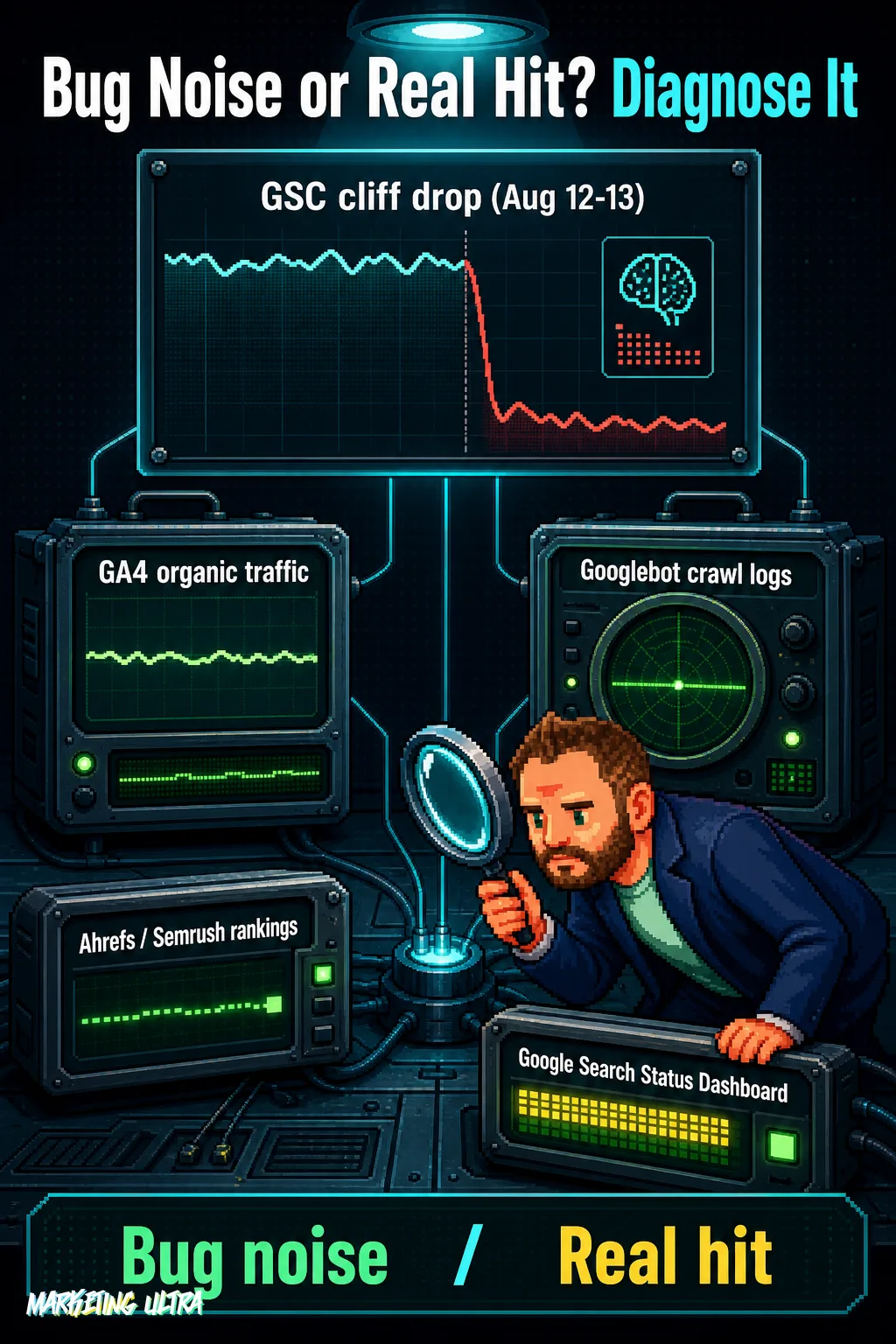
1. Compare GSC with Google Analytics. If GA4 shows no drop in organic traffic (sessions, users, conversions), what you're seeing in Search Console is bug noise. Simple as that.
2. Check your server logs. Is Googlebot still crawling normally? If crawl activity hasn't dropped, your real impressions haven't either.
3. Check third-party tools. Semrush, Ahrefs, Sistrix, AccuRanker. If your rankings are holding steady while GSC reports crashes, case closed: logging bug.
4. Segment within GSC. The bug is confirmed specifically around AI-generated impressions. Filter by search type (web, images, video) to isolate where the drop is concentrated and whether it matches the error pattern.
5. Check the Google Search status dashboard. That's the official source. If there's an open incident, wait for it to close before drawing any conclusions.
If after cross-referencing every source you're still seeing real drops, not just in GSC, but in Analytics, logs, and third-party tools, then it might be the spam update. Signs of real impact:
- Sustained drops in rankings, not just impressions, for key target terms.
- Affected pages follow a pattern: duplicate content, unedited AI-generated text, keyword stuffing.
- The impact is concentrated in specific sections of the domain, not site-wide.
Search Engine Roundtable notes that this update doesn't target link abuse or site reputation abuse, which makes it pretty clear who's in the crosshairs and who isn't.
What not to touch this week
Nothing. Or close to it.

Don't do a mass content rewrite. Don't touch your site structure, redirects, or robots.txt. Don't rethink your link strategy because you saw a red chart. One day of data tells you nothing, and Google recommends waiting at least until the update finishes rolling out before assessing impact.
Recovery from a real spam hit can take months. Google's automated systems need time to verify you've actually fixed the problem. Making changes while an update is still rolling out is like performing open-heart surgery in a moving ambulance: technically possible, but not the plan.
In my experience, the worst damage these episodes cause isn't algorithmic. It's behavioral. The SEO industry has an unhealthy addiction to real-time data that creates massive operational fragility. A fluctuation gets read as a catastrophe. The catastrophe demands "immediate action." And that action introduces new variables that make it impossible to diagnose what actually happened.
Google makes thousands of changes to Search every year. The vast majority go unnoticed. Knowing how to tell a reporting error from normal volatility from a real algorithmic hit, that's what separates an SEO professional from someone chasing charts. As I explain in the guide on agentic search and SEO's new role, what sets apart those who add value from those who create noise is knowing when not to act.
If you have a Google update diagnosis protocol, this is the moment to use it. If you don't, this article just gave you one. For the record: the best SEO move this week is to do absolutely nothing.
Frequently asked questions about the GSC bug and August 2026 spam update
How long does it take Google to fix a data bug in Search Console?
Google doesn't give fixed timelines. The most recent precedent, the May 2026 bug, took weeks to resolve. Google adds retroactive annotations in reports to flag affected periods, but until the incident is closed the data for that window isn't reliable.
Do Google's spam policies apply to AI-generated results?
Yes. Google has confirmed that its spam policies apply to attempts to manipulate AI-generated responses in Search, including AI Overviews and AI Mode. The August 2026 spam update reinforces that detection.