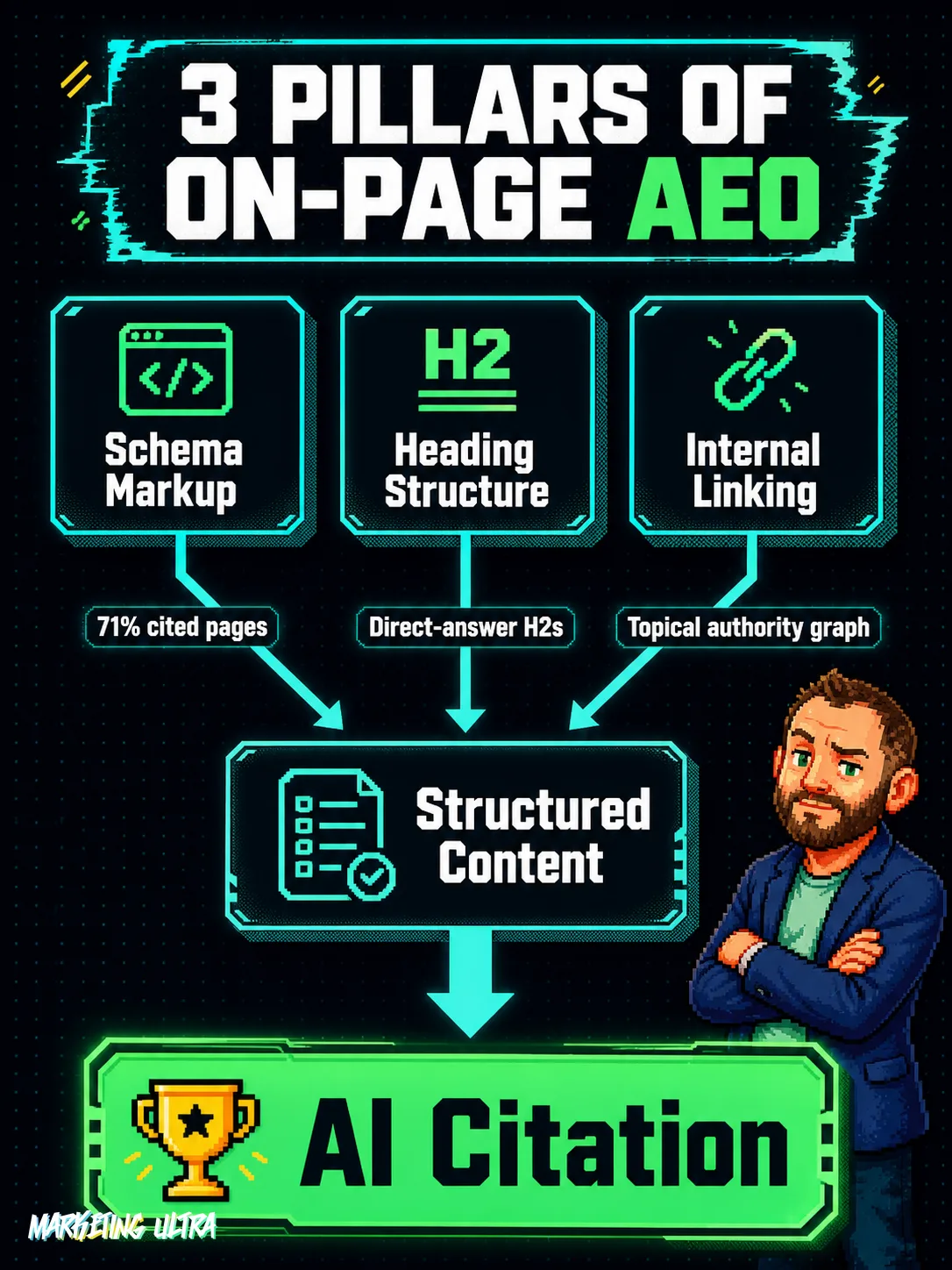
71% of the pages ChatGPT cites use structured data. The other 29% trusts the AI to "figure it out." On-page AEO is what separates content LLMs cite from content they ignore: schema, heading hierarchy, and logically structured internal linking. Writing well is no longer enough. The machine needs structure, not pretty prose.

TL;DR: The No-Nonsense Summary
- Schema markup: pages with FAQPage schema appear 3.2x more often in AI Overviews. This is not optional.
- Direct-answer headings: LLMs extract the first paragraph after each H2. If the answer is buried in the third paragraph, they move on.
- Semantic internal linking: you build a topical authority graph that AI traverses when decomposing a query.
- Key stat: AI-referred sessions on schema-enabled content grew 527% between January and May 2025.
In this article
- What Is On-Page AEO, and Why It's Not Just SEO by Another Name?
- Schema Markup for AEO: The Native Language of LLMs
- Heading Structure: The Hierarchy AI Actually Needs
- Internal Linking for Citability: Build the Graph, Not Just Links
- The Plumbing Nobody Wants to Do
- Frequently Asked Questions About On-Page AEO
What Is On-Page AEO, and Why It's Not Just SEO by Another Name?
On-page AEO is the practice of structuring your page's HTML so that language models (ChatGPT, Gemini, Perplexity) can extract, understand, and cite your content as a source in their responses. It doesn't replace SEO. It complements it. SEO is still fighting for the click. AEO is after something else entirely: making your content the answer.
Why does this matter now? Because answer engines don't "read" a page the way a human does. They tokenize the HTML and look for clear structures. What's explicit wins; what needs to be inferred gets lost. If your content depends on an AI guessing what you mean, you're out of luck.
We covered the AEO strategy layer, the what and the why, in the strategic AEO guide. This article is about getting your hands dirty: the technical how, with templates you can copy right now.
Schema Markup for AEO: The Native Language of LLMs
Schema markup (Schema.org vocabulary in JSON-LD format) translates your content into data machines can understand without guessing. It's explicit context. And the numbers speak for themselves: around 65% of pages cited by AI Mode and 71% of those cited by ChatGPT use schema markup.
But there's a catch. One I see in a lot of implementations.
Copying a JSON-LD block from a tutorial and dropping it at the bottom of your page doesn't make you citable. Schema works when it mirrors real, visible content that's structured to be extracted. If your FAQPage schema lists questions that don't appear in the visible HTML, Google catches it, and the AI discards it.
The Schemas That Actually Move the Needle
Not all schemas carry the same weight when it comes to getting cited. Here are the ones I've seen make a real difference:
- FAQPage: the highest direct impact. Pages with this schema appear 3.2x more often in Google AI Overviews. Each question-answer pair must be self-contained, with ideal answers running 40-60 words.
- Article + Person/Organization: classifies your content and reinforces E-E-A-T signals. LLMs prioritize sources with clear authorship and verifiable credentials.
- HowTo: ideal for step-by-step tutorials. LLMs pull the steps directly as lists in their responses.
Don't pick just one. Combine them. A FAQPage nested inside an Article with Organization schema builds a data layer none of them achieves individually, not even close.
One thing that's non-negotiable: always validate with Google's Rich Results Test before publishing. A markup error is worse than no markup at all.
Heading Structure: The Hierarchy AI Actually Needs
LLMs extract fragments associated with headings. If your H2s are vague ("More Information," "Conclusion"), the AI has no context to determine whether your content answers the user's query. It really is that mechanical.
Four rules we apply to every page we optimize at Marketing Ultra:
- One clear H1 with answer intent: "How to [X]: [concrete result]" or "What Is [X] and Why [It Matters]." No pure branding H1s.
- H2s phrased as direct questions when intent allows. LLMs map the user's question against your headings. Match them and you have the edge.
- H3s to break down each H2. AI models pull H3s to build bulleted lists in their responses.
- Lead with the direct answer at the top of every section: one or two sentences that stand alone as a complete response before you develop the idea. That's the fragment the LLM extracts. If the answer is buried in the third paragraph, it won't find it.
The trick: think of every heading as a search query. If nobody searches "More Information," don't make it an H2. If thousands of people search "How to implement FAQPage schema," there's your heading.
Internal Linking for Citability: Build the Graph, Not Just Links
For LLMs, internal links build a topical authority graph. When a user asks a question, the AI decomposes it into sub-questions, what's known as "query fan-out." If your site has an interconnected content cluster covering all those sub-questions, your odds of being cited go up.
Three patterns I've seen work consistently across the sites we touch:
- Pillar + satellites: a pillar page like the agentic search and SEO guide linking out to specific articles. The pillar covers the "what"; the satellites cover each "how."
- Relational schema: properties like
isPartOffor series andrelatedLinkfor thematically connected pages. Explicit context so the AI understands the relationship between your pages. - Intent-driven anchor text: no "click here." The anchor should describe exactly what the reader, and the AI, will find on the other side.
The most common mistake? Confusing internal linking with stuffing anchors with keywords. A bare keyword repeated ten times across your link anchors doesn't build authority. It builds spam.
The Plumbing Nobody Wants to Do
I'd bet 90% of sites implementing schema for AEO do it the same way people used to add meta keywords back in 2008: because "you're supposed to." They copy the JSON-LD, paste it in, and move on.

Schema without clear headings and front-loaded answers is like putting a restaurant sign on an empty building. The AI reads the schema, goes looking for the content, and if what it finds are dense paragraphs with no hierarchy, it moves on. What works is having all three legs in place. If your schema promises content your headings don't deliver, the AI walks away. If there's no internal linking connecting the pieces, it lacks the context to trust you. All three together, or none of it works.
And that 527% growth in AI-referred sessions on schema-enabled content doesn't come from pasting a JSON-LD block and hoping for the best. It comes from treating each page as a structured product built for a machine to take apart, piece by piece.
That is EXACTLY what an LLM does every time it answers a question. Give it well-organized pieces, or give it nothing.
Frequently Asked Questions About On-Page AEO
What is JSON-LD and why is it the preferred format for schema?
JSON-LD (JavaScript Object Notation for Linked Data) is a format that lets you embed structured data as a standalone code block in the HTML, without touching the visible content. Google recommends it over alternatives like Microdata or RDFa because it's cleaner, easier to maintain, and less prone to implementation errors.
Can you implement AEO schema in WordPress without coding?
Yes. Plugins like Rank Math or Yoast SEO let you add FAQPage, Article, and Organization schema through the visual interface, no coding required. The key is ensuring the schema content matches what the user sees on the page: real questions, real answers, verifiable authorship.