Google DeepMind just dropped three Gemini models at once: 3.6 Flash, 3.5 Flash-Lite, and 3.5 Flash Cyber. Three names, three performance and cost profiles, and a model race moving faster than most teams can actually evaluate what they're getting.

TL;DR: The No-Fluff Summary
- Gemini 3.6 Flash: the workhorse. Better at code and multimodal tasks, 17% fewer output tokens than its predecessor.
- 3.5 Flash-Lite: speed and price. 350 tokens per second, built for massive volume at minimum cost.
- 3.5 Flash Cyber: a cybersecurity model with invite-only access. Not for the general public.
- EU availability: unconfirmed. Google says "global," but hasn't specified for the EU.
In this article
Gemini 3.6 Flash, Flash-Lite, and Cyber: What Each One Actually Is
Gemini 3.6 Flash, 3.5 Flash-Lite, and 3.5 Flash Cyber are three AI models from Google DeepMind, each optimized for a different profile: general performance, high-speed low-cost processing, and cybersecurity. Lumping them together would be a mistake.
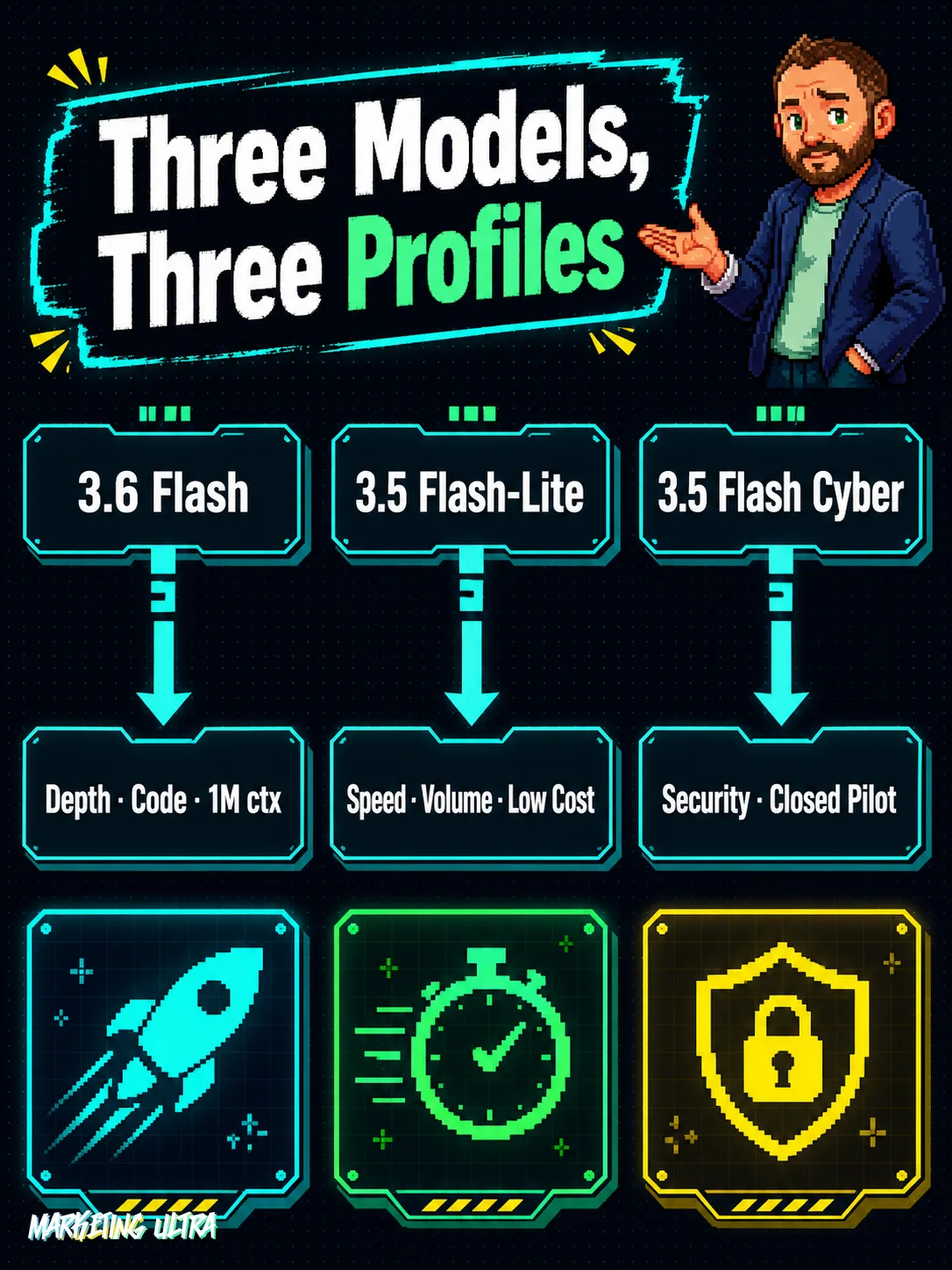
Gemini 3.6 Flash is the flagship of the batch. Google positions it as their primary model for code, reasoning, and multimodal tasks. The numbers from the official Google DeepMind announcement: 17% fewer output tokens compared to 3.5 Flash according to the Artificial Analysis Index, a figure that climbs to 65% on coding benchmarks like DeepSWE by Datacurve. It supports a one-million-token context window and handles text, images, video, audio, and PDFs. In plain English: more output, lower cost per query.
Gemini 3.5 Flash-Lite goes to the opposite extreme: raw speed. 350 output tokens per second. Built for high-volume, low-latency tasks where you don't need a heavy model: document processing, data extraction, agent pipelines firing thousands of requests. Also multimodal, but optimized so each query costs as little as possible.
Gemini 3.5 Flash Cyber is the odd one out. A model specialized in cybersecurity, built on Flash 3.5 and fine-tuned to detect, validate, and patch software vulnerabilities. It isn't open to the public: it's deployed through a pilot program at CodeMender, limited to governments and trusted partners.
What They Mean for Marketing and E-Commerce
3.6 Flash fits where you need analytical depth and complex content; Flash-Lite handles massive volume at low cost; Flash Cyber protects platforms by detecting code vulnerabilities. Each one has its place.
3.6 Flash is your go-to for tasks that require reasoning and broad context: generating technical or long-form content, analyzing campaign data across multiple sources, or building automation workflows that need to "think" before acting. Its one-million-token window lets you feed an entire product catalog as context and have the model process it in one shot. If you're already automating content at scale with AI, this model expands what you can do without sending your cost per token through the roof.
3.5 Flash-Lite is the scale machine. Product descriptions for an e-commerce store with thousands of SKUs. Automated chatbot responses. Bulk data extraction to feed SEO reports or paid media dashboards. Everything that needs to be fast, cheap, and good enough. If you already work with AI agents for campaigns, Flash-Lite can handle the routine tasks while you save 3.6 for the heavy lifting.
And Flash Cyber? For most marketers, it doesn't apply directly. But if you run an online store, security isn't decoration. A model that catches vulnerabilities before someone exploits them protects your data, transactions, and a reputation that a single breach can destroy in an afternoon. The catch: invite-only access, and it's likely a long wait before it reaches anyone else.
How to Access Them, and the Fine Print
Gemini 3.6 Flash and 3.5 Flash-Lite are available in the Gemini app, through the API at Google AI Studio and Android Studio, and on Google Cloud's Gemini Enterprise Agent platform. Flash Cyber runs on a different track: a closed pilot program at CodeMender, with no public release date in sight.
Availability in Spain / EU: unconfirmed. Google indicates "global" rollout in the official announcement, but does not specify whether the models are accessible from Spain or the European Economic Area. Status: general availability (GA) for Flash and Flash-Lite; limited pilot for Flash Cyber. Before building anything on top of these models, verify access from your own account.
More Models Doesn't Mean Better, Not Without a System
Here's what the headlines won't tell you.

Google drops three models at once and you already know the pitch: more power, lower cost. But the uncomfortable question is a different one. How many marketing teams actually have a system where swapping out a model is as simple as changing a variable?
Very few. Most teams are still pasting prompts by hand into a chat interface, no versioning, no measurement. In that scenario, three new models or thirty makes absolutely no difference. You're not going to benchmark them, you're not going to A/B test Flash against Flash-Lite, and you'll keep using the one you already know, because it works, or so you tell yourself.
The value of this wave isn't the model. It's having an architecture that lets you swap them out without rewriting everything. Test Lite for volume, Flash for depth, measure results, and decide with data. If switching models in your workflow costs you three days of manual adjustments, you have an infrastructure problem.
Flash for depth, Lite for volume, Cyber for vigilance. On paper, all three look solid. Now the real question: can what you've built actually take advantage of any of them? Because plugging the world's most powerful model into a broken workflow is just a waste of time.