Pay a YouTube creator and hope for the best. That's been the branded content playbook for years. At Cannes Lions 2026, Google unveiled tools that promise to swap the guesswork for actual data: real performance measurement for YouTube creator collaborations. Now in GA, rolling out "globally." With one glaring caveat: no one's confirmed European availability yet.

TL;DR: The no-fluff summary
- New measurement tools: Google launches GA-phase performance data for branded content campaigns with YouTube creators.
- The problem they solve: until now, measuring the return on a sponsored video was basically an act of faith.
- Google's play: more data inside YouTube = more reasons to keep your budget away from TikTok or Instagram.
- Europe and the EU: the rollout is described as "global," but there's no explicit confirmation for European or EEA markets.
In this article
What did Google announce at Cannes Lions 2026?
Google has moved a data tools package into GA (General Availability) for advertisers investing in YouTube creator collaborations. The official announcement on the Google Ads blog details performance measurement features for branded content campaigns: data on how sponsored creator videos actually perform.
In plain English: if you're paying a creator to talk about your product on YouTube, you now have (in theory) a dashboard showing whether it's moving the needle, or burning budget on a video with 40 likes and zero sales.
GA means we're out of closed beta. Google is pitching this as a global rollout, open to all advertisers.
Who does this actually help?
Advertisers and agencies allocating budget to YouTube creator partnerships. If you run paid campaigns and part of your spend goes to branded content with YouTubers or Shorts creators, this applies to you.
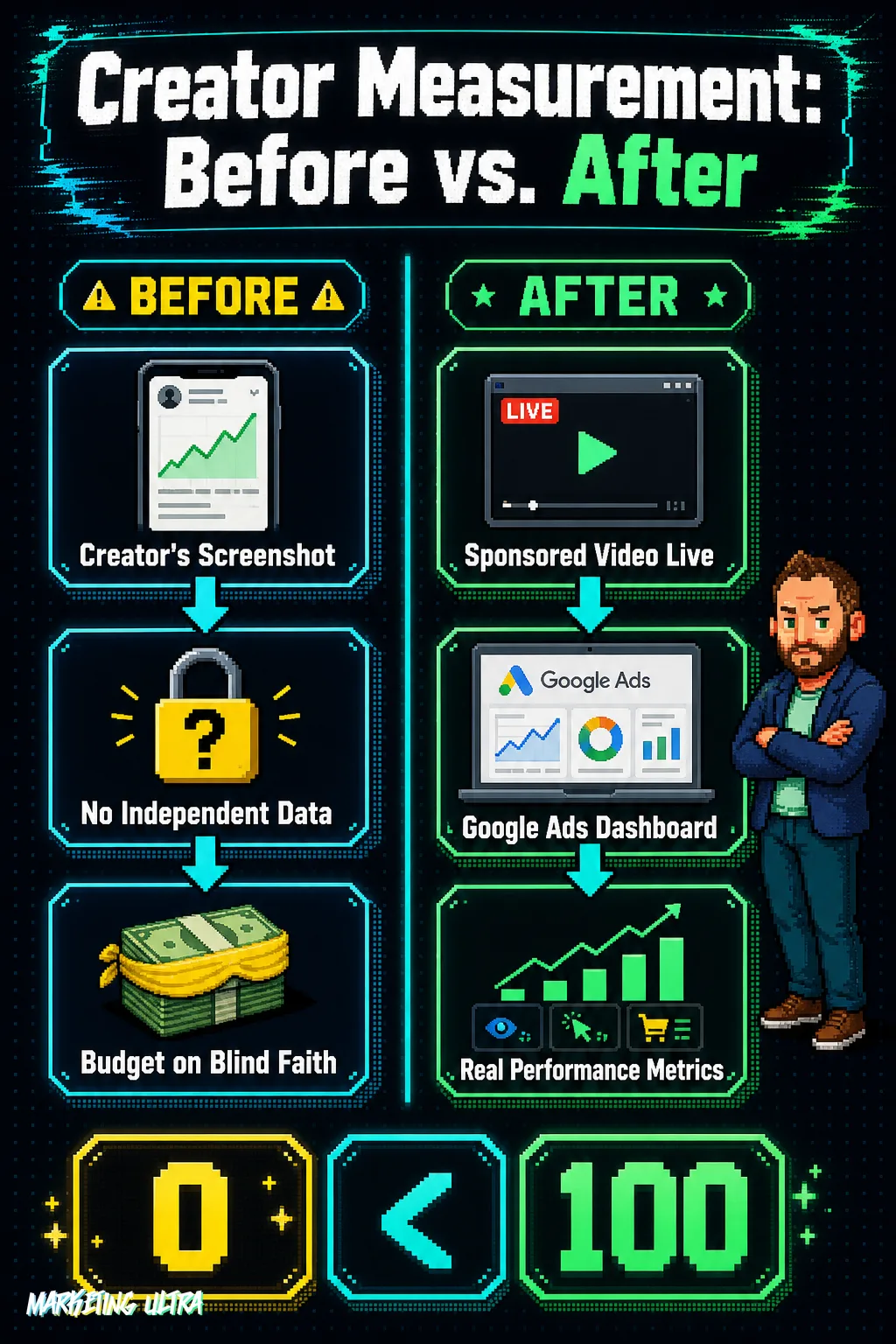
The idea: stop relying on the data the creator (or their rep) sends over and get your own visibility inside the Google Ads ecosystem. If you run your campaigns in Expert Mode and branded content sits alongside the rest of your media mix, you already know how badly that visibility was missing.
The old workflow: creator sends a screenshot of their stats, you take their word for it, and justify the spend with metrics you don't control. For anyone managing serious budgets, that's a real problem.
Google sold this from Cannes as a step toward transparency in creator marketing. The reality: it's a step toward transparency inside YouTube's walled garden. Outside it, you're still flying blind.
Branded content on YouTube: measuring what used to be blind faith
Here's what the press release doesn't say. Someone had to.
Creator branded content has been the murkiest corner of digital marketing for years. You pay X to a creator, they publish, send you a polished report, and you're left with a vague sense that "something probably worked." The real return was, in many cases, blind faith dressed up as strategy.
And what happened? The big budgets went to whoever told the best story, not whoever delivered the best results. A creator with a slick media kit and a smooth pitch could walk away with the entire allocation without the advertiser having solid data to compare against.
Google steps in here with an agenda that isn't exactly altruistic: it wants that money to stay on YouTube. Give advertisers performance data inside the platform, give them reasons not to shift creator budgets to TikTok or Instagram. They're competing for your spend and packaging it as a favor.
The data is useful, no question. But Google is releasing it because measuring inside their house benefits them, not because they've suddenly developed a passion for cross-platform transparency. Expect these metrics to become a YouTube sales pitch within six months: "Why go to TikTok when we give you measurement they can't match?"
And here's the question nobody's asking: what about cross-channel attribution? If a creator posts on YouTube and Instagram, Google's data covers YouTube only. Obviously. Because Google wants you to see how well their platform performs, not how it compares to what that same creator drives elsewhere. That bias is by design.
More data beats less data. Just be clear about who benefits most from this move.
European availability: the "global" with a catch
Availability (EU/EEA: unconfirmed | Phase: GA)

Google describes a global rollout, but the official source does not explicitly confirm availability in the EU or the European Economic Area. It cannot be stated that this feature is accessible to European advertisers at this time.
Google describes the rollout as "global." Sounds like everyone's in. But the official source doesn't explicitly confirm availability in the EU or the European Economic Area.
In Google Ads terms, "global" can mean many things: from "available in 12 English-speaking markets" to "everyone's got it." If you manage European advertiser accounts, the move is to check your Google Ads dashboard directly before building campaigns around these features.
It wouldn't be the first time a Google "global" launch takes months to land in the EU. Between privacy regulations, GDPR adaptations, and the typical European rollout pace, caution costs nothing. Data where there were once screenshots is progress, yes, but don't forget who's dangling the carrot and why.
If you're a European advertiser, don't celebrate until you see it in your account.