Most paid media teams plan campaigns as if the market will wait for them. Monthly meeting, endless spreadsheet, and hope for the best. Then an algorithm update hits, a competitor pours in budget, or a client pivots, and everything goes straight to the bin. Scrum applied to marketing turns that chaos into two-week cycles: short, measurable, and correctable before the damage is real.

TL;DR: The No-Nonsense Summary
- Scrum in marketing: an agile framework that replaces the quarterly plan with 2-week sprints and measurable deliverables.
- 87% more productive: according to the State of Agile Marketing Report 2026, agile teams outperform their peers and report lower stress.
- The retrospective is the key: not the sprint itself, but the meeting where the team decides what to change every 14 days.
- Without real leadership, it fails: poorly implemented Scrum is just micromanagement with a modern name.
In this article
What is Scrum in marketing, and why is it not just for developers?
Scrum is an agile framework that organizes work into short cycles called sprints, with defined roles and specific meetings to review results and course-correct every few weeks. It was born in software development, yes. But its logic, deliver value fast, measure, adjust, repeat, fits digital marketing perfectly, where conditions can shift in a matter of days.
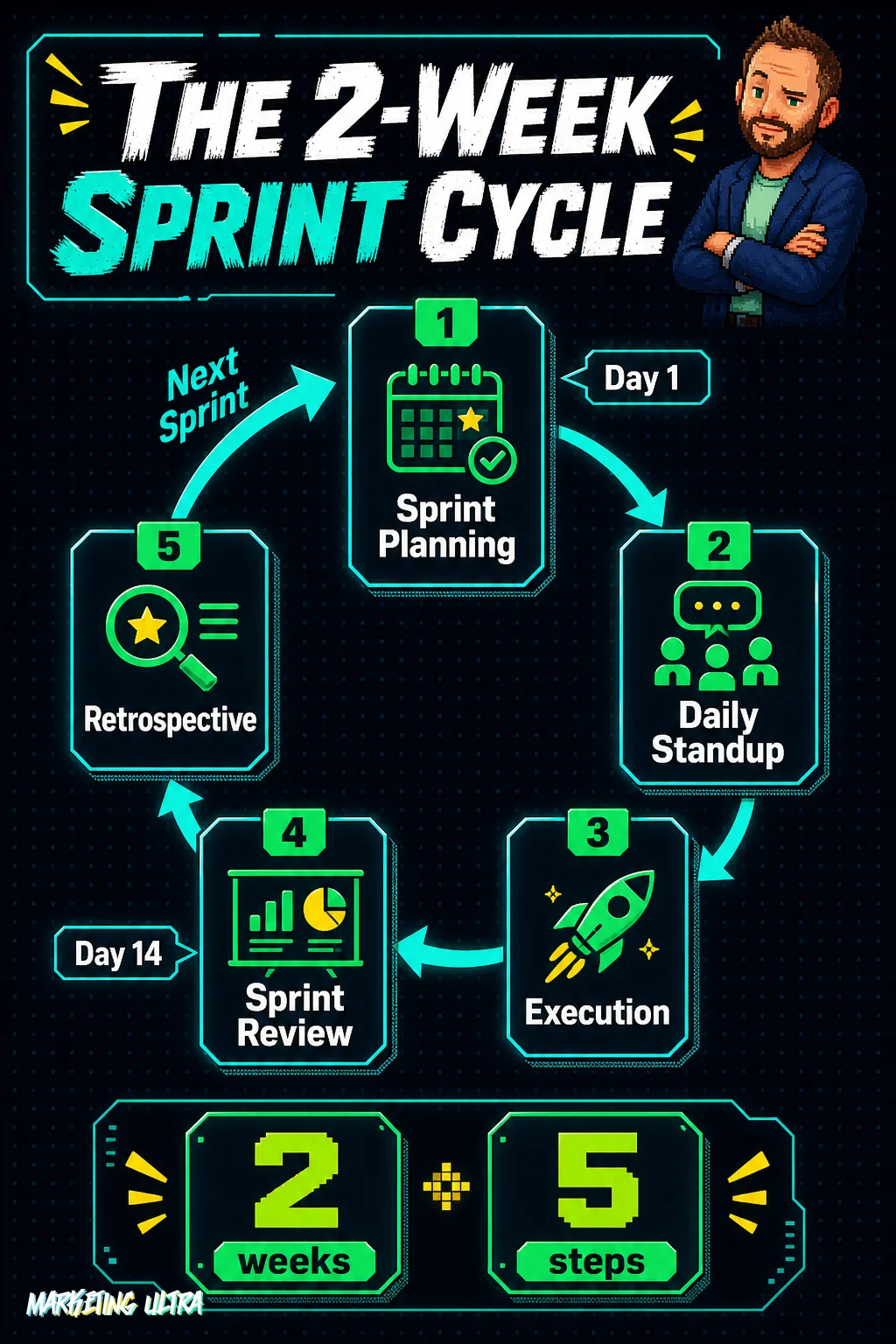
The concept is straightforward: instead of a quarterly plan that goes stale before it is even executed, you break work down into sprints of one to four weeks. Each sprint has a concrete objective, a measurable deliverable, and a review at the end. If something is not working, you know in 14 days. Not in 90.
According to the 9th Annual State of Agile Marketing Report 2026 by AgileSherpas, 87% of agile marketing professionals reported higher productivity. 77% reported lower stress levels. And 64% of leadership profiles already use agile methodologies to navigate a market that changes faster than any quarterly plan can absorb.
And you know what happens when a paid media team stops winging it? They start making decisions based on data from two weeks ago, not three months ago. The Agile Alliance has documented cases of digital marketing teams that cut launch times significantly using exactly this model.
The 2-week sprint for paid media campaigns: a practical model
A two-week sprint applied to paid media has five key moments. You do not need a master's degree in agile methodologies: you need discipline and the desire to stop planning in a vacuum.
1. Sprint planning (day 1). The team selects the highest-priority tasks from the backlog, the ordered list of pending work: which audiences to test, which creatives to launch, which A/B tests to set up, which KPIs to track. The account lead acts as Product Owner: they decide what delivers the most value over the next two weeks.
2. Daily 15-minute standup. Every day, each person shares what they did, what they will do, and what is blocking them. No monologues. No slide decks. 15 minutes and done. The meeting that is hardest to sustain, and hurts most when it disappears.
3. Execution. The team works on what was committed: launching campaigns, analyzing performance, adjusting bids, creating ad variants. Anything NOT in the sprint does not get touched. The "urgent" client who calls on a Friday afternoon goes to the next cycle's backlog, unless it is a genuine emergency (spoiler: it almost never is).
4. Sprint review (day 14). Results are presented to the stakeholder or client: what was launched, how it performed, what was learned. Atlassian documents the process in detail, but the ceremony matters less than the outcome: every 14 days you have a real checkpoint. You pivot a campaign before burning budget. You scale what works before the window closes. That alone justifies the entire setup.
5. Retrospective. The team looks in the mirror: what worked? What slowed us down? What do we change for the next cycle? This is the most important meeting, and the one most teams skip.
Serious mistake.
Scrum as a leadership tool, not a micromanagement tool
This is where most people get it wrong. Scrum is a leadership model that forces you to genuinely delegate. If you reduce it to four recurring meetings on a calendar, you are wasting everyone's time.

With Scrum, the leader has one job: remove obstacles, prioritize the backlog, and trust the team to execute. No more being the bottleneck who approves every ad and every bid. For many managers, that is terrifying. Because it means letting go of control. And letting go of control is the opposite of what most accidental managers know how to do.
The AgileSherpas report notes that agile companies are up to three times more likely to successfully adopt AI. It makes sense: if your team already works in short cycles, testing an AI tool within a sprint feels natural. If you plan by quarter, that tool stays on the "things we will try someday" list. One caveat: do not let AI become an excuse to stop managing, we have already seen how that plays out.
I would bet that most paid media teams that "fail" with Scrum do not fail because of the model. They fail because the manager refuses to let go of the wheel. They turn daily standups into control sessions, ignore the retrospective, and end up using the sprint as a modern-looking costume for the same old micromanagement. If the culture does not change, it does not matter what you call it, sprint or quarter.
As I cover in the guide on team management and trust, leading means creating the conditions for people to do their best work without needing you every step of the way. Scrum forces you to do exactly that. Which is precisely why it makes people uncomfortable.
Scrum in marketing forces you to make decisions EVERY 14 DAYS. Whether the word "agile" looks good on your LinkedIn profile is completely beside the point. Making frequent decisions with fresh data is what separates a team that optimizes from one that merely survives.
Scrum will not work miracles for your paid media team. No framework does. But if your current planning consists of a January spreadsheet that nobody looks at come March, two weeks of sprints are infinitely more useful than three months of good intentions.
Setting up the meetings is the easy part. The hard part is accepting that every 14 days you will look yourself in the mirror and decide whether what you are doing is working or not. That requires honesty. And in marketing, honesty is a premium commodity.
Frequently asked questions about Scrum in marketing
Scrum or Kanban for paid media teams?
Scrum works better when work can be planned in 2-week blocks with clear deliverables: campaign launches, creative rounds, optimization cycles. Kanban fits better for teams with continuous, unpredictable workflows, such as support or community management. For paid media, Scrum wins because campaigns have natural test-and-measure cycles that align naturally with sprints.
Do I need a dedicated Scrum Master on a marketing team?
Not necessarily as a full-time role. In small paid media teams of three to six people, the account lead can facilitate meetings and clear blockers. What matters is that someone protects the sprint's focus and ensures the retrospective actually happens. Without a retrospective, Scrum loses half its value.