Rewriting an application in Rust sounds great until one response changes, an integration breaks, and nobody knows where things went wrong. Rust Anything aims to prevent that headache by recording the original behaviour and checking every rewritten component before deployment. It is built for teams with a slow application and a coding agent, not for anyone looking for a magic button.

TL;DR: The No-Nonsense Summary
- What it does: records the original code's outputs and effects to compare them with the Rust version.
- The useful guardrail: its quality gate does not mark the work complete until recorded cases match.
- Price: the project is free and open source, under the MIT or Apache-2.0 licence.
- The limitation: validating recorded cases does not prove that you captured every possible behaviour.
In this article
| What it is | A skill that rewrites your application in Rust piece by piece, recording original behaviour and verifying that every port reproduces it exactly before deployment. |
|---|---|
| Official website | https://rustanything.ai/ |
| Repository | repo |
| Licence | MIT OR Apache-2.0 |
| Price | open source |
| Alternative to | Manual Rust rewrites without automated verification |
| GitHub stars | 10,679 |
| Release year | 2026 |
| Maintained by | erkamyaman (individual) |
Reviewed on 2026-11-27
This tool is included in these collections: Skills for Claude Code, Codex and Coding Agents by Task
The Problem It Solves
Rust Anything is a tool for moving an application to Rust piece by piece. First, it records what the existing code returns, which errors it throws and which effects it produces; then it runs those cases against the new version and flags any differences.
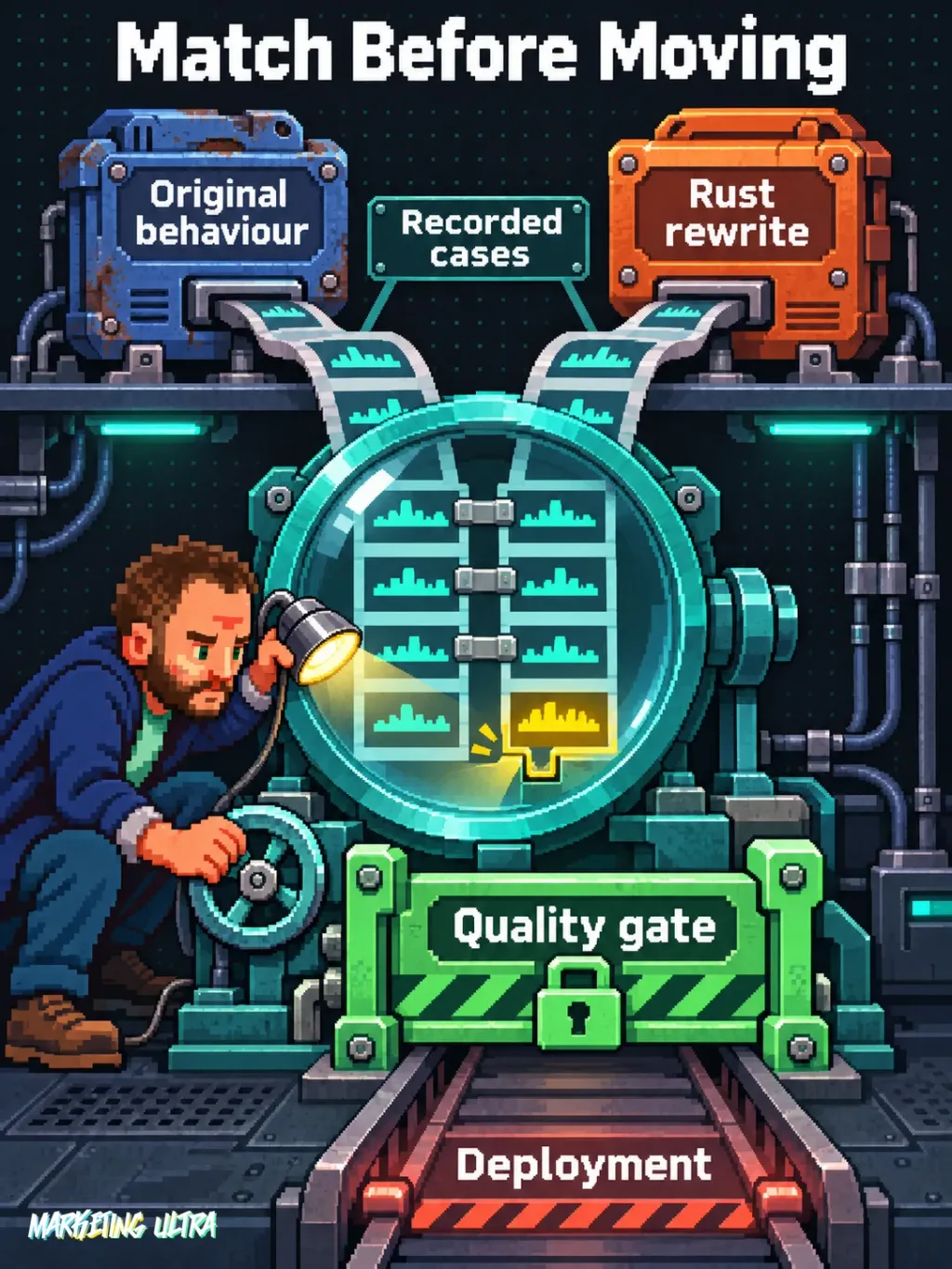
The problem is not writing Rust. An agent can generate a huge amount of code and call it a day. The difficult bit is proving that the rewrite preserves the behaviour the rest of the application expects.
The approach uses the original program as the reference. It generates the bridge needed to preserve the same interface, leaves implementation to the agent, and blocks progress when the comparison or quality gate fails. The original is not modified, and the documentation says every change can be disabled with a command.
That is far more sensible than commissioning a mass translation and hoping for the best. These migrations usually go sideways because of the oddity nobody documented: a strange character, one specific exception, or a side effect that has kept the system together with duct tape for years.
Getting Started
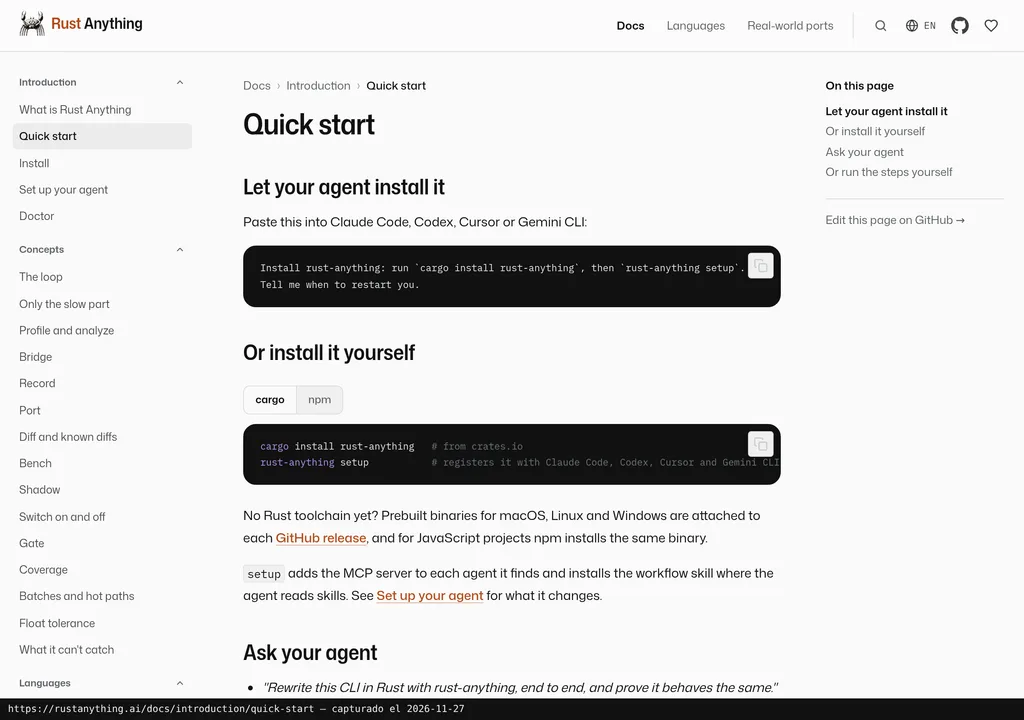
The official setup has three steps: install the tool, run setup to register the MCP server and skill with a compatible agent, then launch the process against a slow application command. The official Rust Anything repository documents installation through Cargo or npm.
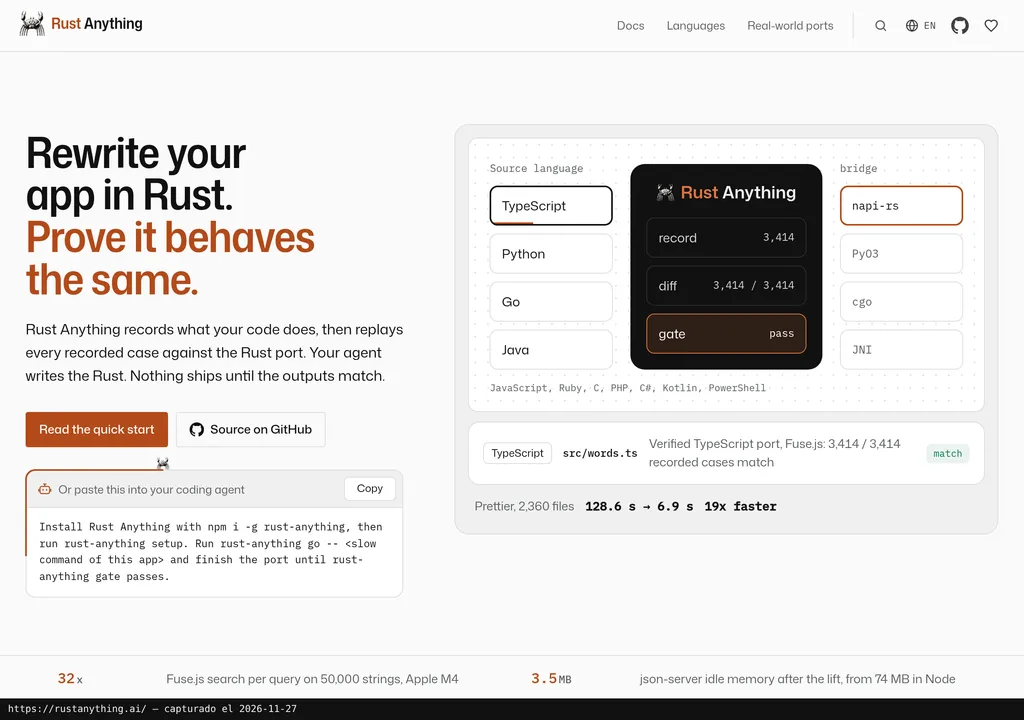
The setup command declares compatibility with Claude Code, Codex, Cursor, Gemini CLI and OpenCode. Then, rust-anything go -- <slow command> profiles a real run, records cases, prepares the bridge and guides the agent through the rewrite. The full agent reference is available in the llms.txt documentation.
Give your assistant this instruction to review the requirements and follow the official installation process:
Review the requirements for Rust Anything at https://rustanything.ai/llms.txt and install it following the official documentation.
Run setup and test a slow command from this application with rust-anything go.
Do not consider the test complete until the comparison and quality gate pass; explain any changes made.
You do not need to be a Rust expert. The assistant can handle installation, setup and testing, but you will need technical oversight if something fails.
Before touching an important application, I would insist on finding a reproducible process, saving the repository state and verifying the way back. The tool promises to leave the original intact, but that does not turn a migration into a school trip. Code, dependencies and deployment are all on the line.
Using It in Real Marketing
At an agency, the sensible use case would not be rewriting the entire client platform because Rust is fashionable. It would be identifying a slow, measurable task: processing catalogues, transforming files or running an internal search with verifiable inputs and outputs.
The team could run that task with representative data, let Rust Anything record the calls, and ask the agent to move only the expensive section. It would then compare every captured case and measure whether the new version actually improves anything. If it does not, stop. What a revolutionary concept.
The documentation includes its own examples. In its Prettier test, 59 files produced byte-for-byte identical results and total time fell from 3.63 to 0.20 seconds. By contrast, the vercel/ms case was slower per call, with a relative result of 0.56x. The tool itself shows where Rust delivers little or loses performance, which is exactly the information that prevents a migration for show.
We have not run an independent test for this review. These figures come from tests published by the project and do not demonstrate what will happen with your application, infrastructure or data.
What They Do Not Tell You
A match is only as good as the cases recorded. Rust Anything adds generated cases, semantic traps and calls from a real run, but no finite test suite guarantees it has seen every path through a program. Boom. The old testing problem is still there.
You also need a task worth the trip. The documentation shows that a small call can be slower when crossing between languages and that some operations barely improve. Rewriting by default would mean swapping known complexity for new complexity, with a friendly crab on the cover.
The project launched in 2026. As of 27 November that year, its repository had 10,679 stars and remained active, according to the reviewed dossier. Plenty of attention, yes. A stability audit? Not a chance. There are also no verifiable public reviews in the material received, so there is no basis for inventing a consensus.
The tool is free and open source under either the MIT or Apache-2.0 licence, at the user's choice. That does not make the migration free: the coding agent, test runs, human review, integration and maintenance still cost money, although the sources do not support putting a euro figure on them.
Alternatives
The alternative covered in the dossier is rewriting in Rust manually, without automated verification. It gives full control over architecture, testing and deployment, but the team must build its own behaviour recording, bridges and comparisons.
When would I choose that route? When the application already needs a deep redesign and preserving the exact previous interface is part of the problem. Rust Anything is a better fit when you want to replace components gradually and prove they still respond the same way.
When working with agents, it helps to understand what a skill installs and what authority the human retains. The guide to skills for Claude Code, Codex and coding agents explains that context without selling autopilot as magic.
Verdict
Rust Anything tackles the right problem. Compiling is only the beginning. A rewrite is complete when it preserves the required behaviour and improves a metric that matters. Recording, comparison, the quality gate and rollback offer a far more defensible process than translating files in bulk.
I would use it to isolate a real bottleneck, start with one component and require a match before deployment. I would not use it to justify a full rewrite without profiling, representative tests or someone able to review the generated code.
Rust Anything does not remove the risk of migrating to Rust. It makes it visible. And between a tool that also shows when it loses and one that promises speed by decree, I prefer the one that knows when to tell you to stop.