A good AI session often ends like a family recipe: it worked, nobody can fully explain why, and whether you can repeat it tomorrow is anyone's guess. Skill Distill turns a successful Claude Code or Codex session into tested instructions so another model can reproduce the task. It is built for technical teams working with open-weight models, not anyone looking for one-click automation.

TL;DR: The No-Nonsense Summary
- What it does: turns a reference session into a skill tailored to a specific model and agent.
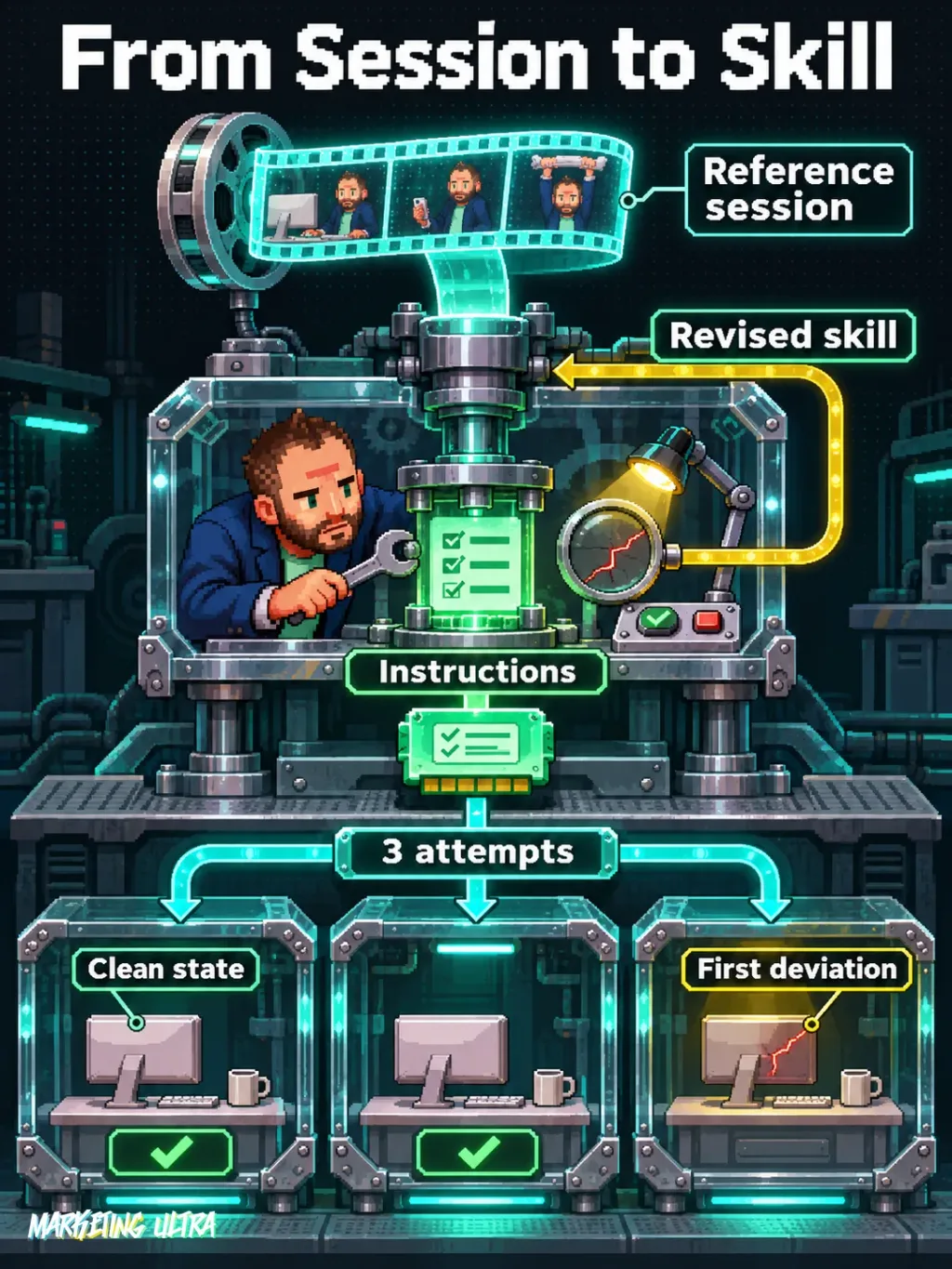
- How it validates: runs three attempts per version, compares the outcomes, and fixes the first point where the student fails.
- What it requires: a strong session, a reproducible environment, and human judgment to approve the final result.
- The real cost: the repository uses an MIT license, but the model, infrastructure, and review time are separate costs.
In this article
| What it is | Turns a successful Claude Code or Codex session into an instruction manual that a local open-weight model can follow to reproduce the task. |
|---|---|
| Official website | https://github.com/sybil-solutions/skill-distill |
| Repository | repo |
| License | MIT |
| Price | open source |
| Alternative to | Manually documenting coding procedures so other models can replicate them. |
| GitHub stars | 983 |
| Release year | 2026 |
| Maintained by | sybil-solutions (organization) |
Reviewed on 2026-11-27
This tool is included in these collections: Skills for Claude Code, Codex and Coding Agents by Task
The Problem It Solves
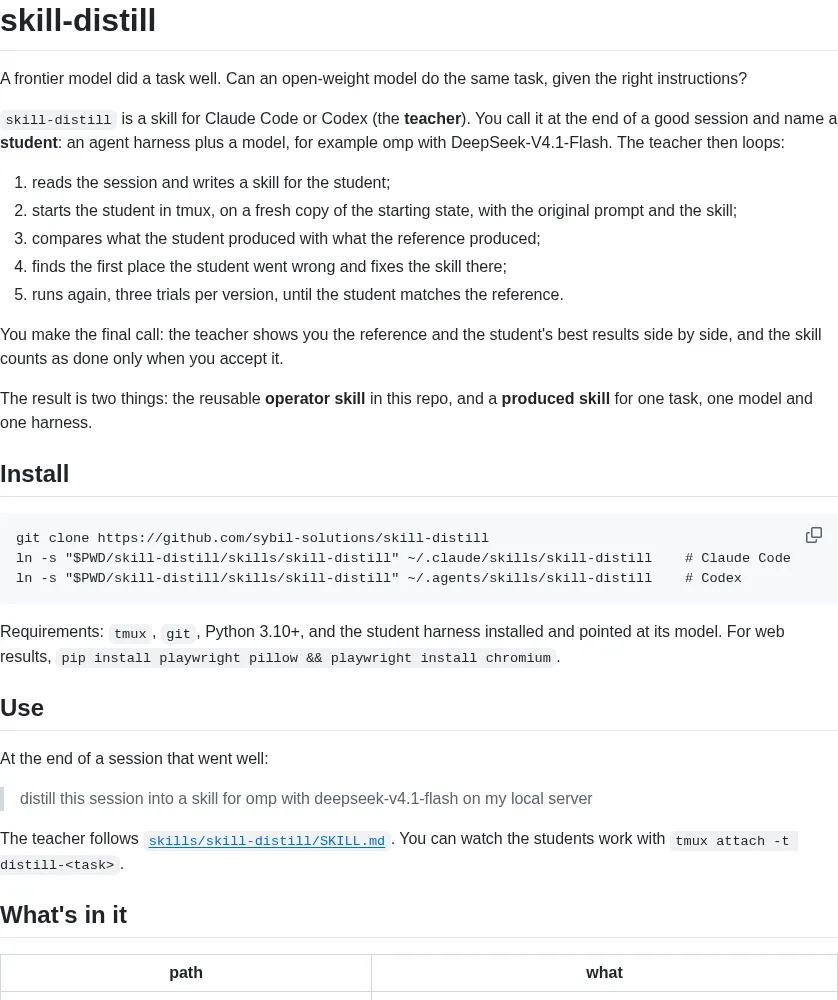
Skill Distill tackles a fairly awkward question: if an advanced model completed a task well, can an open-weight model repeat it when given the right instructions? Its answer is to write the skill, put the student model to work, and compare the result against the reference. Writing a pretty manual and hoping for the best is left to everyone else.
Until now, the sensible alternative was documenting the process by hand: review the session, separate useful decisions from dead ends, write checks, and hope another model understands the whole picture. Plenty of craft. And plenty of room to leave out the one detail holding everything together.
Skill Distill turns that transfer into a cycle of reading, instructions, clean-state tests, and corrections. More precisely, Skill Distill is a Claude Code or Codex skill that teaches a student model to reproduce a specific task through iterative testing.
There is no training here, nor a universal capability that works for everything. The outcome is tied to a particular task, model, and agent. That distinction matters A LOT.
Getting Started
The documented installation starts by cloning the official Skill Distill repository and creating a symbolic link to the Claude Code or Codex skills folder. It requires Git, tmux, Python 3.10 or later, and the student agent already installed and connected to its model.
For web work, add Playwright, Pillow, and Chromium. The repository includes adapters for omp, Codex, Claude Code, pi, and opencode, though they are not all equally mature: omp is tested; Codex is tested as a teacher; pi and opencode are listed as untested. On top of that, opencode does not yet have a parser for its JSON log.
Usage begins once a session has gone well. You then choose which agent and model will act as the student, verify that it responds, and save the starting point. Next comes the part that often causes the most friction: defining exactly what it means to match the reference.
The project's original skill describes a cycle of three tests per version. If something fails, the teacher identifies the first deviation, changes the instructions, and runs it again. To uninstall, simply remove the symbolic link created in the skills folder; the cloned repository can be kept or removed separately.
Copy this and paste it into Claude Code or Codex:
Install Skill Distill from https://github.com/sybil-solutions/skill-distill following its README.
Check the requirements and configure the skill for my compatible agent.
Run a minimal response test without starting a full distillation yet.
This is not a one-click install. The assistant can guide you, but you will need a prepared environment and must oversee the setup and tests.
Using It in Real Marketing
At an agency, generating more copy is not particularly mysterious. The interesting part is preserving a process that went especially well: a technical audit, a landing page build, or an internal automation with several steps and checks.
Imagine Claude Code solves a complex integration and you want a cheaper open-weight model to repeat equivalent work. Skill Distill would extract the useful decisions from that session and subject the student to new runs from the same starting point. A human would still compare outcomes and have the final say.
This fits the logic of skills for Claude Code, Codex, and other coding agents: collecting prompts gets you very little. The value appears when you turn judgment and checks into a reusable procedure.
There is no documented test in the dossier showing Skill Distill's performance on a real marketing task. That makes this a reasonable scenario, not a Marketing Ultra experience or a savings promise.
What They Do Not Tell You
The main limitation is simple: you need a genuinely good reference. If the original session solved the task poorly, the system can document mediocrity extremely well. Distillation does not fix weak starting judgment.
It also requires a reproducible environment. Every attempt must start from a clean state, with the same brief and without handing the finished result to the student. When external services, private data, or hard-to-restore infrastructure are involved, preparing reliable tests becomes a major part of the work.
Raw logs remain in a Git-ignored folder because they may contain machine paths and context. Keep an eye on that. Before sharing the final skill, review secrets, private names, and personal data.
The trap is confusing repetition with generalization. Having a model reproduce one specific task three times does not prove it has learned an entire discipline. It proves something narrower and useful: that this procedure works under observed conditions. Less epic. Much more honest.
Alternatives
The dossier confirms only one alternative: manually documenting the procedure for other models to reproduce. The advantage is obvious. You control every sentence and, if the task is stable and simple, can produce much shorter instructions.
Skill Distill makes sense when a process contains decisions, stumbles, and verifications that written documentation created from memory may miss. For a short task, the setup may be excessive. For a delicate execution you want to transfer to a less capable model, iterative comparison adds a discipline that is hard to achieve by eye.
Verdict
Skill Distill deserves attention because it treats skills as artifacts that need testing, not Markdown files blessed by faith. The rule of three attempts per version and final user acceptance tackle two common vices: celebrating a lucky run and believing the model's own “everything looks good” message.
Would I use it for every session? Not a chance. I would use it for valuable, repeatable tasks with an outcome that can be compared seriously. Without a good reference and clear acceptance criteria, you are only setting up a lab to produce longer instructions.
The score remains undefined because there is no Dani-approved rating or independent test supplied. The thesis, however, is clear: Skill Distill proposes a rigorous way to transfer work between agents. The human remains there, defining what good work means. That is already more than many AI tools demand.