Some people are like a nuclear power station: messages, meetings, documents, tasks, more messages. Everything is flashing. Everything is on fire. But ask what has improved for the customer and silence falls. Mistaking activity for value is a very expensive way to stand still.

TL;DR: The No-Nonsense Summary
- Activity is not value: doing more only matters if it brings a necessary outcome closer.
- Metrics can be distorted: when you reward movement, people learn to look busy.
- A deliverable must enable something: a decision, an improvement, lower risk or useful knowledge.
- Priorities require trade-offs: if everything gets in, nothing is prioritised.
In this article
What does prioritising value over activity mean?
Prioritising value over activity means judging a task by the outcome it enables, not by the hours, messages or documents it produces. It may support a decision, reduce risk, improve a service or preserve knowledge. If it does none of those things, it is workplace decoration.
My benchmark is pretty straightforward: I would rather someone do less and do what matters than fill their day with pointless tasks. The phrase “I’m busy, I’m busy, I’m busy” does not impress me. Sometimes it describes a genuine workload. Other times, it is a smokescreen with a shared calendar.
Working less as a rule is not an achievement either. The key is to work with direction. Specific goals matter: a meta-analysis on goal setting found strong support for difficult, specific goals over easy, broad ones or “do your best” targets. It also found better results when progress feedback was included, although that additional analysis covered only three studies and 170 participants.
A clear goal and a thoughtful review. Far less sexy than setting up another colour-coded board, but a better compass.
Why can always being busy be a bad sign?
Because organisations tend to get more of whatever they reward, even when they reward a poor proxy for the outcome. Reward visible activity and you will get visible activity. Lots of it. By the bucketload.
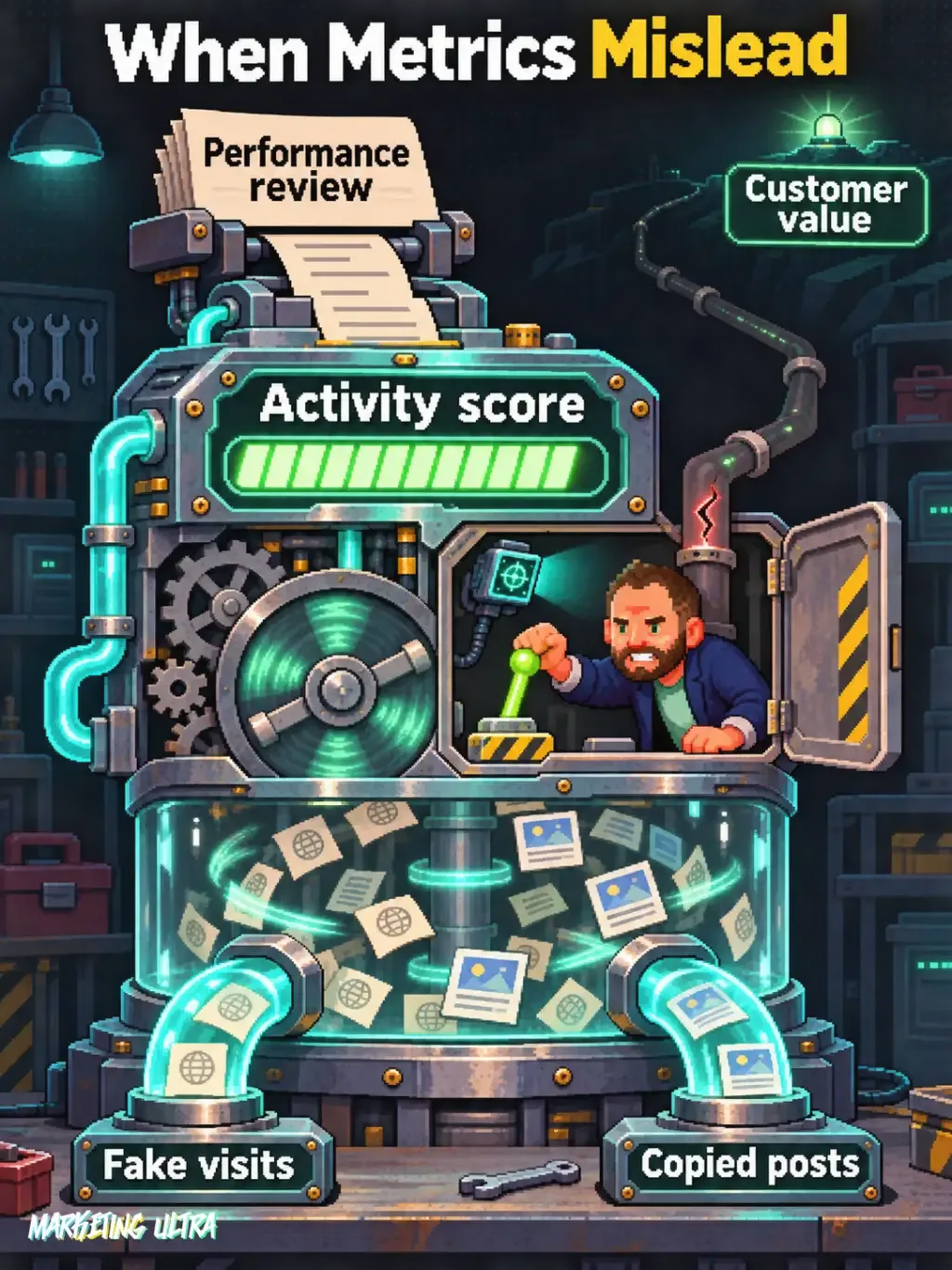
A 2023 ethnographic study documented a tech company where a digital activity score affected performance reviews and promotions. Some employees ended up generating fake visits, copying posts and taking actions to raise the metric with no clear connection to sales.
There it is. The indicator was no longer measuring work: it was manufacturing behaviour.
Another study on explicit incentives, conducted in a large public organisation, found strategic reporting of results to maximise rewards. That behaviour harmed the organisation’s real objective. Does that mean every metric is bad? Not a chance. But turn one into a trophy and it will start inviting shortcuts.
In marketing, we see it easily: more campaigns, more reports, more changes and more meetings can happily coexist with a stagnant account. A high volume of intervention is no proof of good judgement. In fact, it can reveal that nobody dares leave what is working alone.
The trap appears when a company confuses availability with performance. The person who replies instantly looks committed; the one who blocks out two hours to think looks absent. Then we wonder why everyone spends their life reacting and nobody spots the important problem.
Do we need that deliverable right now?
Before requesting a document, presentation or report, I ask four questions: what decision does it enable, who needs it, when do they need it and what is the minimum sufficient version? If the answers are vague, the deliverable probably will be too.
I like documents when they are useful. What I do not buy is the PDF fetish: thirty pages nobody will read, created to prove someone has worked really hard. Deliverable or not, if it does not move anything forward, work on something that will.
The nuance matters. The Agile Manifesto values working software over comprehensive documentation, but makes clear that documentation has value too. Its original principles define simplicity as the art of maximising the amount of work not done. Documentation can make sense. Manufacturing work for its own sake does not.
A deliverable deserves to exist if it stops a decision depending on memory, helps several people coordinate, reduces risk or explains something that will be needed again. It may also deserve to exist without immediate urgency. What it does not deserve is an open bar because of tradition: “we have always done this report” is the administrative cousin of “because I said so”.
Workload needs designing too
Lack of focus is not some individual quirk. Microsoft’s 2023 Work Trend Index, based on 31,000 workers across 31 markets, found that 68% did not have enough uninterrupted focus time. Inefficient meetings were the biggest reported barrier to productivity.
In the Spanish sample, 60% said they struggled to find the time and energy needed to do their work, while 62% said they lacked sufficient uninterrupted focus time. Bear in mind: these are survey responses. The report also analyses aggregated Microsoft 365 usage, but it does not establish causation or measure all productivity. Even with those limitations, the symptom is perfectly recognisable.
If you want autonomous people, you need to protect their ability to decide what not to do. That links directly to leadership that helps without creating dependency: delegation is not about handing out unwanted jobs while continuing to dictate every step.
It also requires facing up to the workload left behind when layers of coordination are cut. Removing meetings or managers can free up time, yes. It can also shift decisions and bottlenecks onto the rest of the team. Less structure does not guarantee more value.
How to decide which work deserves time
I would use an uncomfortable filter: if this task disappeared, what would genuinely get worse? Not who would get upset, which template would be left blank or which meeting would lose its content. What outcome would get worse?

Then decide the sufficient version. Sometimes twenty slides can be reduced to three figures and a recommendation. Other times, the analysis needs two days because the risk is serious. And perhaps the campaign should not launch yet. If we are going to do things badly, I would rather spend nothing at all.
With the data in front of you, that is when it is time to think, correct, spot what was missed and debate the approach. That is where the time should go. The performance of work can wait.
The next time someone arrives with another urgent deliverable, do not ask how long it will take. Ask what it changes. If it changes nothing that matters, you probably already have your answer: prioritise value over activity.

