Snap Map for brands looks like a new storefront on a busy street. The mistake is confusing people walking past with customers who left home looking for a shop. Snap Map can drive local discovery, but it does not yet replace the search intent behind Google Maps.

TL;DR: The No-Nonsense Summary
- Social discovery: Snap Map helps brands appear during a social experience between friends; it is not a replacement for local search.
- The uncomfortable data point: only 29% of participants used Snap Map to discover businesses.
- Advertising potential: 71% said they would be open to visiting a location after seeing it as a sponsored pin, but intent does not equal a visit.
- Test with control: measure opens, directions, verified visits, cost per visit and incremental sales.
In this article
Snap Map for brands is an advertising option designed to highlight physical businesses within Snapchat's social map. Its value lies in sparking discovery while users check what is happening nearby or where their friends are.
That definition matters because it puts everything in its proper place. Google Maps usually receives functional intent: finding, comparing, checking hours or getting directions. Snap Map comes in earlier, when the user may not even have considered visiting that business.
What potential does Snap Map hold for brands?
The opportunity lies in placing a business within a social experience that has huge reach. Snap reported 450 million global monthly active Snap Map users in the first quarter of 2026.
Be careful not to turn that number into a beautiful slide and run with it. These are not 450 million people looking for restaurants, shops or gyms. They are users of the feature.
The study commissioned by Snap from eye square, together with Horizon, surveyed more than 17,000 digital map users aged 13 to 44. Participants came from the United States, Canada, the United Kingdom, France, Germany and Saudi Arabia. Spain was not included in the sample.
The dominant use case was social: 76% checked where their friends were, while 27% used the map to coordinate in-person meetups. That is where the real opportunity lies. Hospitality, entertainment, retail, events and venues linked to group plans can enter a decision that has not yet been settled.
Snap also says consumers were 2.9 times more likely to report discovering their favourite physical businesses on Snapchat. The comparison is with other social platforms, not Google Maps or Apple Maps. Dropping that nuance would be playing games with a very pretty figure.
Does Snap Map really compete with Google Maps?
Comparing them as if they were playing the same game makes little sense. Snap Map stands out in social discovery; Google Maps remains far more closely associated with navigation and practical information about places.
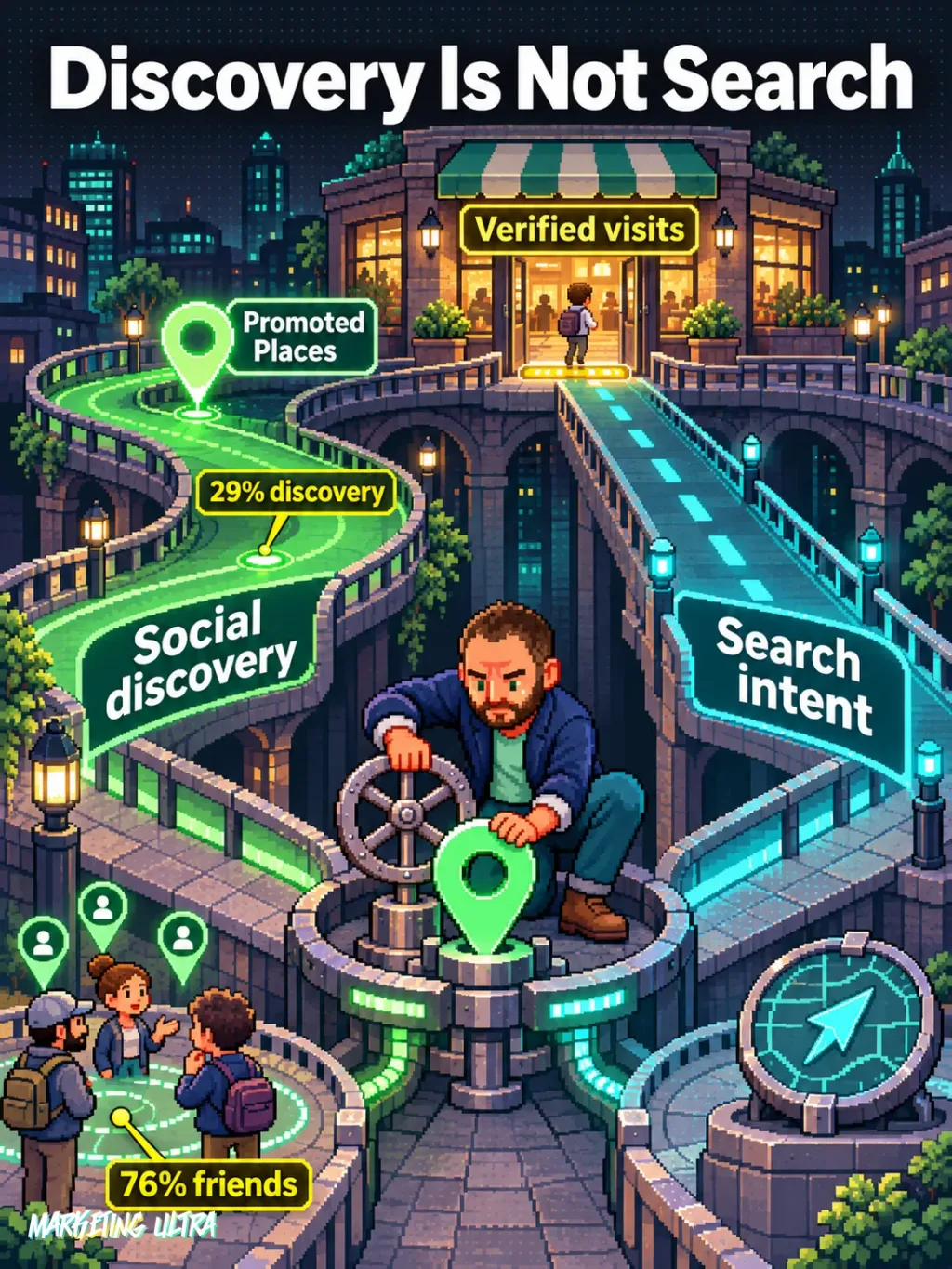
Only 29% of participants used Snap Map to discover businesses. As Social Media Today's analysis notes, more than 70% did not use the feature for that purpose.
That does not prove that all of that 70% uses Google Maps. It does show that presenting Snap Map as its replacement is inflating the balloon until it pops. A Google Business Profile and organic Google Maps presence remain basic infrastructure for any local business.
My take is fairly straightforward: Snap does not need to win local search to be useful. It needs to prove it can influence a visit that would not have happened without the ad. That is a higher bar than showing lots of impressions, but it is the only one that pays the bills.
Promoted Places data needs the fine print
Promoted Places highlights businesses through sponsored pins. The format began testing with partners in October 2024 and now has documentation for creating campaigns in Ads Manager.
Only physical businesses already listed in the Snap Map database can be selected. In addition, each campaign allows one place per selection. Commercial availability in Spain is not confirmed by the sources reviewed, so access, inventory and reachable audience need checking before making forecasts.
Seventy-one percent of respondents said they would be open to visiting a business after seeing it as a sponsored pin. Declaring intent from the sofa is not the same as walking through a shop's door. Not even close.
Snap tested the format in context with more than 11,000 participants and conducted a follow-up survey of 2,100 users. Compared with sponsored pins on utility maps, it reported stated lifts of 9 points in visual awareness, 5 in appeal and 4 in interest in clicking. Between 14 and 25 days later, the exposed group reported being 1.1 times more likely to visit the store and to change their opinion of the brand.
France offers a somewhat more tangible commercial data point. In a case study published by Snap on Bouygues Telecom, the company reported 73 million store views, €0.12 per listing open and €0.92 per attributed visit during April and May 2026.
Those are interesting results. They are also figures from Ads Manager and Kairos Fire, published by the platform itself. I would not extrapolate them to Spain, another category or a chain with different coverage. Test first. Brag later.
What metrics should a local test measure?
A Snap Map test must separate visibility, interaction, visits and sales. Throwing everything into a report full of arrows only makes a mediocre campaign look like a party.
- Reach, frequency and impressions within the business's useful catchment area.
- Listing opens, open rate and cost per open.
- Saves, shares and direction requests, where the setup allows them to be measured.
- Verified visits and cost per visit, with the attribution method properly documented.
- Incrementality against a control group or comparable areas with no exposure.
- Sales, customer acquisition cost and return on ad spend (ROAS) where attribution is sufficiently reliable.
The headline metric cannot be chosen after seeing which one looks best. Before starting, define which result justifies continuing, how much budget the test can lose and which exceptions are acceptable. There will always be noise. The question is how far it takes you from the goal.
It would be easy to spot Snap Map performing badly. The tricky part is celebrating listing opens without knowing whether they moved a single sale. To make decisions based on more than platform enthusiasm, it is worth applying a real data-driven decision-making discipline.
Snap Map as a complement, not a religion
Local brands with a young audience and businesses tied to social plans have reasons to test it. With incremental budget, a well-chosen area and independent measurement, it may uncover demand that Google Maps was not capturing because that search did not yet exist.

I would not cut local organic visibility, Google Business Profile investment or campaigns already capturing intent to fund this test. Sacrificing the infrastructure that responds to real searches to pay for a promise of discovery would be quite a creative stunt. And not the good kind.
The case for Snap Map for brands is simple: it may open an interesting promotional door, but it still needs to prove how many people walk in, buy and return. The map shows where the business is. Your numbers must show whether there was business to be had.

