Your channel did not suddenly become brilliant overnight. Since August, YouTube has started counting earlier and the public counter moves faster. If you compare that number with historical data as though nothing changed, YouTube engaged views are the clue that your dashboard is already misleading you.

TL;DR: The No-Nonsense Summary
- New counting method: YouTube logs a public view as soon as playback begins.
- Engaged views: the previous measurement remains in Analytics and reflects viewers who choose to keep watching.
- No magic formula: YouTube does not publish a time threshold or a healthy ratio.
- Ask YouTube: opens another discovery path, but for now it is limited to the United States and English-language searches.
In this article
An engaged view on YouTube happens when a viewer chooses to keep watching after playback starts. And that is as far as we can go: YouTube has not published how many seconds it requires or the exact formula.
What has changed with YouTube engaged views?
Since August 24, 2026, YouTube has counted a public view from the very first frame across Shorts, long-form videos, podcasts and livestreams. The change is global and explained in the official TeamYouTube announcement.
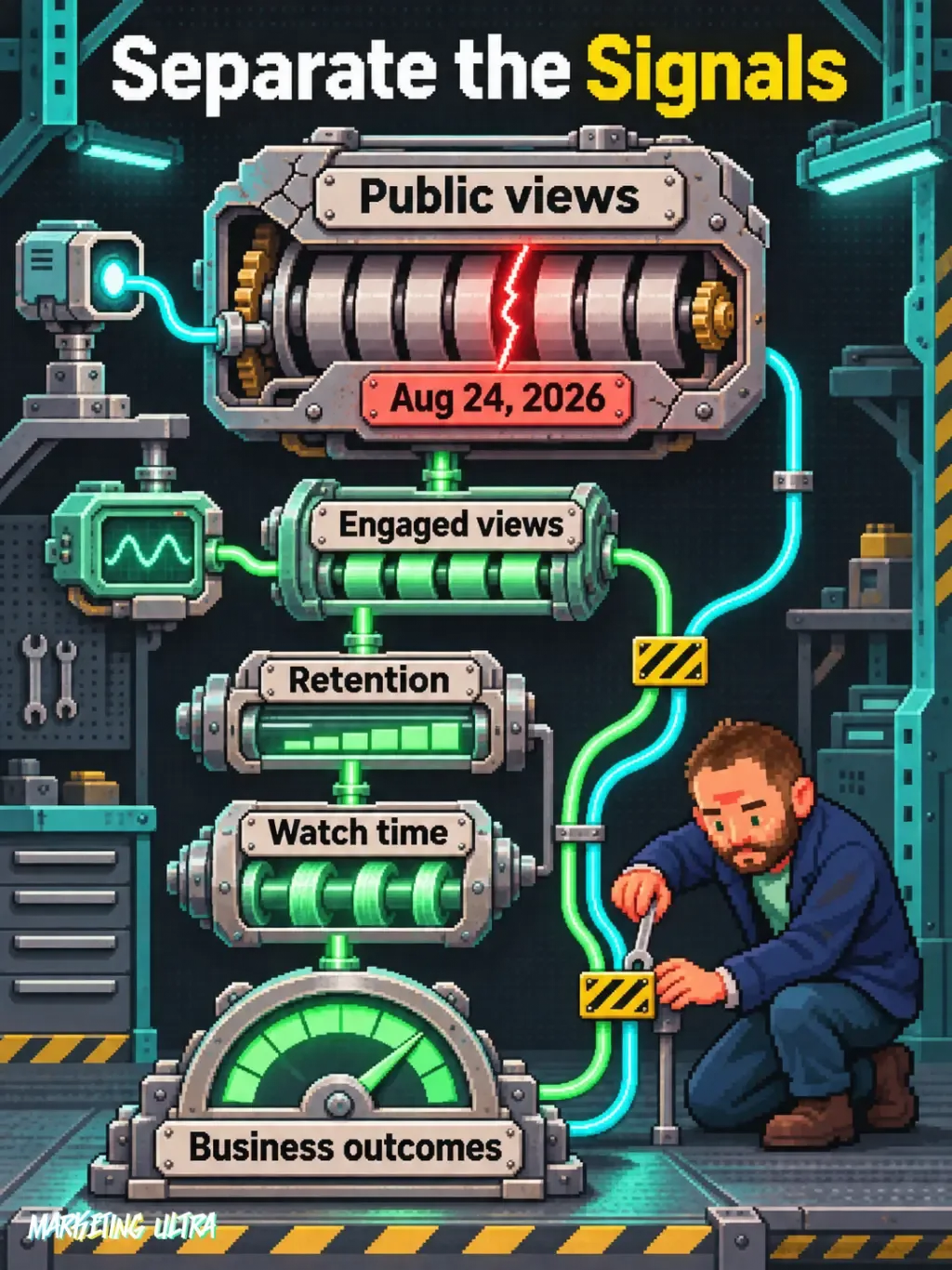
The previous methodology has not disappeared. It has been renamed “engaged views” and remains available in YouTube Analytics’ advanced mode. So no, YouTube has not retired views: it has changed what qualifies for the public counter and kept the old measurement under a new name.
The practical impact? The visible number can grow faster even when the business does not. Social Media Examiner reports on Primal Video, which saw a jump in views without an equivalent rise in business results. It is one specific case, not a universal benchmark, but it captures the trap perfectly.
Boom. More views.
More attention and more business? You need to prove that separately.
Your YouTube dashboard needs surgery
A useful dashboard must separate gross reach from engaged views, retention, watch time and, ultimately, business outcomes. Throwing everything into an upward chart looks great in a meeting. For making decisions, it is pretty useless.
Building a dashboard is easy enough for me. The hard part is connecting and properly cross-referencing the sources with the rest of the reporting. On YouTube, that distinction matters even more because the platform has just broken the continuity of public-view data.
You cannot compare September 2026 views with July and conclude that your content improved. Flag the methodology change, compare metrics that retain a similar meaning and cross-reference them with subscribers, qualified visits, sales or whatever action actually pays the bills.
Revenue and eligibility for the Partner Program do not change directly because of the new counter. YouTube continues to use qualified or engaged Shorts views and watch hours for those purposes, according to its official announcement. Another reason not to treat a public view as the channel’s only currency.
An inflated figure becomes a problem when it rewards the wrong decisions: replicating a format that creates accidental starts, cutting investment in pieces with fewer views but more business impact, or selling a client a success story that falls apart when you compare it with conversions. For a deeper look at separating exposure from value, I have already explained how to approach measuring branded content on YouTube.
How does Ask YouTube work, and what can you optimise?
Ask YouTube is a conversational search experience that combines text, videos, Shorts and clips that can begin at the relevant moment. It selects and ranks those clips by relevance, engagement and quality, as stated in the official Ask YouTube documentation.

Hold off on the excitement: it is currently available to users in the United States searching in English. YouTube announced it for web, mobile and TVs, but has not provided a launch date for Spain or the European Union.
What should you do in the meantime? Create videos that answer specific questions, explain the topic early and divide content into descriptive sections. Chapters let you assign titles and timestamps to specific parts of a video, and YouTube documents how to set them up correctly.
That does not turn chapters into a VIP pass. YouTube does not publish a list of metadata that guarantees an appearance in Ask YouTube. Writing titles and chapters around real queries is a sensible tactic, not an official signal with a guaranteed payoff.
YouTube, ChatGPT and the myth of shared optimisation
There is no shared official formula for ranking a video in Ask YouTube and ChatGPT. They are independent systems, with different sources, crawlers and criteria. Putting both under the “AI SEO” label sounds neat. It also erases important differences.
OpenAI explains that ChatGPT Search uses relevance and reliability factors, and that no ranking is guaranteed. For websites, it recommends allowing OAI-SearchBot, but its ChatGPT Search documentation does not establish specific signals for YouTube video titles, chapters or metadata.
Should you ignore visibility in AI assistants? Not a chance. You should work on it without selling magic: clear answers, understandable structure, clearly named entities and content worth citing. In the guide to AEO for getting an AI to cite your website, I explain the approach in greater depth.
The sensible move is far less sexy than the headline: update your dashboards, note the historical break on August 24, review chapters and titles, and measure what ultimately happens beyond the counter. YouTube engaged views are not a new analytics religion. They are a warning that a view no longer means what it used to mean.

